
In This Article
Follow BestForAndroid


OpenAI just released its most powerful AI model, and for a few weeks, the U.S. government wouldn’t let anyone use it.
OpenAI made GPT-5.6 Sol, along with two smaller models called Terra and Luna, available globally to everyone beginning July 9 across ChatGPT, Codex, and the OpenAI API. The company first previewed Sol on June 26 but limited access to about 20 government-approved partners while the Commerce Department reviewed the model’s cybersecurity capabilities. The Trump administration cleared the wider release this week.
It’s the AI version of a new car sitting behind a fence you can see but can’t touch. People online spent two weeks hyping how good Sol supposedly was, and almost none of them could actually try it.
Why the Trump adminstration held Sol back
The delay came down to security testing. Federal officials wanted to check Sol before letting it loose everywhere. In tests against Chromium and Firefox, Sol found real bugs and some of the pieces you’d need to build a working exploit, but it didn’t assemble a full attack on its own.
OpenAI says that it kept it under the line, but its own safety framework treats it as a serious risk. The company still paired the release with a heavier safety setup than past models got. A benchmark passing doesn’t mean every possible use is safe.
What GPT-5.6 Sol can actually do
Sol adds a max reasoning setting that gives the model more time to think through a problem before answering. There’s also a new ultra mode that splits hard tasks across multiple subagents working at once.
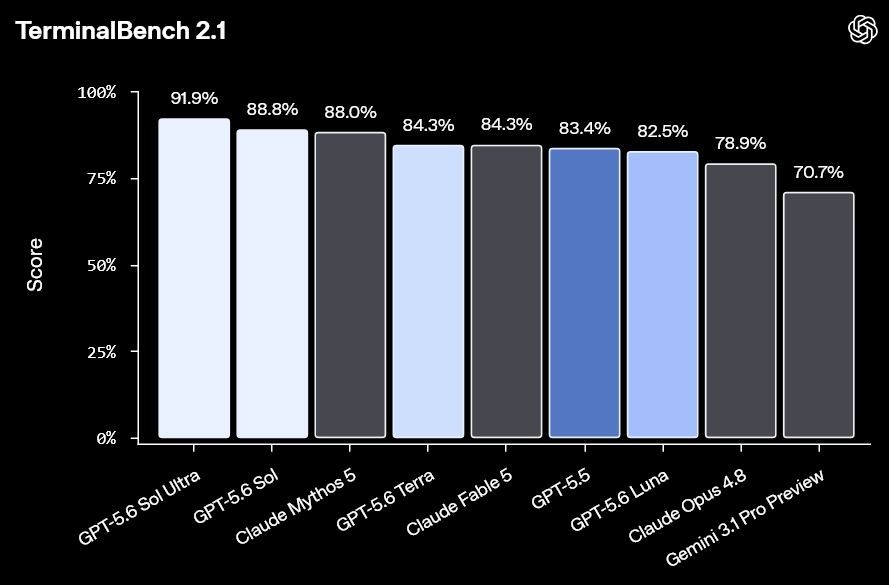
On Terminal-Bench 2.1, a test that measures how well a model handles real command-line engineering work, Sol scored 88.8 percent, and the beefed-up Sol Ultra version hit 91.9 percent. The context window holds 1.05 million tokens, so it can work through long documents or large codebases without losing track of earlier details.
Interestingly, the comparisons to Anthropic’s Fable 5 started within hours. Sol edged out Claude Mythos 5 on that same coding benchmark, 88.8 percent to 88 percent, close enough that it barely counts as a win.
The government has finally opened the gate. Now it’s just two chatbots and their users comparing notes on which one broke first.


