In This Article
Follow BestForAndroid


As technology is part of our day-to-day lives, we can easily notice how the latest tech trends sneak up on us and continue to reshape and impact our lives. The world of tech never stops advancing, and honestly, it sometimes becomes hard to keep up and differentiate between what really matters to us and what is just plain hype.
The most important aspect to consider here is that some trends are genuinely transforming how we use and interact with technology. On the other hand, we have tech advancements that are like noise.
In this blog post, we are going to share some glimpses of tech trends worth paying attention to.
Key Trends Reshaping the Landscape
- Agentic AI: AI is evolving from “help me do this” to “I’ll get this done myself.” Expect more autonomous agents handling multi-step workflows.
- Decentralized Data: You control your data rather than big platforms owning it. You decide who gets access to it.
- Invisible Computing: Technology fades into the background. Interfaces become context-aware, and devices predict your needs rather than waiting for commands.
- AI doctor assistants: AI helps read scans and predict illness, while smartwatches and patches track your heart, sleep, and stress in real time.
- Climate Tech & Resilience Innovation: Think innovative materials, climate-prediction AI, and adaptive infrastructure.
- Immersive Tech (Metaverse, AR/VR): Not just VR headsets; seamless overlays, contextually aware augmented view, and 3D experiences that blend with the real world.
1. AI Gets Personal (And Actually Useful)

Look, we’ve all heard enough about artificial intelligence to last a lifetime. But here’s where it gets interesting: AI is finally moving away from replacing humans and toward making our daily tasks less annoying.
Think about it. Your phone now suggests replies to texts that actually sound like you wrote them. Photo apps automatically organize your vacation pictures without you lifting a finger. Even customer service chatbots have stopped sounding like they were programmed by robots having a bad day.
The shift is pretty straightforward.
Companies behind such tech are focusing on developing AI that solves real-world problems rather than just presenting what’s technically possible through these tools. Innovative tech market research reveals that businesses are prioritizing practical AI apps over flashy ones, and honestly, it’s about time every company worked on this aspect.
2. The Internet Gets More Private (Finally)
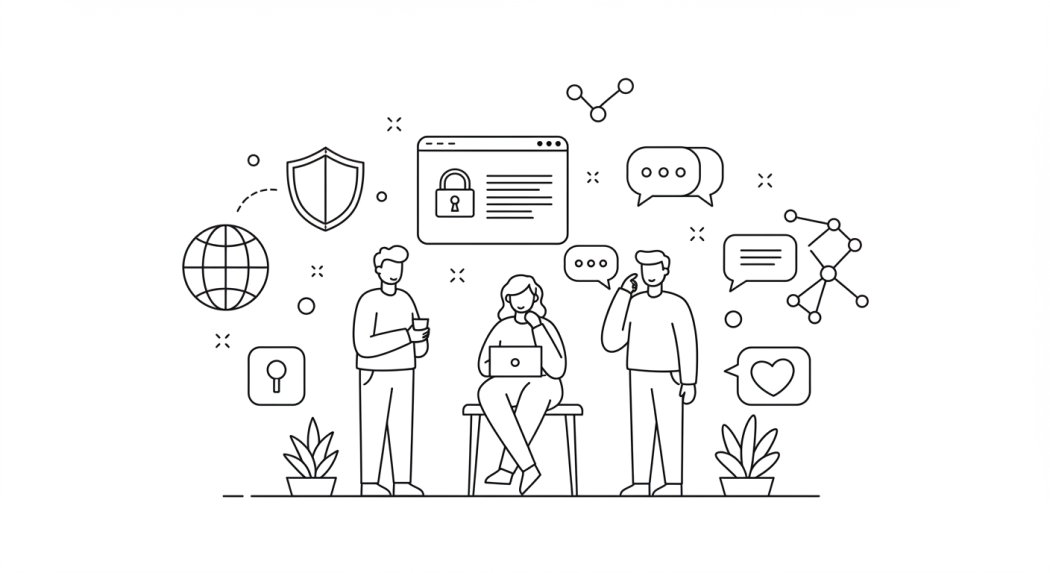
Remember when we all just accepted that our data was basically public property? Those days are ending, and not a moment too soon.
Privacy-focused browsers are gaining serious traction. Encrypted messaging apps aren’t just for tech nerds anymore. Even the big social media platforms are scrambling to prove they’re taking data protection seriously. Some of this is driven by regulations, sure, but a lot of it comes down to people finally saying “enough.”
The truth is, we’re seeing a fundamental shift in how companies handle user data. It’s not perfect yet, but the direction is encouraging.
3. Remote Work Tools Actually Work Now

Here’s something that would have sounded crazy five years ago: working from home doesn’t feel like a compromise anymore. The tools have caught up to the ambition.
Video calls that don’t randomly drop out? Check. Collaboration platforms that don’t make you want to throw your laptop out the window? Pretty much there. Cloud storage that actually syncs when it’s supposed to? We’ve arrived.
But here’s the kicker. The best remote work tools aren’t trying to recreate the office experience digitally. They’re building something entirely different, and often better.
4. Sustainable Tech Becomes Standard

There used to be a time when every company focused on the “green tech” movement, and now the whole market is shifting toward expensive feel-good technology. Certain tech products, including energy-efficient devices, solar panels, and electric vehicles, are becoming the norm because, logically, these technologies make sense financially as well as environmentally.
Companies are redesigning products with sustainability in mind from the ground up. Longer-lasting batteries, repairable devices, and recyclable components are becoming selling points rather than afterthoughts.
This part’s a bit tricky, but the market is rewarding companies that can prove their environmental credentials without sacrificing performance or affordability.
5. Health Tech Gets Personal

When it comes to health, wearable devices have moved way beyond counting steps. The latest tech products can continuously monitor health metrics such as blood pressure, ECG, blood oxygen, and stress levels. All this data, when combined, can spot potential health issues, sometimes even before symptoms appear.
On the other hand, sleep tracking has become amazingly sophisticated; for instance, heart rate monitoring can detect irregularities that may require medical attention. Specific devices can even monitor blood oxygen levels and detect stress levels throughout the day.
In all of these, do you know the exciting part? All this collected data is becoming genuinely actionable. Previously, devices were used solely to collect information; now, they are learning to provide personalized recommendations that actually improve health outcomes.
Concluding Notes

You must be wondering what this all means for tech trends. All of these share something important: they are making technology much more human-centric. So instead of asking people to adapt to new tech, companies and developers are working together to create and offer solutions that naturally fit into your existing routines and day-to-day life, and also solve real problems.
The companies succeeding right now aren’t necessarily the ones with the most advanced technology. They are the ones who best understand what people actually need and want from their devices and services. That’s the trend worth watching above all others.