In This Article
Follow BestForAndroid


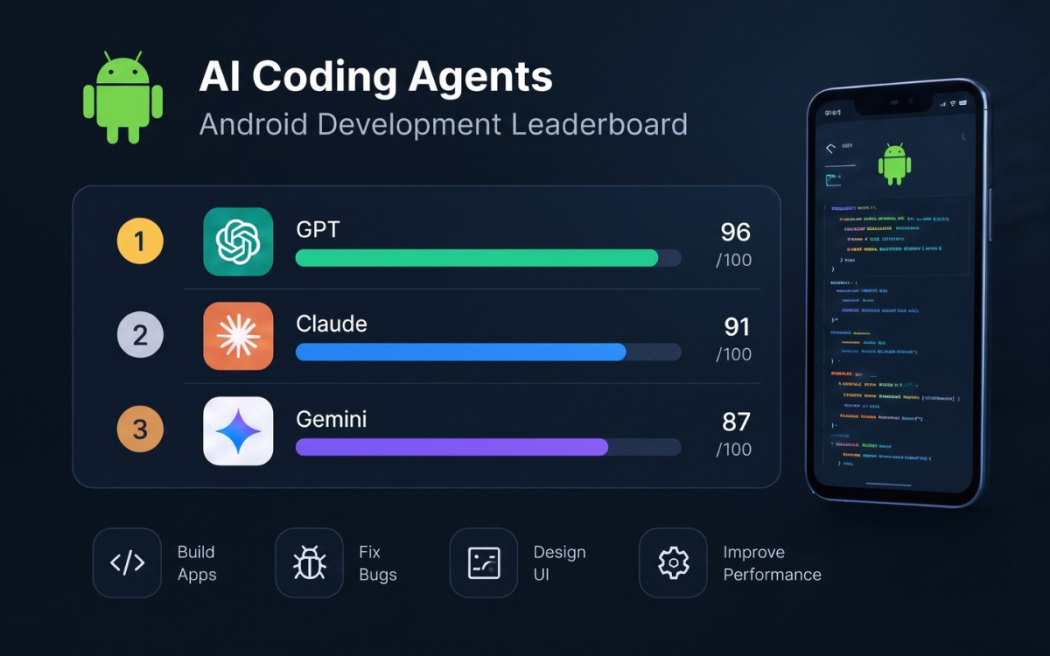
Claude Sonnet 5.5 leads Google’s latest Android benchmark, while a cheaper GPT-6.1 model wins on value.
- Claude Sonnet 5.5 leads with a 40% pass rate
- Gemini 4 Argon posts a 21.3% pass rate
- GPT-6.1 Sol costs $99.50 per run against Claude’s $1,574.90
- Each score reflects a model plus its coding agent
Google’s Android Bench leaderboard now shows its new Gemini 4 Argon model trailing the latest Claude and OpenAI models on Android coding. The October 26 update lists Argon at a 21.3% pass rate, while Claude Sonnet 5.5 leads at 40%. The results arrive weeks after Argon’s launch, as developers decide which AI assistant deserves their money.
What the Leaderboard Shows
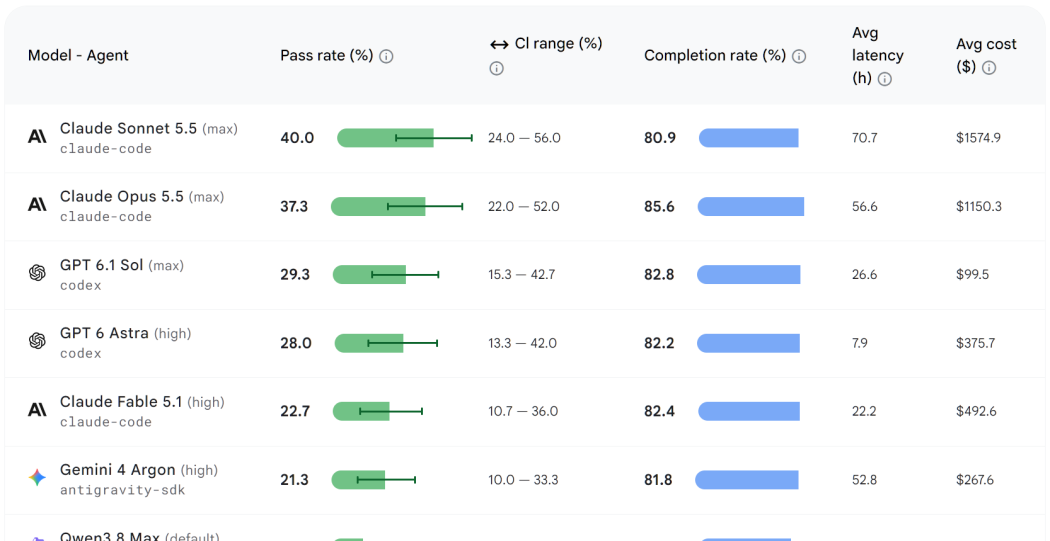
Android Bench launched in March as Google’s way to test AI models on real Android work. In September, it became Android Bench 2.0, which uses 30 long-horizon tasks such as migrating an app to a new framework or building a feature from scratch. The October 26 update adds Claude Sonnet 5.5, GPT-6.1 Sol, and Argon, and now shows the reasoning effort used for each.
Every result pairs a model with a coding agent. Claude runs through Claude Code, GPT through Codex, and Argon through Google’s Antigravity SDK, so the scores reflect the whole setup.
Claude Sonnet 5.5 posts a 40% pass rate and an 80.9% completion rate, with Claude Opus 5.5 close behind. Argon lands at 21.3% pass and 81.8% completion, at an average cost of $267.70. Completion rate measures how close a run came to a full solution even when it failed, so Argon often gets near the finish line but misses it.
Why Price Matters as Much as Rank
GPT-6.1 Sol is the surprise. It scores a 29.3% pass rate and an 82.8% completion rate for $99.50 per full benchmark run. Claude’s winning run costs $1,574.90, roughly 16 times more.
For a small studio watching its spending, a lower score at a fraction of the price can be the smarter buy. Argon sits in an awkward middle, costing more than GPT-6.1 Sol while passing fewer tasks. Publishing numbers that sting its own flagship is a bold PR move, and it makes the board a buyer’s guide.
A Familiar Pattern for Google
Google’s models once led this board. In the original 100-task version, Gemini 3.1 Pro topped the March launch, GPT 5.4 tied it in April, and GPT 5.5 took the lead in May. Those scores sat in the 70s, which shows how much tougher the new long-horizon test is.
Argon’s debut has also drawn doubts. After its September 30 launch, Bloomberg reported that some Google employees said the model struggles with real-world coding despite strong standard test scores. Google denied that and points to Argon’s 77.9% result on a different test called DeepSWE v1.1. The gap shows how the benchmark you choose can decide the winner you get.
What Comes Next
The bigger story is not one weak result. Google now publishes data that lets developers shop on price and performance instead of brand loyalty. If Argon cannot close the gap, Google risks losing the developers who build for its own platform.
So here is the question for you. Would you trust the model that wins, the one that costs less, or the one made by Android’s owner?


