
In This Article
Follow BestForAndroid


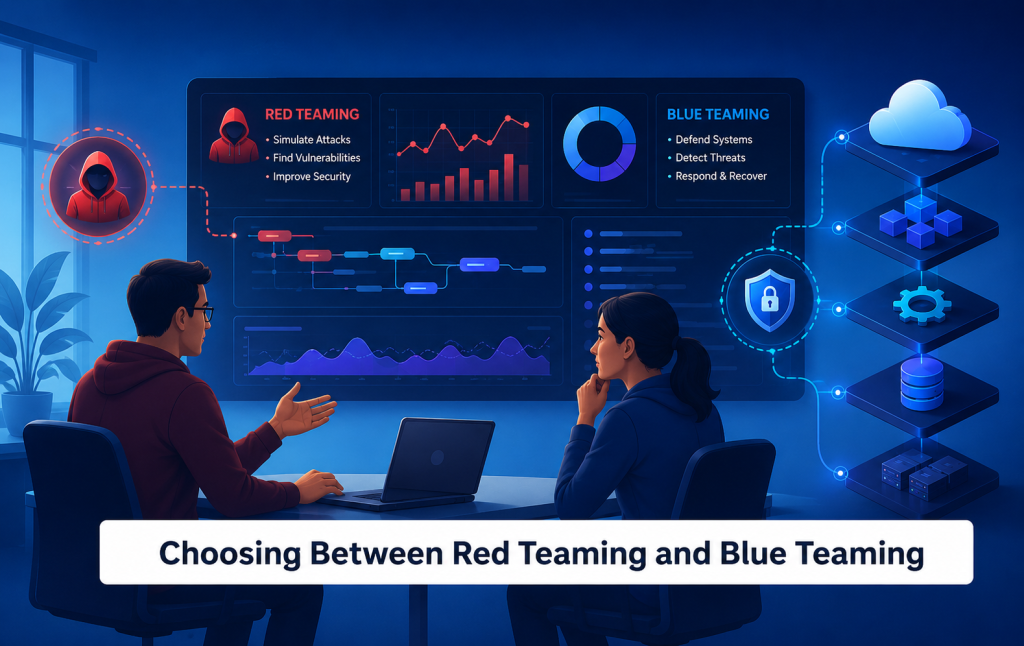
Short answer: build your blue team first. With ransomware now turning up in 44% of breaches, visibility, detection, and incident response are the foundation that makes red teaming worth paying for. A red team proves whether mature defenses actually hold, so it pays off once you can already see and respond to threats. Get the order wrong and you buy expensive proof of gaps you should have caught for free. With the average breach costing around $4.44 million, the sequence is not an academic question.
When CISA sent a red team against a United States federal agency, the testers spent five months inside the network before anyone noticed, and even then it was the red team that raised its hand. The lesson was not exotic exploits. It was the basics: logging, detection, and someone owning the response. That is the uncomfortable backdrop to the argument over red teaming and blue teaming, which usually starts the moment defensive controls that looked fine on paper meet someone actively trying to break them. The honest framing is not which one matters more. Red Teaming and blue teaming are both essential. The real question is which to build first, because the wrong starting point leaves you exposed while making you feel more mature than you are.
That sequencing question is the whole focus here. The guidance below draws on how offensive specialists frame engagements in the field, including the red team practice at CyberNX, alongside public standards and breach research you can check yourself.

Red team and blue team are not interchangeable
At a glance the split looks simple. Red teams simulate attackers. Blue teams defend systems, watch for suspicious activity, and respond when something breaks. In practice the gap runs deeper than offense versus defense. Trouble starts when leaders treat the two as interchangeable line items on a security budget.
They solve different problems. A red team exercise run against weak monitoring mostly surfaces obvious findings your own people should have caught. A blue team that never faces realistic attacks can get very good at watching the wrong things. The standard testing taxonomy from NIST SP 800-115 treats this kind of assessment as one discipline with several techniques, not two rival teams, which is a useful corrective.
| Blue team | Red team | |
|---|---|---|
| Goal | Detect, respond to, and contain threats | Find exploitable paths before real attackers do |
| Mindset | Assume compromise and watch everything | Think like an adversary and break assumptions |
| Core work | Monitoring, alert triage, response, hardening | Recon, exploitation, lateral movement, social engineering |
| Looks like success | Faster detection, cleaner containment | Honest proof of what an attacker could reach |
| Main output | Better visibility and response muscle | A ranked list of weaknesses worth fixing |
Why most teams start in the wrong place
There is a pattern across growing organizations. Leadership wants proof the environment can survive a sophisticated attack, and red teaming sounds advanced. It mirrors the language of breach reports and threat intelligence, and boards respond well to a vivid offensive story. So the money goes to offense before the basics are in place.
The catch is readiness. If endpoint logging is patchy, alert triage is immature, or nobody clearly owns incident response, a red team will expose foundational defensive gaps rather than clever adversary tricks. That is still useful, but you paid for a high-end simulation to learn what a basic review would have told you. The opposite failure is just as common: teams polish dashboards for years without once testing whether the controls stop a determined attacker.
Two expensive mistakes
Buying offense too early. A red team against immature defenses returns findings your own logs should have surfaced, at a premium price and with little to act on.
Polishing defense in a vacuum. Cleaner metrics and tidier dashboards can hide the fact that no one has checked whether real attack paths still work.
When blue teaming should come first

For most teams, blue is the logical starting point because visibility comes before validation. You cannot defend what you cannot observe, and you cannot learn much from an attack simulation you are not equipped to watch. It is also the order seasoned offensive instructors push: when a team stands up its own red capability, SANS advises running a purple team exercise first to baseline detection, on the logic that a stealth red team teaches very little when defensive maturity cannot keep pace.
The payoff is concrete. IBM’s data shows teams that catch a breach themselves shorten its lifecycle by about two months and pay close to a million dollars less than those alerted by the attacker. The catch is that good detection is genuinely hard to build; in one SANS survey, 73% of teams said they struggle to write reliable detection rules, which is exactly why the capability deserves to come first. Without that baseline, every red team finding lands as a surprise, even when the warning signs sat in the logs for days. Lead with blue when:
- Security monitoring is still being built out
- Incident response is inconsistent or has no clear owner
- Analysts are not yet confident handling a live threat
- Logging and telemetry coverage has obvious holes
- Regulators or insurers are asking for operational readiness, not paperwork
When red teaming becomes critical

There is a point where defensive maturity alone stops being enough. A team can detect known threats well and still be blind to complex attack chains, privilege escalation, or identity abuse. That is where red teaming earns its keep. A real engagement tests assumptions under realistic conditions and forces a team to confront how attackers move, not how the policy says they should.
The strongest red teams rarely lean on technical exploitation alone. Human behavior, process gaps, and response delays usually become the real story; a phishing email often succeeds less because a filter failed and more because nobody owned the next step. Frameworks like MITRE ATT&CK map the tactics and techniques attackers actually use, which keeps a simulation honest and measurable. Red teaming becomes especially valuable when:
- Blue team operations are stable and measurable
- Controls look mature but have never been tested under pressure
- Leadership wants realistic resilience validation, not a checklist
- High-value assets are likely to attract targeted attackers
- Internal staff need real adversary-simulation experience
A practical way to decide
The cleanest way to settle the red versus blue question is to look at what your environment needs most urgently, then move up in stages. Each stage assumes the one before it is solid, which is exactly the discipline the maturity ladder at the top of this page is built around.
| Stage | Lead with | What it proves |
|---|---|---|
| 1. Build visibility | Blue | You can see the assets, logs, and alerts that matter |
| 2. Strengthen response | Blue | Analysts can investigate and contain, not just alert |
| 3. Simulate attacks | Red | The controls you trust actually hold under real pressure |
| 4. Combine both | Purple | Offense and defense keep improving each other on a loop |
Stage four is where the strongest programs end up. They stop treating red and blue as separate budgets and let each feed the other: offensive findings sharpen detection, and defensive telemetry sharpens the next simulation. That continuous loop is what most people now mean by purple teaming.
Why the wrong order leaves you exposed
The danger is not just wasted budget. It is misplaced confidence. A team running advanced red team exercises on top of thin monitoring can believe it is testing sophisticated threats while missing routine attacker behavior entirely. A heavily defensive shop that never validates its controls can feel comfortable and be strategically blind at the same time.
Modern breaches tend to succeed through combinations: weak identity controls, slow response, poor segmentation, and overlooked user behavior. Those are failures of alignment between offensive understanding and defensive readiness more than failures of any single tool. The CISA assessment from the top of this piece is a clean example. With logging and detection thin, the red team operated almost at will, and the agency could only reconstruct what happened afterward by combing host, network, and authentication logs. CISA’s published findings are blunt about the cause: it was the operating model, not the product. That is also why a strong static analysis and tooling baseline only helps when someone is actually watching what it produces.
The two ways the sequence backfires
Red without blue. You get a dramatic report and no ability to see whether the same attacker is back next week.
Blue without red. You get clean dashboards and no evidence that any of it survives contact with a real adversary.
Who benefits most from balancing both
Some sectors gain unusual value from getting the balance right early, because a gap between offensive and defensive capability translates straight into business disruption. Mandiant’s M-Trends research puts the global median dwell time, the stretch between a break-in and its discovery, at about 11 days. The detail that matters for sequencing: intrusions a company spots itself are caught in roughly 10 days, against 26 days when an outside party has to raise the alarm. Internal detection, a blue-team strength, is what closes that gap.
| Sector | Biggest pressure | Where to focus first |
|---|---|---|
| Financial services | Constant credential attacks and lateral movement | Detection depth, then targeted red teaming |
| Healthcare | Fragmented systems and patchy visibility | Asset visibility and monitoring before testing |
| Manufacturing | Ransomware and operational disruption | Segmentation and response, then attack simulation |
There is a broader shift behind this too. Cyber insurers, regulators, and enterprise customers increasingly want evidence of both proactive defense and realistic resilience testing. Verizon’s Data Breach Investigations Report now finds ransomware in 44% of breaches, up sharply year over year, and Dragos counted 1,693 ransomware attacks on industrial organizations in a single year, with manufacturing absorbing 69% of them. Basic compliance paperwork no longer carries the weight it once did; programs are judged on operational effectiveness now, not policy documents.
The bottom line
The red teaming versus blue teaming debate usually misses the point. Most organizations do not need to pick one forever. They need to know which capability answers the most pressing risk first. Blue teaming builds the operational foundation; red teaming then checks whether that foundation holds against realistic attacks. Get the sequence wrong and you create blind spots, or confidence that will not survive a real intrusion.
The takeaways
Lead with blue when you still struggle to see and respond. Bring in red once your defenses are stable enough to learn from the test. Aim for purple, where the two feed each other continuously. And whatever you do, do not let an actual breach make the decision for you.
If you are weighing offensive validation against defensive strengthening, the better starting point is usually the one that exposes operational blind spots fastest. Specialist red teams such as CyberNX, whose CERT-In empanelled testers combine intelligence-led testing, social engineering, and application and network penetration testing, are most useful once a blue team can already see and respond. The one thing worth avoiding is delaying the decision until a real breach makes it for you.


