
In This Article
Follow BestForAndroid


Short answer: CapCut if you edit on your phone, Premiere if you already pay for Creative Cloud, and DaVinci Resolve if you want professional color grading for free. Try Fotor Agent when you want AI to build the whole first draft, script and voiceover included, and still hand you an editable timeline.

AI video editing has split into two camps. Assistants speed up the timeline you already use: auto-captions, silence trimming, B-roll suggestions, cuts made by editing a transcript. They are reliable, and most of them ship inside apps you may already have. Generators build clips from a text prompt. They are past the uncanny phase for short shots, but they still fall apart once a clip runs much past ten seconds. Knowing which camp a tool sits in saves a lot of wasted trial time.
A third kind has turned up since: agents that take a prompt, a product link or a folder of raw footage and assemble a complete project you can keep editing. Fotor Agent is the clearest example, and it joins this list at number three.
That makes eleven tools across mobile, desktop and web. For each one you get what it costs now, where its AI saves real time, and where it still needs a human. The table below maps them by platform, best use and starting price.
The short version
- Editing on a phoneCapCut. Captions, silence trimming and script to video in one free app.
- Already on Creative CloudAdobe Premiere, with transcript editing and Firefly tools in the timeline.
- AI builds the draftFotor Agent. Script, voiceover, captions and motion graphics on editable tracks.
- Color and paying onceDaVinci Resolve. Free, or a one-time Studio license.
- Talking-head videoDescript. Edit the transcript and the video follows.
- Generating clipsRunway for control, Pika for effects.
- A presenter without a cameraSynthesia’s AI avatars.
- Nothing to installVEED or Kapwing in a browser.
At a glance: pick by platform and use
Paid prices are monthly list prices in US dollars from each vendor’s own pricing page, and most drop by a fifth or more when billed yearly. CapCut’s vary by region, and Premiere’s is the annual plan billed monthly. Most AI features also spend credits, so the plan price is not always the whole bill.
| Tool | Runs on | Best for | Free option | Paid from |
|---|---|---|---|---|
| CapCut | Android, iPhone, Windows, Mac, web | Short-form video on a phone | Yes, the core editor | $19.99/mo (Pro) |
| Adobe Premiere | Windows, Mac, Android, iPhone | A pro timeline with Firefly tools | The mobile app; 7-day desktop trial | $22.99/mo |
| Fotor Agent | Web, Android, iPhone | AI-built drafts and motion graphics | 1 Agent task and 50 AI chats | $8.99/mo |
| DaVinci Resolve | Windows, Mac, Linux, iPad | Color grading and audio repair | The full editor, up to UHD at 60fps | $295 once (Studio) |
| Filmora | Windows, Mac, Android, iPhone | The widest AI menu for the price | Yes, with a watermark | $9.99/mo |
| Descript | Windows, Mac, web | Editing by transcript | 1 media hour a month at 720p | $24/mo |
| Runway | Web, Android, iPhone | Generated clips with camera control | 125 one-time credits | $15/mo |
| Pika | Web, iPhone | Stylized effects and lip sync | Yes, without a watermark | $10/mo |
| Synthesia | Web | Avatar-led training video | 10 minutes a month, watermarked | $29/mo |
| VEED | Web, iPhone | An all-in-one browser editor | Yes, with limits | $20/mo |
| Kapwing | Web | Team editing and review | 4-minute 720p exports, watermarked | $24/mo |
Free plans are for testing, not publishing
- Most free tiers on this list add a watermark, cap export resolution or ration generation credits. That is fine for deciding whether a tool suits you. Budget for a paid month before a real deadline, and check how many credits one clip costs before you plan a project around generated footage.

CapCut
The best all-rounder on a phone
CapCut puts auto-captions, silence trimming and script-to-video in one editor that runs on your phone, your computer and in a browser, with the same project in each.

- Best forShort vertical video for TikTok, Reels and Shorts.
- PricePro is $19.99 a month; prices vary by region
- Free optionYes, the core editor
- Runs onAndroid, iPhone, Windows, Mac, web
- Standout AIAuto-captions and script to video
The good
- Captions are close to clean on good audio
- Apps for phone, desktop and the web
- The free plan covers most short-form work
The bad
- Owned by ByteDance, TikTok’s parent company
- Templates and music carry their own license limits
CapCut keeps its lead on Android and iPhone because the heavy lifting happens in your timeline, not in a render queue you cannot see into. Auto-captions needed only light fixes on clean audio in testing, the silence-trim slider is fine enough to keep natural breaths, and the script-to-video tool drafts B-roll from a few lines of text.
The Windows and Mac apps mirror the phone version on a bigger canvas, so a short-form creator can stay in CapCut from the first cut to the upload. Paid plans now split into Standard and Pro, with AI credits on top, and prices change by region. The other trade-off is ownership: CapCut belongs to ByteDance, which matters to some clients and employers.
Key features
- Auto-captions: accurate on clean audio, with styling presets you can change per word.
- Script to video: type a script and CapCut drafts matching B-roll and narration.
- Silence trimming: cuts dead air without clipping natural breaths.
- Every platform: apps for Android, iPhone, Windows and Mac, plus a browser editor.

Adobe Premiere
A pro timeline with Adobe’s AI inside
Premiere pairs Adobe’s desktop editor with AI tools like transcript editing, Enhance Speech and Generative Extend, and it now has a free phone app for vertical edits.

- Best forEditors already paying for Creative Cloud.
- Price$22.99 a month on an annual plan
- Free optionThe mobile app; 7-day desktop trial
- Runs onWindows, Mac, Android, iPhone
- Standout AIGenerative Extend and Enhance Speech
The good
- Cut the video by deleting words in the transcript
- Enhance Speech rescues noisy dialogue
- A free mobile app for quick vertical cuts
The bad
- The desktop app is subscription only
- The single-app plan includes only 25 generative credits a month
Premiere is where AI editing feels most at home inside a professional timeline. Text-based editing reads your transcript and lets you cut by deleting words, which is the biggest change if you are coming from Final Cut. Enhance Speech turns rough dialogue into something usable, and Generative Extend adds a couple of seconds to a shot that ends too soon.
The catch is the subscription. The desktop app is only sold that way, and the Firefly features draw on generative credits. If you already pay for Photoshop and Lightroom, the math works. If not, CapCut covers most of the same ground for less. Adobe’s free Premiere app, now on Android as well as iPhone, exports up to 4K without a watermark, so you can try the workflow on vertical video before paying for anything.
Key features
- Text-based editing: delete words in the transcript panel and the timeline follows.
- Enhance Speech: pulls usable dialogue out of noisy lavalier and phone recordings.
- Generative Extend: Firefly adds a few frames to the start or end of a clip.
- Auto Reframe: tracks the subject when you turn horizontal footage into vertical.

Fotor Agent
AI that builds the whole first draft
Fotor Agent turns a prompt, a product link or your raw footage into an editable video project, with the script, voiceover, captions and motion graphics each on their own track.

- Best forCreators, marketers and teams who want AI to run production but keep an editable project.
- PriceFrom $8.99 a month
- Free option1 Agent task and 50 AI chats
- Runs onWeb, Android, iPhone
- Standout AIAgent-built multitrack projects
The good
- Starts from a prompt, a product link or your own clips
- Every element lands on its own editable track
- Motion graphics stay editable, down to the numbers
The bad
- Less fine control than a desktop editor like Premiere
- The free plan allows just one Agent task
Most AI video tools hand you a clip and leave the editing to you. Fotor Agent works the other way around. Instead of hopping between separate tools for the script, visuals, voiceover, motion graphics and captions, you describe the video you want and the agent runs the production.
You can start from a short prompt, a product link or a pile of raw clips. The agent breaks the request into tasks, plans the edit and assembles a multitrack project, with footage, voiceover, music, sound effects, subtitles, B-roll and motion graphics on separate tracks. When the first draft is close but not right, you fix it on the timeline or ask for changes in chat instead of generating the video again. Seasoned editors may still miss the fine control of a desktop editor. For a product video or an explainer on a deadline, though, it takes most of the assembly work off your plate.
Key features
- Agent orchestration: coordinates scripting, visuals, voiceover, music, captions, motion graphics and editing in one workflow.
- Multitrack editing: sorts video, voiceover, music, sound effects, subtitles, B-roll and motion graphics onto their own tracks.
- Editable motion graphics: animated text, numbers and charts that stay editable after the agent builds them.
- Semantic editing: reads what is seen and said to pick highlights, cut mistakes and long pauses, and add B-roll and captions.
- Edits without regenerating: change text, graphics, timing or one asset directly on the timeline.
- 4K motion graphics: Fotor renders its motion graphics at up to 4K.

DaVinci Resolve
Free color grading with pro AI tools
Resolve is the free desktop editor that professionals use for color, and the Studio version adds Neural Engine tools such as Magic Mask and voice isolation.

- Best forDesktop editors who care about color and audio, and want to pay once.
- PriceFree; Studio is $295 once
- Free optionThe full editor, up to UHD at 60fps
- Runs onWindows, Mac, Linux, iPad
- Standout AIMagic Mask and voice isolation
The good
- The free version is a complete professional editor
- Studio is a one-time purchase, not a subscription
- The best color tools on this list
The bad
- A steep learning curve for beginners
- No Android app; the mobile version is iPad only
Resolve is still free at the base tier and still the standard for color grading. The Studio version adds Neural Engine voice isolation that holds its own against dedicated audio repair plugins, and Smart Reframe keeps a subject in frame when you reformat for vertical. Magic Mask cuts a person out of a busy background without hand rotoscoping, and Speed Warp builds smooth slow motion from 24p footage.
Resolve is not the answer if you film and edit on a phone. There is no Android version, and the iPad app suits short cuts rather than full projects. For desktop work where color matters, nothing else here comes close. The one-time Studio license costs about what a year of Premiere does, and you keep it.
Key features
- Voice isolation: separates dialogue from room noise, traffic and air-conditioning hum.
- Magic Mask: isolates a subject for grading or effects without manual rotoscoping.
- Smart Reframe: follows the subject when you squeeze 16:9 footage into 9:16.
- Speed Warp: optical-flow slow motion that fills in frames cleanly.

Filmora
The widest AI menu for the money
Filmora packs text-to-video, AI translation, transcript editing and voice cloning into a desktop and mobile editor that is easy to learn.

- Best forHobbyists who want pro-style AI tools without an Adobe bill.
- PriceFrom $9.99 a month; $49.99 once on Windows
- Free optionYes, with a watermark
- Runs onWindows, Mac, Android, iPhone
- Standout AIText to video and AI translation
The good
- The easiest desktop AI editor to learn
- Apps for Windows, Mac, Android and iPhone
- A one-time Windows license for $49.99
The bad
- Most AI tools spend credits, even on paid plans
- Renders run slower than CapCut on a phone
Wondershare has pushed Filmora hard into AI, and it now has the broadest AI feature list per dollar on the desktop. Text-to-video drafts a sequence from a script, AI translation carries dialogue into another language, text-based editing cuts the video from its transcript, and voice cloning fills in narration. It is not as deep as Premiere or as color-accurate as Resolve, but it is the easiest of the three to learn.
The Android app shares the engine and most of the AI tools, though renders are slower than CapCut’s. Most AI features draw on credits even on paid plans, so check the allowance before a big project. For hobbyists who want a pro editor’s AI menu without the Adobe price, Filmora is the practical choice.
Key features
- AI text to video: drafts a sequence with B-roll and narration from a script.
- AI translation: translates the dialogue in a finished video into another language.
- Text-based editing: cut the video by editing its transcript.
- Voice cloning: record narration in a copy of your own voice.

Descript
Edit video like a text document
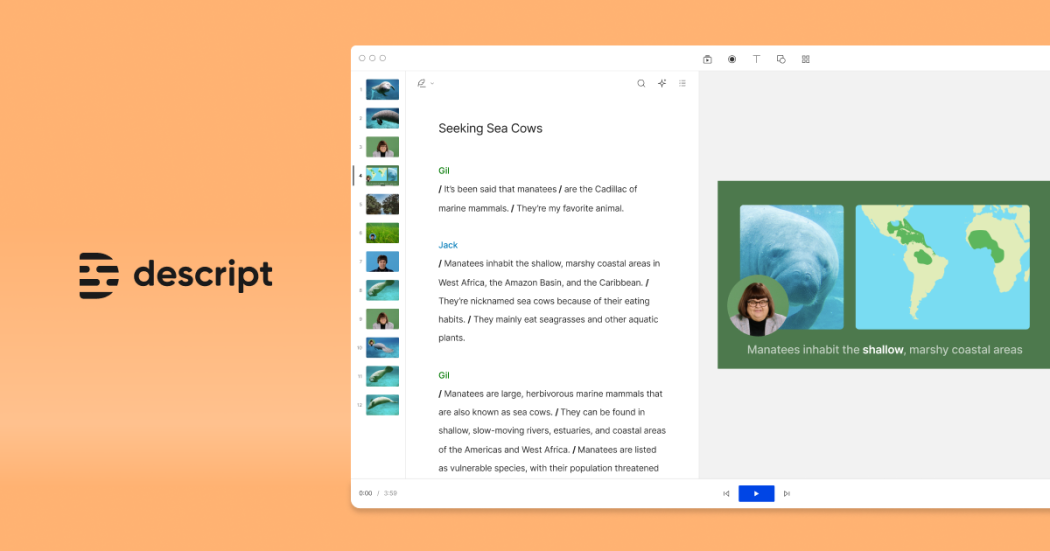
Descript turns your recording into a transcript, and cutting a sentence from the text cuts it from the video too.
- Best forPodcasters, course creators and talking-head YouTubers.
- Price$24 a month, or $16 billed yearly
- Free option1 media hour a month at 720p
- Runs onWindows, Mac, web
- Standout AITranscript editing and Studio Sound
The good
- The fastest way to edit someone talking to camera
- Studio Sound cleans noisy audio in one click
- Fix a misspoken word in your own AI voice
The bad
- No Android or iPhone app
- Awkward for fast cuts and layered B-roll
Descript treats your video like a Word document. You edit the transcript and the timeline follows. Its voice cloning is good enough to patch a missed word without recording again, which matters a lot if you publish every week. Studio Sound cleans up noisy lavalier audio in the same edit, and Eye Contact nudges off-camera glances back toward the lens.
Descript struggles with rapid cuts and layered B-roll. It is built for people talking to a camera, and pushing it past that means fighting the tool. For interviews, courses, podcast clips and talking-head YouTube video, it is still the quickest route to a finished cut.
Key features
- Transcript editing: cut, move and delete clips by editing the words.
- AI Speech: regenerate misspoken or missing words in a clone of your own voice.
- Studio Sound: strips room echo, hum and background noise.
- Eye Contact: corrects your gaze when you glance away from the lens.

Runway
The deepest toolkit for generated clips
Runway turns text and images into short video clips, with fine control over camera moves and a set of AI tools for editing footage you already have.

- Best forCommercial creators who need short B-roll, intros and reference shots.
- Price$15 a month, or $12 billed yearly
- Free option125 one-time credits
- Runs onWeb, Android, iPhone
- Standout AIGen-4.5 text and image to video
The good
- Gen-4.5 plus partner models in one workspace
- 4K upscaling on every paid plan
- Apps for Android and iPhone as well as the web
The bad
- Gen-4.5 needs a paid plan
- Standard’s credits buy about 52 seconds of Gen-4.5 a month
Runway is the deepest prompt-to-clip toolkit here. Its Gen-4.5 model turns a text prompt or a still image into a clip of two to ten seconds, and the faster Gen-4 Turbo is still there for quick drafts. Partner models such as Kling sit in the same workspace, and the Android and iPhone apps let you generate a shot away from your desk. Gen-4.5 needs the Standard plan or higher and costs 12 credits a second, so Standard’s 625 monthly credits go faster than you expect.
The hard ceiling is still continuity. Faces drift between shots, hands break, and longer motion tends to morph. Treat Runway as a B-roll factory with an editor on top, not a way to make a finished video on its own. For an establishing shot or a stylish intro card, a couple of prompts usually gets you something usable.
Key features
- Gen-4.5: text to video and image to video, two to ten seconds per clip.
- Gen-4 Turbo: a faster model for rough drafts before you spend on Gen-4.5.
- Partner models: Kling and Google’s Nano Banana Pro alongside Runway’s own.
- 4K upscaling: included on Standard and above.

Pika
Playful effects and quick social clips
Pika is a lighter, cheaper video generator built around one-tap effects and short, stylized clips for social feeds.

- Best forMusic clips, memes and stylized short-form video.
- Price$10 a month, or about $8 billed yearly
- Free optionYes, without a watermark
- Runs onWeb, iPhone
- Standout AIPikaffects and Video Studio
The good
- One-tap effects that land cleaner than prompts
- Video Studio strings shots up to 30 seconds
- Cheaper to start than Runway
The bad
- Longer clips drift and lose detail
- Less camera control than Runway
Pika sits next to Runway as the other serious text-to-video tool, with a sharper focus on stylized characters and effects. Pikaffects apply one-shot effects such as inflate, melt, crush or explode to a source image, and they land cleaner than the same idea written as a Runway prompt. Video Studio builds anything from a single short clip to a 30-second multi-shot sequence. The whole thing feels more creative toy than studio tool.
The same continuity ceiling applies. Long single shots drift, busy scenes with several people fall apart, and text inside the video is still unreliable. For stylized intros, music video segments and TikTok-style effect clips, Pika is the lighter and cheaper choice.
Key features
- Pika 2.5: Pika’s own model for text to video and image to video.
- Pikaffects: one-tap effects such as inflate, melt, crush and explode applied to a photo.
- Video Studio: plans and stitches several shots into a clip of up to 30 seconds.
- Partner models: Seedance and others sit alongside Pika’s own.

Synthesia
Presenter videos without a camera
Synthesia turns a script into a talking-head video with an AI avatar, so training and explainer videos need no camera, studio or presenter.

- Best forTraining, sales enablement and internal explainers.
- Price$29 a month, or $18 billed yearly
- Free option10 minutes a month, watermarked
- Runs onWeb
- Standout AIAI avatars in 160+ languages
The good
- No filming at all, just a script
- AI dubbing on every paid plan
- A slide-style editor that non-editors pick up fast
The bad
- Avatars still look synthetic in long close-ups
- Not built for personal creator content
Synthesia is the avatar tool. Type a script, pick a presenter from the stock library or make a personal avatar from a short recording of yourself, and it renders a talking-head video with no camera, studio or presenter. The Starter plan has more than 125 stock avatars, the top plans go past 240, and the site lists more than 160 languages.
This is not a creator tool for YouTube essays. Synthesia is built for training, sales enablement, product onboarding and internal communication, where you need ten module videos out the door this week without booking a studio day. Internal viewers soon stop noticing the avatars. For brand video aimed at customers, a real person still reads better.
Key features
- Stock avatars: 125+ on Starter, 180+ on Creator and 240+ on Enterprise.
- Personal avatars: record one continuous take of one to five minutes to make an avatar of yourself.
- 160+ languages: write the script once and render it in other languages.
- Slide-style editor: a PowerPoint-like layout that training teams pick up quickly.

VEED
An all-in-one editor in your browser
VEED puts subtitles, filler-word removal, AI avatars and a podcast recorder in one browser editor with nothing to install.

- Best forFreelancers and small teams who work across several computers.
- Price$20 a month, or $10 billed yearly
- Free optionYes, with limits
- Runs onWeb, iPhone
- Standout AIAuto-subtitles and Magic Cut
The good
- Runs in any browser, even on a Chromebook
- Auto-subtitles in 125+ languages
- Recording, editing and avatars in one place
The bad
- Long 4K projects hit browser limits
- No Android app yet, only a waitlist
VEED is a browser-based all-in-one. Auto-subtitles in more than 125 languages, AI avatars, Magic Cut for filler words, eye-contact correction, background removal and a clean podcast recording mode all live in the same workspace. There is nothing to install and no GPU to worry about, so it runs happily on a Chromebook, and an iPhone app covers quick edits on the go.
VEED sits between Descript, which is transcript-first and podcast-minded, and CapCut, which is timeline-first and phone-minded. It is not the deepest editor here, but it is the easiest no-install option for a freelancer cutting client video on more than one machine. Agencies that need a shared workspace can move up to a team plan for collaborative editing.
Key features
- Auto-subtitles: 125+ languages, burned in or exported as an SRT file.
- Magic Cut: trims filler words and pauses across the whole timeline.
- AI avatars and voiceovers: build a presenter-led explainer without leaving the editor.
- Podcast recording: multitrack recording in the browser with automatic leveling.

Kapwing
Team editing with a generous free plan
Kapwing is a web editor built for teams, with live co-editing, timestamped comments, auto-subtitles and smart cuts.

- Best forTeams reviewing short videos together.
- Price$24 a month, or $16 billed yearly
- Free option4-minute 720p exports, watermarked
- Runs onWeb
- Standout AISmart Cut and auto-subtitles
The good
- Several people can edit the same video at once
- Timestamped comments speed up review rounds
- The free plan exports without a limit on count
The bad
- Slows down on long, full-length edits
- Mobile browser editing works but feels cramped
Kapwing is the collaborative web editor: think Google Docs for video, with live multi-user editing plus auto-subtitles, background removal, Smart Cut and a big template library. The review workflow, with comments pinned to timestamps, works well when an agency needs several rounds of feedback on short cuts.
Kapwing leans short-form. It handles a four-minute clip comfortably but slows on full-length YouTube edits. The free plan caps exports at four minutes and 720p with a watermark, which is still enough for a student or first-time creator to try real AI features before paying anything.
Key features
- Real-time collaboration: several editors in one project with live cursors and a comment thread.
- Subtitles: auto-generated captions you can translate into 100+ languages.
- Smart Cut: removes silences and filler words in one click.
- Templates: meme, social and short-form layouts with editable text and motion.
Label AI footage before you publish

Once generated clips or cloned voices go into a video, the platforms expect you to say so. YouTube asks creators to disclose realistic altered or synthetic content when they upload, and adds a label to the video. The Coalition for Content Provenance and Authenticity is the wider industry effort to attach signed provenance data to a file, so viewers can check how it was made. For the ethics behind all this, Partnership on AI’s framework for synthetic media sets out how to make and share this kind of footage responsibly.
For more on the tools themselves, see our free AI video generators for turning photos into clips, the Android video editing apps roundup for phone-only workflows, and our video to MP3 tools for pulling audio out of a finished cut. On the document side, AI editing is covered in our PDF editor roundup.
Common questions about AI video editors
Do AI video tools still need a human editor?
Yes, for anything you plan to publish. Captions, silence trimming, transcript editing and rough scene detection are reliable enough to trust. Generated clips, cloned voices and script-to-video drafts still need someone to watch them before they go out. An agent like Fotor’s gets you further along, but a person still signs off on the cut.
Which AI video editors run on Android?
CapCut, Filmora, Adobe Premiere, Runway and Fotor all have Android apps. Premiere’s is the newest, and it is free, with exports up to 4K. DaVinci Resolve, Descript, Pika, Synthesia, VEED and Kapwing have no official Android app, so skip the lookalikes in the Play Store that borrow their names. VEED and Kapwing work in a mobile browser, but neither is comfortable as your main workflow.
Is CapCut safe for commercial use?
It depends on what is in the video. CapCut’s materials license marks templates, effects and stock items as either non-commercial or dual use, and dual use covers only limited commercial jobs such as e-commerce promotion. It grants no rights to music unless a track says otherwise. Your own footage is yours, but check each asset, and the music above all, before you run a video as an ad or monetize it. If a client is uneasy about ByteDance, Premiere or Resolve avoid the question.
How long can Runway and Pika clips run?
Runway’s Gen-4.5 makes clips of two to ten seconds per generation. Pika’s Video Studio can string shots into a sequence of up to 30 seconds. Past a few seconds, faces drift and motion starts to morph, so for anything longer, generate short shots from reference frames and cut them together in a proper editor.
Do I need a powerful computer for these?
Not for the web tools. Fotor Agent, Runway, Pika, Synthesia, VEED and Kapwing do the heavy work on their own servers. Premiere, Resolve and Filmora run better with a dedicated graphics card, though they still work on integrated graphics with some effects turned down. CapCut on Android scales its features to your phone.
What about Sora and Google Veo?
OpenAI has shut Sora down, so it is no longer an option. Google’s video generation lives in the Gemini app for Google AI subscribers, and Veo stays available to developers through the Gemini API. Neither is an editor. Treat them like Runway or Pika: generate the shot, then cut it in one of the tools above.
Picking your AI editor

Mobile creators who want one tool should start with CapCut. Its captions, silence trimming and script-to-video cover most of what a short-form workflow needs, and the price is forgiving while you learn.
Desktop editors already on Creative Cloud get the most from Premiere. Color and audio specialists should default to DaVinci Resolve, and podcasters and talking-head creators will move fastest in Descript. If you would rather describe the video and edit a draft than build it from nothing, Fotor Agent is the one to try.
For pure prompt-to-clip work, Runway is the deepest toolkit and Pika is the lighter, more playful option. Synthesia owns avatar-led training video, while VEED and Kapwing cover the no-install browser workflow for freelancers and teams. The trap is letting the generators convince you that you can skip the timeline. You still can’t.
How we put this guide together
The original ten tools were tested against the same brief over two weeks: a four-minute YouTube cut and a thirty-second vertical clip for Reels, shot on a Pixel 9 Pro and an iPhone 16 Pro. Each AI feature was measured against doing the job by hand (manual cuts, typed captions, hand-drawn masks) for quality and for time saved. Tools whose AI did not clearly beat a non-AI alternative were dropped.
Fotor Agent joined in this update. We assessed it from Fotor’s product pages and its web workspace rather than the full test cut, so read its entry as a first look. Prices and free plans come from each vendor’s own pricing page and store listing, checked for this update.