In This Article
Follow BestForAndroid


The wrong email app turns your inbox into a chore you avoid. The right one fades into the background. Here is the short list we actually tested, and which pick fits how you work.
Android email apps fall into four camps. The first-party clients (Gmail, Outlook) ride your existing account ecosystem. The end-to-end encrypted clients (Proton Mail, Tuta) seal your inbox so the server itself cannot read it. The power-user clients (Spark, Spike, Edison) bolt AI summaries and unified inboxes onto plain IMAP. And the open-source camp (Thunderbird for Android, descended from K-9 Mail) makes the code itself the trust model.
Pick badly and you spend an hour a day fighting your inbox. Pick well and email recedes to where it belongs. We tested ten apps as daily drivers on a Pixel 8a and a Galaxy S24, with the trade-off each one makes and where it fits.
Quick answer
For most readers, Gmail is still the right default: it is the most polished mobile client and integrates deeply with Drive, Calendar, and Meet. Work users on Microsoft 365 should run Outlook for its combined mail-and-calendar surface. If you want your inbox sealed from the provider, choose Proton Mail or Tuta. If you would rather pay for email than be the product, Fastmail is the independent pick.
The pick for most people

If you have a Google account and no strong privacy objection, install Gmail and stop shopping. It is the most refined mail client on Android, and the integration with the rest of Google Workspace is hard to walk away from once you rely on it.
The honest caveat: Google reads free-tier mail to power features and ad targeting. If that bothers you, the privacy picks below exist for exactly this reason. Everyone else can treat Gmail as the safe default and move on.
At a glance: pick by what you need
Side by side on the dimensions that decide a mail client: who hosts it, whether it is encrypted end to end, what AI features it offers, and what it costs.
| App | Host / Jurisdiction | E2E encrypted | AI features | Starting price |
|---|---|---|---|---|
| Gmail | Google (USA) | No | Gemini summaries plus reply | Free |
| Outlook | Microsoft (USA) | No | Copilot plus Focused Inbox | Free |
| Proton Mail | Proton (Switzerland) | Yes (default) | None | Free (1 GB) |
| Tuta Mail | Tuta (Germany) | Yes (default) | None | Free (1 GB) |
| Spark | Readdle (Ukraine) | No | Thread summaries (on-device on Premium) | Free |
| Spike | Spike (Israel / USA) | No | Magic AI | Free |
| Thunderbird | Mozilla (USA) | OpenPGP (manual) | None | Free |
| Fastmail | Fastmail (Australia) | No | None | $3 per month |
| Edison Mail | Edison (USA) | No | Package plus travel digest | Free with ads |
| Blue Mail | BlueMail (USA) | No | Magic AI | Free |
1. Gmail
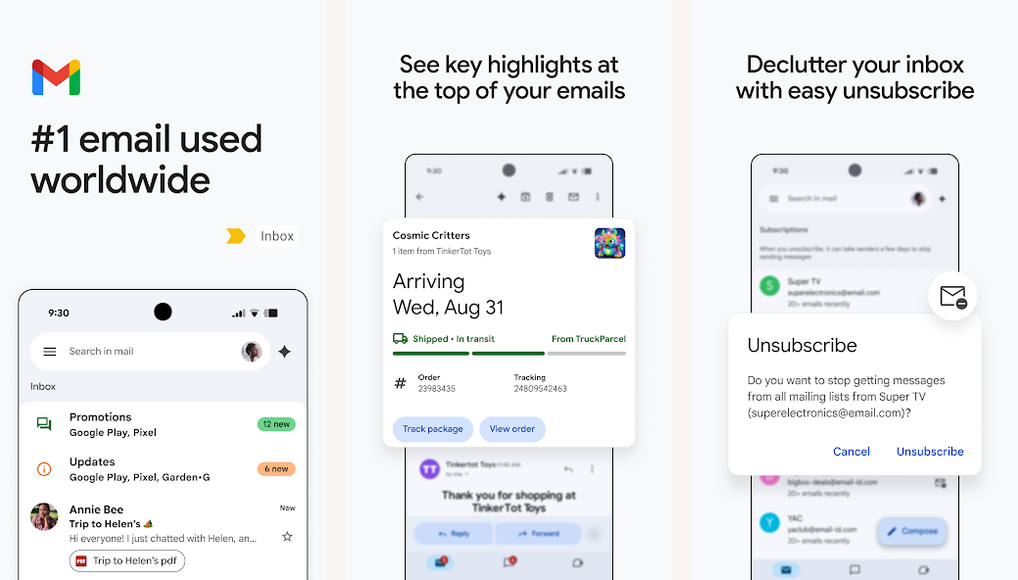
Gmail is the most polished mobile email client on Android. Smart Compose learns your phrasing. Gemini-powered suggested replies on Pixel hardware draft three responses for you to pick from. AI summaries compress long threads into a sentence at the top of the conversation view. Integration with Drive, Calendar, Meet, and Tasks runs deep, so leaving Gmail means leaving the wider Google Workspace gravity well.
The free tier covers most readers. Workspace at $7 per user per month adds custom domains, admin controls, and stronger service guarantees. The privacy trade-off is real: Google reads free-tier mail to power features and target ads, though paid Workspace accounts get contractual carve-outs. If that does not bother you, Gmail is the obvious default.
Highlights
- ⭐ Best for: most readers who want the default that earns its place through polish and integration.
- ⚠️ Watch out for: free-tier mail is read by Google for features and ad targeting.
- 💰 Pricing: free with a Google account. Workspace from $7 per user per month.
Key features
- Gemini in Gmail: AI summaries, suggested replies, and Help me write on Pixel and Workspace.
- Smart Compose: autocompletes phrases from your writing patterns and saves real keystrokes on routine replies.
- Workspace integration: Drive attachments, Calendar events, and Meet calls inline in the message view.
- Multi-account support: add Outlook, iCloud, Yahoo, and any IMAP account alongside Gmail in one app.
2. Microsoft Outlook

Outlook is the productivity pick on Android. Mail and calendar share one surface, which sounds trivial until you switch away and notice how often you flip between inbox and schedule during a workday. The Focused Inbox uses Microsoft’s AI to surface important mail above the noise. Swipe gestures handle archive, schedule-send, and snooze without leaving the message list.
For Microsoft 365 subscribers, Outlook is effectively mandatory. The Teams, OneDrive, and SharePoint integrations are all native, and the Copilot draft-and-summarize features land on mobile alongside desktop. It is free for personal accounts. Outlook also handles Gmail, iCloud, and IMAP, which makes it a credible Gmail alternative even for non-Microsoft readers.
Highlights
- ⭐ Best for: work users on Microsoft 365 and anyone who lives in mail-plus-calendar all day.
- ⚠️ Watch out for: a denser interface than Gmail, with a real learning curve on first run.
- 💰 Pricing: free for personal Microsoft accounts. Microsoft 365 from $6.99 per user per month.
Key features
- Focused Inbox: AI sorts important mail into the top tab and lower-priority mail into Other, training on your habits.
- Mail-plus-calendar surface: swipe between mail and calendar without leaving the app.
- Copilot in Outlook: draft, summarize, and coach replies on Microsoft 365 subscriptions.
- Teams and OneDrive native: attach OneDrive files, join Teams meetings, and share SharePoint links inline.
3. Proton Mail

Proton Mail is end-to-end encrypted by default. Messages between Proton users are sealed so even Proton cannot read them. Messages to non-Proton addresses can be sent password-protected, where the recipient unseals a one-time link in their browser. Servers sit in Switzerland under one of the world’s strongest privacy regimes. The cryptography is open source and the clients have been independently audited.
The trade-off is feature depth. Search inside encrypted bodies relies on a client-side index, which slows it on lower-end Android hardware. The free tier limits you to one address and 1 GB. Proton Unlimited at $9.99 per month bundles Mail, VPN, Drive, Calendar, and Pass, and it is the package most privacy-serious readers settle on.
Highlights
- ⭐ Best for: readers who want their inbox sealed from the provider, including journalists and anyone sending sensitive mail.
- ⚠️ Watch out for: slow client-side search on older phones, and a free tier capped at 1 GB and one address.
- 💰 Pricing: free up to 1 GB. Mail Plus $4.99 per month. Proton Unlimited $9.99 per month with VPN, Drive, Calendar, and Pass.
Key features
- End-to-end encryption: default between Proton users, optional password-protected to outside addresses.
- Swiss jurisdiction: outside the Five and Fourteen Eyes intelligence-sharing alliances, with Swiss law applying.
- Open-source clients: Android, iOS, and web code is public and independently audited.
- Bundle with VPN and Calendar: Proton Unlimited covers privacy across the stack from one subscription.
4. Tuta Mail
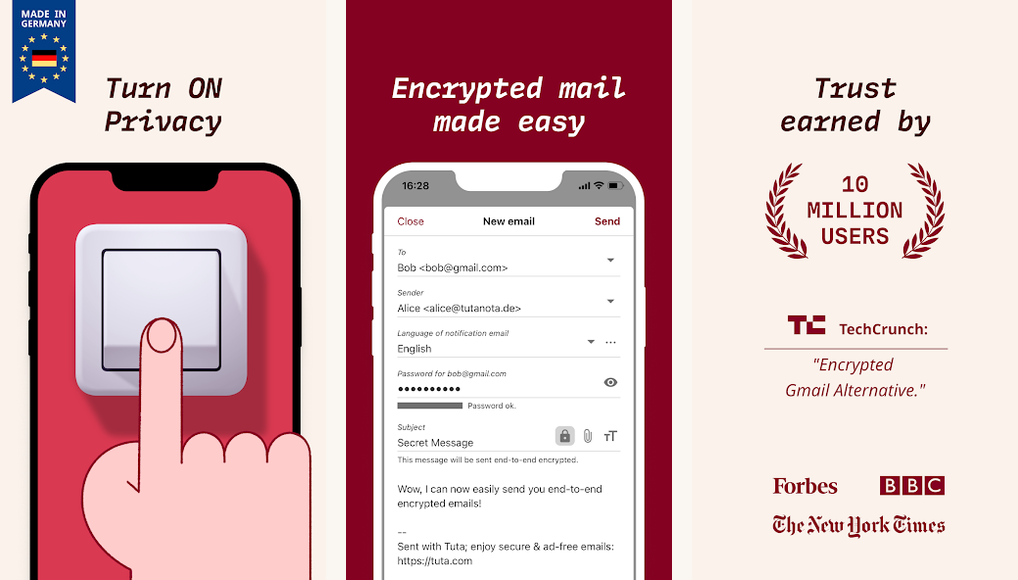
Tuta (formerly Tutanota) is the German alternative to Proton Mail. It uses the same end-to-end encryption model: sealed between Tuta users, password-protected to outside addresses. It takes the same open-source posture. The differentiator is the encrypted calendar and contacts. Proton encrypts each of those in separate apps, while Tuta wraps them into one mobile client. For readers who want their schedule and address book at the same privacy level as their inbox, that is the cleaner integration.
Pricing undercuts Proton at the entry tier: the paid plan starts at three euros per month for 20 GB and 15 aliases, against Proton Mail Plus at $4.99. Search inside encrypted bodies is quicker than Proton’s because Tuta indexes more aggressively, at some cost to battery. The free tier (1 GB, one address) is comparable to Proton’s.
Highlights
- ⭐ Best for: privacy-serious readers who want encrypted mail, calendar, and contacts in one app at the lowest paid tier in the category.
- ⚠️ Watch out for: a smaller ecosystem than Proton, with no bundled VPN or password manager.
- 💰 Pricing: free up to 1 GB. Paid plans from three euros per month for 20 GB plus aliases.
Key features
- Encrypted calendar and contacts: bundled in the mail app at the same privacy level, with no separate apps required.
- German jurisdiction: strong GDPR enforcement and a court track record of protecting user data.
- Open-source Android client: code on GitHub, also distributed via F-Droid for readers who skip the Play Store.
- Aliases: 15 included on the paid plan, useful for separating signups from your primary address.
5. Spark Mail

Spark by Readdle is the AI-summary email client. Long threads collapse into one or two sentences at the top of the conversation view. Smart Inbox triages newsletters, notifications, and pinned threads into separate sections. Premium users get on-device summarization that keeps email content off Spark’s servers, plus team collaboration where multiple people can comment on a thread before anyone replies.
The free tier dropped its account limit and kept it dropped, which makes it usable for casual readers. Premium at $7.99 per month unlocks unlimited follow-up reminders, send-later scheduling, and the on-device AI tier. Spark’s mobile experience still leads the category for AI-summary inboxes; the only real competitor for that specific use case is Superhuman, which is desktop-first and several times the price.
Highlights
- ⭐ Best for: high-volume readers who measure inbox time in hours per day and want AI to compress long threads.
- ⚠️ Watch out for: cloud AI summaries route through Spark’s servers unless you pay for the on-device tier.
- 💰 Pricing: free with limits. Premium $7.99 per month. Teams from $8.99 per user per month.
Key features
- AI thread summaries: long conversations collapse to a sentence or two at the top of the view.
- On-device summarization: the Premium tier keeps AI inference on the phone so email content stays local.
- Smart Inbox: newsletters, notifications, and pinned threads are triaged into separate buckets automatically.
- Team comments on threads: reply internally before replying externally, useful for shared inboxes.
6. Spike

Spike reformats email as chat. Subject lines disappear. Threads render as message bubbles, the way iMessage or WhatsApp do. For readers who already prefer DMs to formal email, Spike removes the friction that makes inbox work feel like inbox work. Voice messages, video chat, and shared notes sit on top.
The trade-off is that Spike sits oddly between an email app and a Slack alternative. Internal team threads stay inside Spike. External email to non-Spike recipients renders normally on the receiving end, with an auto-generated subject line. Some readers find that freeing; others find it confusing. It is free for personal use. Pro at $5 per user per month adds collaboration features and is the natural upgrade for small teams.
Highlights
- ⭐ Best for: readers who would rather DM than draft, and small teams wanting a unified inbox-plus-chat surface.
- ⚠️ Watch out for: the conversation view drops subject lines, which complicates search and breaks the convention everyone else uses.
- 💰 Pricing: free for personal use. Pro $5 per user per month. Business from $8 per user per month.
Key features
- Chat-style threads: messages render as bubbles, the way iMessage and WhatsApp do.
- Voice messages: hold-to-record audio replies inline, like a messaging app.
- Magic AI: compose, summarize, and translate threads with built-in AI tools.
- Shared inboxes and notes: team channels and collaborative documents inside the same app.
7. Thunderbird for Android

K-9 Mail’s long run as the open-source Android email pick changed when Mozilla took the project on. The first stable Thunderbird for Android shipped as version 8.0, built on the K-9 codebase. K-9 itself still lives in parallel for readers who want continuity. Both apps share the same engine, settings, and feel. Thunderbird gets new features first; K-9 stays conservative.
What you get is IMAP and POP3 done well, full PGP encryption support via OpenKeychain, and no telemetry or data harvesting. There are no AI features, no marketing surface, and no upsell path. For readers who want their mail client to be a tool rather than a platform, this is the pick. Mozilla’s stewardship is steady, and the F-Droid build matches the Play Store binary.
Highlights
- ⭐ Best for: readers who want an open-source email client with PGP support and zero data harvesting.
- ⚠️ Watch out for: no AI features, a functional rather than polished interface, and FCM push that needs a manual workaround on Google-free devices.
- 💰 Pricing: free. No paid tier. Donations support Mozilla’s stewardship.
Key features
- Open source under Mozilla: code on GitHub, an F-Droid mirror, audited and community-reviewed.
- OpenPGP integration: sign and encrypt messages via OpenKeychain, with full PGP/MIME support.
- IMAP plus POP3: works with any standards-compliant mail server, with no proprietary lock-in.
- Zero telemetry: no usage tracking, no ads, and no AI features that route mail content elsewhere.
8. Fastmail

Fastmail is the independent paid email host. Australian jurisdiction. No ads, no data harvesting, no AI training on your mail. The mobile app is a thin native shell over an excellent web client, which means feature parity across devices and no learning curve when switching. The infrastructure has been quietly best-in-class for over twenty years.
What you get for $5 per month is mature IMAP with custom-domain support, Masked Email integration with 1Password for tracker-resistant signups, and calendar and contacts that sync across devices. There is no free tier; Fastmail is paid-only with a 30-day trial, which keeps the userbase serious. For readers who would rather pay for email than be the product, Fastmail is the obvious independent pick.
Highlights
- ⭐ Best for: readers who would rather pay $5 per month than be the product, and custom-domain hosters who want a clean IMAP.
- ⚠️ Watch out for: not end-to-end encrypted, and no free tier, only a trial.
- 💰 Pricing: Basic $3 per month. Standard $5 per month. Professional $9 per month. 30-day free trial.
Key features
- Custom domains: bring your own and host it on Fastmail’s infrastructure, on the Standard tier and above.
- Masked Email with 1Password: generate per-signup forwarding aliases with one tap inside 1Password.
- Calendar and contacts: first-party sync across Android, iOS, and web, on the open CalDAV and CardDAV standards.
- Long track record: independent, Australian, over twenty years old, with no acquisition rumors.
9. Edison Mail

Edison Mail is the AI assistant inbox. Package tracking is automatic: parse a shipping email and a tracker card appears at the top of the inbox. Travel digests collect your flights, hotels, and reservations. Receipts get categorized. A subscription scanner finds recurring charges across your mail history. The intelligence layer is the differentiator; the mail client itself is competent but not best-in-class.
Edison took a privacy reputation hit when it emerged that the company sold anonymized email data for analytics. It has since published a privacy policy stating a no-data-sale posture. Here is the part worth weighing: feature updates have slowed against competitors over the past year, so treat Edison as a capable app on a slower release cadence. It is free with ads. Edison+ at $14.99 per year removes ads and adds priority support.
Highlights
- ⭐ Best for: readers who want automated package tracking, a travel digest, and subscription scanning in one place.
- ⚠️ Watch out for: a past privacy reputation hit, and feature updates that have slowed against Spark and others.
- 💰 Pricing: free with ads. Edison+ $14.99 per year. OnMail Premium $5 per month for the hosted inbox.
Key features
- Package tracking: shipping emails surface as tracker cards in the inbox automatically.
- Travel digest: flights, hotels, and car rentals are consolidated into a single trip view.
- Subscription scanner: finds recurring charges in your mail history, useful for trimming forgotten subscriptions.
- Unified inbox: Gmail, Outlook, iCloud, Yahoo, Exchange, and IMAP accounts in one feed.
10. Blue Mail

BlueMail handles ten or more accounts in a single unified inbox better than any other free app. Gmail, Outlook, Exchange, iCloud, Office 365, IMAP, POP3: anything with credentials becomes another tab. The unified pane stacks them all so you can swipe through every account at once. The MagicSync engine handles push notifications without the battery drain of per-account IMAP IDLE.
BlueMail’s interface is denser than Gmail or Outlook because it has to surface far more accounts at once. The free tier is full-featured, which is rare in this category, and has no ads. The AI features (Magic AI summaries, compose, translate) sit on top and can be switched off. For readers running personal, work, school, and side-project mail through one phone, this is the cleanest aggregator available without a subscription.
Highlights
- ⭐ Best for: readers running ten or more accounts who want one unified inbox without paying a subscription.
- ⚠️ Watch out for: a denser interface, a setup wizard that pushes BlueMail’s own services hard, and AI that feels half-baked next to Spark.
- 💰 Pricing: free with no premium tier. Business at custom pricing for shared workspaces.
Key features
- Unified inbox: Gmail, Outlook, Exchange, iCloud, Yahoo, IMAP, and POP3 in one feed.
- MagicSync: push notifications across all accounts without per-account battery burn.
- Smart clusters: auto-grouping by sender, topic, and project, useful for high-account-count readers.
- Dark mode and theming: richer customization than Gmail or Outlook offer on mobile.
Privacy mistakes worth avoiding
Most inbox privacy problems are not about the app you chose. They are about how you use it. A few quiet habits cause most of the damage, and the same care that protects your inbox applies to your choice of Android keyboard, which also sees everything you type.
| Mistake | Why it matters | Better move |
|---|---|---|
| Treating end-to-end encryption as automatic | Mail to a non-encrypted recipient drops back to standard TLS, so only both-sides-encrypted threads stay sealed | Use password-protected messages, or confirm the recipient is on the same provider |
| Loading remote images by default | Tracking pixels confirm your address is live and log when you open mail | Switch your client to block remote content until you tap to load it |
| Using one address for every signup | A single breach links your identity across every service you joined | Use aliases or Masked Email so each signup gets a disposable address |
| Granting an aggregator full mailbox access without reading the policy | Some inbox apps have historically monetized scanned mail data | Read the privacy policy, and prefer apps with on-device processing |
The verdict
Ten apps, but the decision comes down to how you work, not how many features a spec sheet lists. Pick one and configure it well rather than installing five.
The verdict
Bottom line: Gmail is the right default for most readers, and Outlook is the work pick for anyone on Microsoft 365.
If you want your inbox sealed from the provider, choose Proton Mail, or Tuta when you want encrypted calendar and contacts at a lower price. Prefer to pay for email rather than be the product? Fastmail. Drowning in long threads? Spark Premium. Would rather DM than draft? Spike. Loyal to open source? Thunderbird for Android.
Questions people actually ask
- Will any of these forward my mail to AI training?
Gmail’s AI runs on Google’s infrastructure under your Workspace privacy controls, and Microsoft has similar enterprise contracts on Outlook. Spark’s on-device summarization on Premium keeps content local. Proton, Tuta, and Thunderbird have no AI features that route mail content anywhere. None of the major clients here train models on your mail without explicit consent, though free-tier Gmail has the loosest privacy posture. - Is end-to-end encryption worth the friction?
For most readers, no. Sending sensitive mail to a non-Proton or non-Tuta recipient drops back to standard TLS in transit, and the full benefit only kicks in when both sides use the same encrypted provider. For journalists, activists, and anyone with a credible adversarial threat model, the friction is worth it. For routine personal mail, Gmail or Fastmail offer better daily ergonomics. - What happened to K-9 Mail?
Mozilla took over the project and shipped Thunderbird for Android as version 8.0, built on the K-9 codebase. K-9 still exists in parallel for readers who want continuity, but new features land in Thunderbird first. The two apps share the same engine and settings format. For most readers, Thunderbird for Android is the modern pick. - Should I pay for email?
Most readers do not need to. Gmail, Outlook, BlueMail, and Thunderbird are full-featured at the free tier. Pay when you want a custom domain (Fastmail, Proton Mail Plus, Tuta), end-to-end encryption with serious storage (Proton Unlimited, a Tuta paid tier), or AI-summary scaling for a high-volume inbox (Spark Premium). The tier most people land on, if they pay at all, is the $4 to $10 per month range. - Are Spark’s AI summaries actually useful?
For inboxes over 50 emails a day, yes. For inboxes under 20 a day, no, because you would read the threads anyway. The summaries shine on long internal threads where decisions and action items are buried in fifteen replies. They are less useful on transactional mail like orders, notifications, and newsletters, where there is nothing to summarize. - Can I run Gmail and Outlook in the same app?
Yes, in either app. Gmail accepts Outlook, iCloud, Yahoo, and IMAP accounts, and Outlook accepts Gmail via OAuth. BlueMail, Spark, Spike, and Edison Mail all handle every major provider in unified inboxes. The choice of app is less about which accounts you have and more about which interface matches how you work.
How we put this guide together
How we tested
We ran each app as a daily driver for two weeks on a Pixel 8a and a Galaxy S24, with mixed personal, work, and newsletter inboxes. AI features were stress-tested on threads of ten or more messages. Privacy posture was corroborated against vendor documentation and the EFF’s privacy guidance. Encryption claims were checked against public audits where available, for Proton and Tuta, and OpenPGP support was tested via OpenKeychain. Apps that had not shipped a feature update in six months were dropped. If your inbox lives next to a busy schedule, our roundup of the best Android calendar apps pairs naturally with these picks, and Gmail users hitting stability trouble can work through the fixes for the Gmail app crashing.