
In This Article
Follow BestForAndroid


Short answer: For one room you only need drawn and sent to somebody, a no-install browser planner like Free Room Planner is enough. Beginners who want to keep going should start with Planner 5D for its huge furniture library and easy 2D-to-3D switch. Floorplanner suits realtors and staging pros, and its $5 tier unlocks exports you can actually send a client. SketchUp is the choice for serious 3D and architecture, Roomstyler is best for mood boards, MagicPlan is built for on-site scanning with your camera, and SmartDraw fits teams that live in diagrams.

Floor plan apps used to be little more than digital graph paper. Now the good ones ship with libraries of thousands of furniture and decor items, snap a flat sketch into a walk-through 3D render, and some can map a whole room just by pointing your camera at the walls. Whether you are an architect roughing out a layout, an agent staging a listing, or a renter trying to picture a sofa before you buy it, there is a tool here that fits.
The range is wider than it looks. A simple floor plan creator lets you drag walls around in minutes, while the heavyweight tools edge into proper 3D modeling, and the field apps measure a room straight off the camera, using a LiDAR sensor where the phone has one and working the depth out from the video feed where it does not. We looked at six of the most capable options on Android, with two honesty notes up front. A couple of these are not native phone apps at all. And the slickest scanning tricks were built for Apple hardware first, which changes what you get on an Android handset. We flag both wherever they bite.
You may not need any of them. If the job is one room and the thing you owe somebody is a picture they can quote against, a browser tool with no account and no install covers it: Free Room Planner snaps walls to a 1 cm grid, keeps a small library of furniture and fittings, and exports a clean PNG. Give it 20 minutes before you install anything. Worst case you have spent a coffee break; best case you walk away with real dimensions and a much clearer idea of which app below is worth your evening.
Quick comparison
Short on time? Here is the whole lineup at a glance. Find the row that matches how you work, then jump down to that app’s section for features, pricing, and the catch worth knowing.
| App | Platform | Best for |
|---|---|---|
| Planner 5D | Android, iOS, web, macOS | Beginners and DIY home designers |
| Floorplanner | Web (browser on Android) | Realtors and staging pros |
| SketchUp | Web and iPad (no Android phone app) | Architects and serious 3D work |
| Roomstyler | Web (browser on Android) | Mood boards and styling |
| MagicPlan | Android, iOS | On-site scanning with your camera |
| SmartDraw | Web and desktop (browser on Android) | Teams and facility planners |
What free actually gets you
Every tool here has a free way in, and free means something different in each of them. The pattern holds across all six though: the drawing is free, and the thing you want to hand somebody is not. Planner 5D will let you design all evening, then stamp a watermark across the render and keep roughly half its catalog locked. Floorplanner caps free exports at 960 by 540 pixels and puts a 10 minute cooldown between them, with DXF and DWG, the two formats a builder actually opens, sitting behind the paid tiers. Read the row for your app before you sink a night into a plan you cannot use.
| App | What the free tier gives you | What you pay to unlock |
|---|---|---|
| Planner 5D | Unlimited designing, watermarked low-resolution renders, about half the item catalog | Clean exports, the full catalog, AR and panorama views |
| Floorplanner | Up to five projects of three floors each, SD exports with a cooldown | Higher-resolution output, DXF and DWG, more render credits |
| SketchUp | The full web modeler, for personal use only | Desktop apps, LayOut documentation, extensions, CAD import and export |
| Roomstyler | The whole catalog and real-time 3D, no payment needed | Premium credits for higher-quality renders |
| MagicPlan | A trial rather than a standing free tier | Per-project pricing once the trial runs out |
| SmartDraw | No standing free tier | Every use, from the first diagram |
1. Planner 5D

Best for: beginners and DIY home designers who want results without a manual.
If you have never drawn a floor plan in your life, Planner 5D is the gentlest way in. It keeps the familiar feel of sketching on paper, then lets you flip the same layout into a real-time 3D render to see how the space actually reads. The catalog now runs to the high thousands of furniture and decor items, plus AI room-layout suggestions and AR so you can drop a design into your real room through the camera. It runs across browser, iOS, Android, and macOS, so a plan started on your phone picks up on a laptop. You can check the current feature set on the Planner 5D listing on Google Play.
- A drag-and-drop library in the thousands of furniture and decor items
- One-tap switch between a 2D plan and a 3D render
- AI layout suggestions and AR preview through the camera
- Syncs across browser, iOS, Android, and macOS
On pricing, there is a free tier that exports with a watermark, a mid Premium plan, and a higher Professional plan, both cheaper paid annually than month to month. Plans and prices shift, so check the in-app rates before you commit, and note that iOS in-app pricing usually runs higher than the web rate.
2. Floorplanner

Best for: realtors, staging pros, and interior designers juggling several projects.
Floorplanner is the polished, project-first option. The drag-and-drop builder is genuinely quick, an auto-furnish feature styles an empty room in a tap, and the photorealistic 3D renders and interactive walkthroughs are the kind of thing you can put in front of a client without apology. A multi-project dashboard keeps separate listings tidy, which is why staging teams and agents reach for it. It runs in the browser rather than as a dedicated phone app, so on Android you open it in Chrome.
- Fast drag-and-drop layout with one-tap auto-furnish
- Photorealistic 3D renders and interactive walkthroughs
- A dashboard for running multiple projects at once
- Credit-based exports rather than per-file fees
Pricing stays friendly for individuals. A free account covers up to five projects but exports them at SD quality with a watermark, a Plus plan sits around five dollars a month, and a Pro plan runs close to thirty for heavier use, with exports drawn from a credit pool. Larger company tiers exist if a whole team needs in.
3. SketchUp

Best for: architects and designers who need real 3D power, not a quick sketch.
SketchUp is the heavyweight here. It is built for proper 3D modeling, with a 2D LayOut tool for documentation, a deep plugin ecosystem for rendering and BIM, and integration with Trimble and CAD workflows. That power comes with a steeper learning curve, so it rewards people who model regularly rather than once a year.
- Robust 3D modeling with a 2D LayOut tool for drawings
- A large plugin ecosystem for rendering and BIM
- Trimble and CAD integration for professional pipelines
- Free web tier, with paid Go, Pro, and Studio plans above it
Expect a free web tier, an entry Go plan billed yearly, a mid Pro plan, and a top Studio plan, with Pro and Studio both having crept up in price lately. Confirm the current annual rates on SketchUp’s own pricing page before you subscribe.
4. Roomstyler 3D Home Planner

Best for: visual people who plan by mood board rather than by measurement.
Roomstyler comes from the Floorplanner team, but it leans into styling over technical precision. The pull is the catalog: well over a hundred thousand real, brand-name furniture and decor items you can drop into a space and preview in real-time 3D. A community side means you can browse rooms other users have designed, which is half inspiration board and half shortcut. If you think in vibes and finishes rather than wall lengths, this is your tool, and it runs in the browser on Android.
- A library of well over a hundred thousand real-brand items
- Real-time 3D previews of every change
- Community designs you can browse for ideas
- Free to use, with premium render credits on top
Roomstyler is free to start, with premium credits unlocking higher-quality renders and advanced tools. For casual styling, the free account goes a long way.
5. MagicPlan

Best for: contractors, restoration crews, and anyone measuring a real room on site.
MagicPlan flips the usual workflow. Instead of drawing a plan, you walk the room and let the camera do the measuring, and you get an auto-dimensioned floor plan out of it without touching a tape. One thing to know before you lean on that: the LiDAR-assisted scan is an Apple hardware feature, so on Android the app works the depth out from the camera feed instead. It still works, it is just fussier. Scan in good light, keep glass and clutter out of frame, and spot-check the long walls with a tape before anyone orders materials. From there you add annotations, objects, and 360-degree panoramas, then export to PDF, DXF, or the cloud for a quick report. It is the pick for field work, claims, and on-site documentation, and you can see the current capabilities on magicplan on Google Play.
- Camera-based room scanning into auto-dimensioned plans, LiDAR-assisted on Apple hardware
- Annotations, objects, markups, and 360-degree panoramas
- Export to PDF, DXF, or the cloud for fast reporting
- Built for on-site contractors and claims work
Pricing has moved away from flat monthly tiers to a per-project model, so the free tier is now closer to a short trial than a long-term free plan and the paid plans charge by the project. If you scan rooms regularly it can pay off, but check the per-project rates against your volume first.
6. SmartDraw
Best for: teams and facility planners who already work in diagrams.
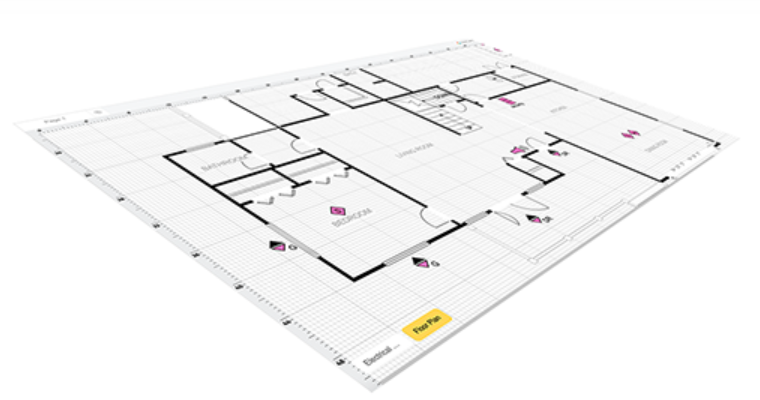
SmartDraw is really a visual-collaboration suite with a Floor Plan Designer built in. That heritage shows: it ships thousands of symbols for kitchens, HVAC, lighting, and wiring, ties into Microsoft Office, Google Workspace, and Visio, and is happy with team collaboration and data automation. For a corporate environment or a facilities team that already lives in flowcharts, it slots right in.
- A Floor Plan Designer with thousands of architectural symbols
- Integration with Office, Google Workspace, and Visio
- Team collaboration and data automation built in
- Templates for architecture and engineering layouts
There is no standing free tier, so budget for it from the first diagram. Individual plans run in the region of eight dollars a month billed annually, team seats come out a little cheaper per head on a three-seat minimum, and a site licence drops the per-user rate again. Price it for your headcount rather than off the sticker.
Measure the room before you draw it
Every app on this list is only as good as the numbers you feed it, and a room is almost never the tidy rectangle you remember. Walls bow. Floors run out of square. A tape reads differently at skirting height than it does at waist height. Spending 10 minutes with a tape before you open anything saves an evening of nudging walls that were never in the right place, and it gives you something to check a camera scan against. This is the order that works, whether you are drawing by hand or letting the phone take the first pass.
- Measure each wall at floor level rather than at hip height, and write the number down before you type it anywhere.
- Measure both diagonals. If they do not match, the room is out of square, and every app here will quietly straighten it for you.
- Note the ceiling height, plus any bulkhead or slope, since 3D previews and cabinet planning both need it.
- Mark which way each door swings and how far the windows sit off the floor.
- Log the things you cannot move: radiators, the fuse box, waste pipes, and the sockets you actually use.
- Re-measure anything you are about to spend money on, and do it twice.
How to pick the right one
There is no single winner here. The right app depends on how you actually work. Starting cold and want something that feels good fast? Planner 5D is the easy first install. Realtors and stagers who need polished renders to show clients should reach for Floorplanner. And anyone doing precise architectural or 3D work will quickly outgrow the rest and want SketchUp, learning curve and all.
For styling by feel, Roomstyler’s enormous catalog is hard to beat. If your job is measuring real rooms on site, MagicPlan’s camera scanning saves real time, and teams that already diagram everything will feel at home in SmartDraw. Just keep the platform notes in mind: SketchUp and SmartDraw shine on a bigger screen rather than on an Android phone, so match the tool to where the work really happens.
| If you want to… | Reach for |
|---|---|
| Start designing with zero experience | Planner 5D |
| Show clients polished, staged renders | Floorplanner |
| Do precise architectural or 3D work | SketchUp |
| Plan a room by look and feel | Roomstyler |
| Measure a real space on site | MagicPlan |
| Diagram layouts across a team | SmartDraw |
Whichever way you lean, check the live store listing before you commit, since features and prices move. For a wider view of the category, Android Authority’s roundup of home design apps is a useful second opinion on where these tools sit in the home-improvement space.
One last tip before you commit: almost all of these let you draw something real for free before any paywall. Spend an evening sketching one room you know well in your top two picks. The app that feels natural in your hands matters far more than a spec sheet, and the prices listed here move, so confirm the current rate in the app before you subscribe.
Common questions
- Can I make a floor plan on Android for free?
Yes. Every app here has a free way in, and the browser tools need no install at all. The catch is nearly always the export rather than the drawing: free tiers watermark the render or cap its resolution, so the plan is fine to work from and awkward to hand over. - Do I need a phone with a depth sensor?
No. Scanning apps work depth out from the camera feed on ordinary phones. A dedicated sensor makes the first pass cleaner and quicker, it does not decide whether you get a plan at all. - Which file should I send a builder or a kitchen fitter?
A PDF or a PNG for a first brief, DXF or DWG if they work in CAD. Confirm your app exports the CAD pair before you pay, because several keep it on the upper tiers. - Are these plans accurate enough to build from?
Treat them as a brief, not a construction drawing. A careful scan in good light gets you close enough to buy a sofa or settle a layout. Anything that gets cut to size still wants a tape measure, and structural work still wants someone qualified.