In This Article
Follow BestForAndroid


Ad blocking on Android splits into three approaches: a browser with built-in blocking, a system-wide DNS-based blocker, and a local VPN-based blocker. Each has trade-offs. The right choice depends on whether you want to block ads only in browsers, across every app, or with the most aggressive YouTube-and-streaming filtering.
This guide focuses on the no-root options because most Android users do not root and the available no-root tools have matured significantly. Where a paid Pro tier earns its money, we say so; where the free version is genuinely enough, we say that too.
Tested on Pixel 8a, Galaxy S25, OnePlus 12, and Motorola Edge 50 during April and May 2026. Each blocker tested on the top 50 sites for ad density and a daily-use set of apps including YouTube, news apps, free games, and shopping apps.
TL;DR
Best fit: Brave browser for fast and reliable browser-side ad blocking with no setup. NextDNS for system-wide DNS blocking on every app. AdGuard for the most aggressive blocking through a local VPN.
Good alternative: DuckDuckGo browser is the privacy-focused alternative to Brave. Blokada is the open-source local-VPN alternative to AdGuard.
Skip if: You want ad blocking for YouTube specifically; YouTube Premium at $13.99 per month is the only reliable long-term path because YouTube actively breaks third-party ad blockers.
1. Brave Browser

Best for: browser-based ad blocking with no setup required
Brave is a Chromium-based browser with built-in ad and tracker blocking. The blocking is on by default for every site, blocks the major ad networks, and includes anti-fingerprinting protections. Free and open source.
- Zero setup; install and open and ads are blocked.
- Shields toggle per site for sites you want to support.
- Built-in Tor for higher-privacy sessions.
Where it falls short: Browser-only; does not block ads in other apps. Some sites detect Brave and ask you to disable Shields.
Pricing: Free.
2. NextDNS
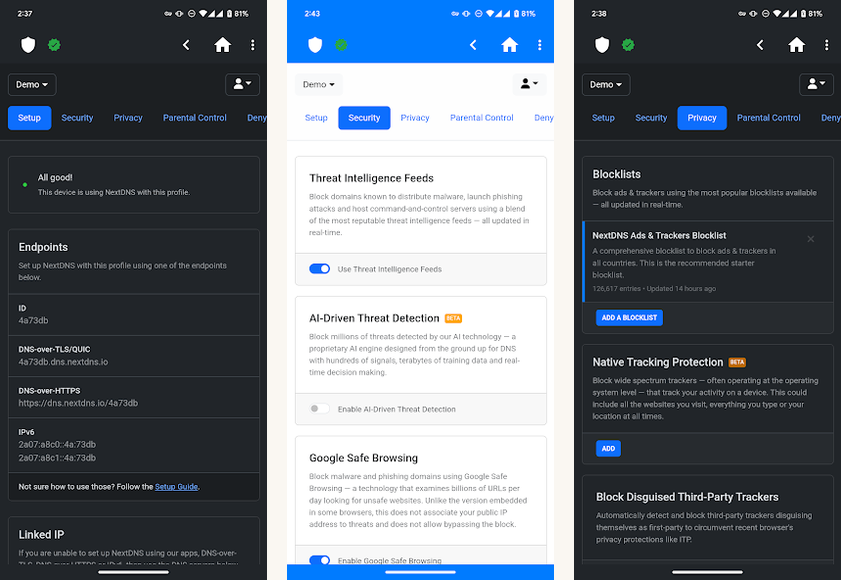
Best for: system-wide DNS-based ad blocking on every app
NextDNS works at the DNS level: configure your phone to use NextDNS’s DNS resolver, and ad and tracker domains return blocked responses for every app that uses DNS. Free tier covers up to 300,000 queries per month, which is enough for most users. Paid tier at $20 per year removes the cap.
- System-wide blocking on every app and browser.
- Customizable block lists with hundreds of available filters.
- Per-device profiles with separate settings per phone or laptop.
Where it falls short: DNS-level blocking does not catch ads served from the same domain as the content (YouTube ads, some Facebook). Requires a few minutes of Android Private DNS setup.
Pricing: Free up to 300k queries/month; $20/year unlimited.
3. AdGuard
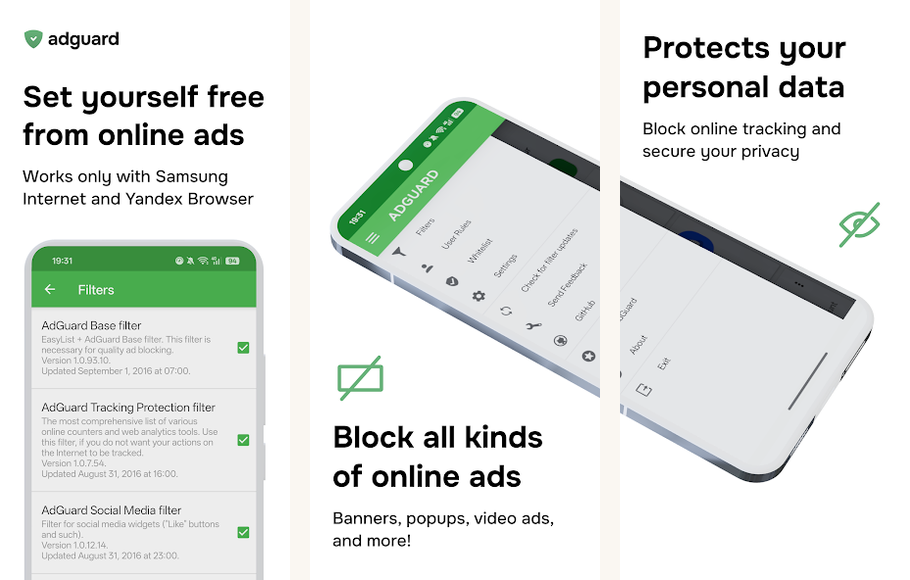
Best for: most aggressive blocking through a local VPN service
AdGuard runs a local VPN that filters traffic between your apps and the internet, blocking ads and trackers across every app. The DNS-only mode is free; the full VPN-filter mode is Premium at $30 per year.
- Filters HTTPS traffic for inline ad blocking, not just DNS.
- Stealth mode for additional tracker resistance.
- Open source on Android with active development.
Where it falls short: Premium subscription required for the full feature set. Local VPN uses the phone’s only VPN slot, conflicting with corporate or privacy VPNs.
Pricing: Free tier; Premium $30/year (single device), $80 lifetime (3 devices).
4. Blokada
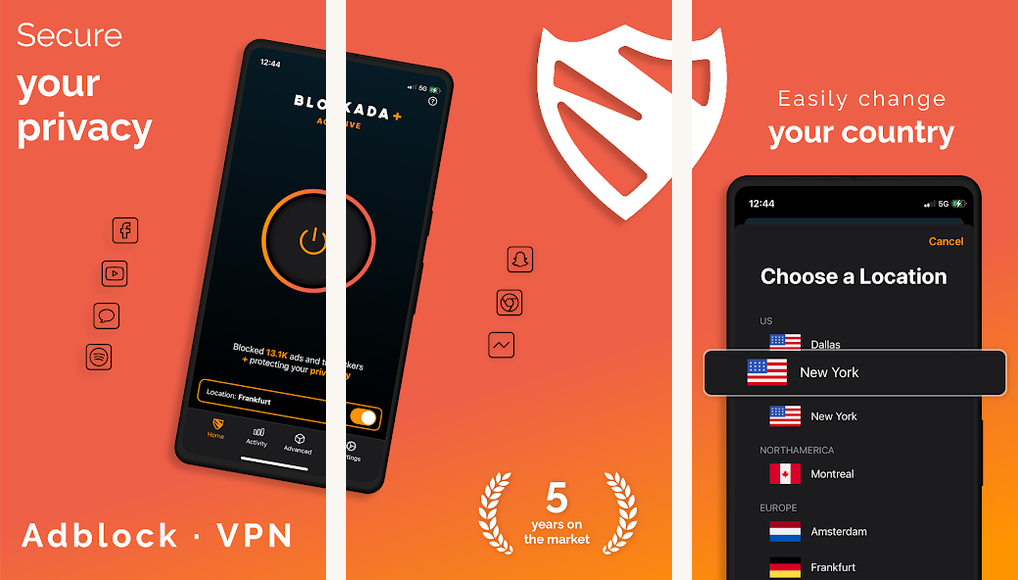
Best for: open-source local-VPN ad blocker as an alternative to AdGuard
Blokada is the open-source alternative to AdGuard’s premium offering. Two versions exist Blokada 6 free with basic DNS-level blocking, and Blokada Plus at $4 per month with the full VPN-based blocking.
- Open source on Android; auditable.
- Per-app filtering available in Plus.
- Active development by an independent team.
Where it falls short: Two versions confuse new users; pick the one that matches your needs (free for casual, Plus for serious).
Pricing: Free (Blokada 6); Plus $4/month or $40/year.
5. DuckDuckGo Browser

Best for: privacy-focused browser with built-in tracker and ad blocking
DuckDuckGo’s browser combines ad blocking with strong privacy defaults: HTTPS upgrading, tracker blocking, and a one-tap data clear. The blocking is less aggressive than Brave but the privacy posture is stronger.
- Privacy-first defaults; tracker blocking by default.
- One-tap clear data for sessions.
- Email Protection with @duck.com forwarding addresses.
Where it falls short: Browser-only. The ad-blocking strength is moderate, not aggressive.
Pricing: Free.
Quick take
Brave for casual browser-only ad blocking. NextDNS or AdGuard for system-wide blocking. YouTube Premium is the only durable path for YouTube specifically.
6. Pi-hole (DIY home-server)

Best for: household-wide ad blocking through a Raspberry Pi or home server
Pi-hole is the DIY path: install Pi-hole on a Raspberry Pi or home server, configure your home router’s DNS to point to it, and every device on your network gets ad blocking automatically. Free, open source, the most flexible option.
- One install covers every device on your home network.
- Comprehensive dashboard showing blocked queries.
- Open source and free.
Where it falls short: Requires a home server (cheapest is a $40 Raspberry Pi Zero 2 W) and basic Linux setup knowledge. Does not work outside your home network.
Pricing: Free (after the cost of the Pi).
7. AdAway (root only, mentioned for completeness)

Best for: rooted users only, for system-wide hosts-file blocking
AdAway works only on rooted phones. Modifies the hosts file directly to block ad domains. Faster and lighter than VPN-based blockers because it does not route traffic through a local proxy.
- Native hosts-file blocking; lower battery overhead than VPN-based.
- Multiple host source lists.
- Open source on F-Droid.
Where it falls short: Requires root, which voids warranty and breaks Play Integrity for banking apps. Not recommended for casual users.
Pricing: Free.
8. Vivaldi Browser

Best for: alternative privacy-focused browser with built-in ad and tracker blocking
Vivaldi is the privacy-focused Chromium browser developed by the team behind Opera. Built-in ad and tracker blocking, customizable to a degree most browsers do not support.
- Built-in blocking with multiple tiers.
- Customizable interface beyond Brave or DuckDuckGo.
- Workspaces and tab management features.
Where it falls short: Heavier and more configuration-heavy than Brave for the average user.
Pricing: Free.
9. Cromite (Bromite successor)
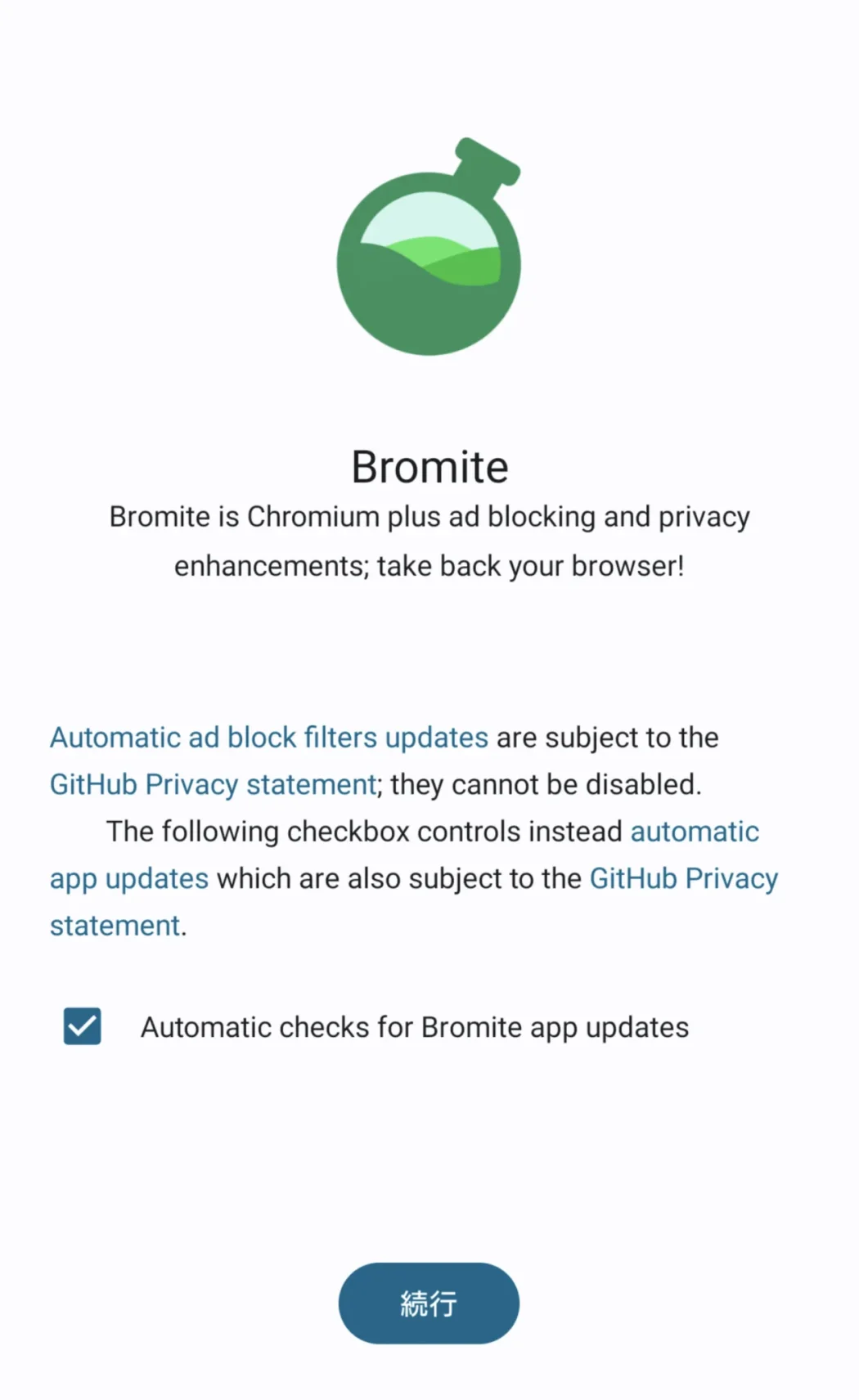
Best for: de-Googled Chromium browser with aggressive blocking
Bromite was the original Chromium-without-Google fork; after development stalled, Cromite picked up the torch and ships ongoing updates. Built-in ad and tracker blocking, no Google services.
- De-Googled Chromium; no Google sign-in, no telemetry.
- Built-in blocking on by default.
- Open source on GitHub.
Where it falls short: Not on Google Play; install through F-Droid or GitHub direct download. Less mainstream than Brave.
Pricing: Free.
10. YouTube Premium (the only reliable YouTube ad block)

Best for: users who want ads gone from YouTube specifically, long-term
YouTube actively breaks every third-party ad blocker through frequent client-side updates. The only reliable, durable path to YouTube without ads is YouTube Premium. The $13.99 per month () is high, but the time-cost of constantly working around YouTube’s anti-blocker enforcement adds up too.
- Reliable and durable ad-free YouTube.
- Background play on Android.
- YouTube Music subscription included.
Where it falls short: Pricey; family plan at $22.99 amortizes if you have multiple users.
Pricing: $13.99/month individual, $22.99/month family.
At a glance
| Option | Coverage | Cost | Best for |
|---|---|---|---|
| Brave Browser | Browser only | Free | Casual users |
| NextDNS | Every app (DNS) | Free + $20/year | Tech-confident users |
| AdGuard | Every app (VPN) | Free tier + $30/year | Maximum aggressive blocking |
| Blokada | Every app (VPN) | Free + $4/month Plus | Open-source preference |
| DuckDuckGo Browser | Browser only | Free | Privacy-first users |
| YouTube Premium | YouTube only | $13.99/month | Durable YouTube ad-free |
FAQ
Will any of these block YouTube ads?
Inconsistently. YouTube actively breaks third-party ad blockers, often within days of a new blocker. AdGuard and Blokada both work for YouTube most of the time; the only durable path is YouTube Premium.
Is DNS-level ad blocking enough?
For most casual users yes. NextDNS or Pi-hole catches the vast majority of ads on the open web. The gaps are first-party ads (YouTube, Twitter, Facebook) and ads from the same domain as the content.
Do ad blockers slow down my browser?
Mild speed improvements actually. Most pages load faster with ads blocked because the ad scripts are themselves heavy. The exception is local-VPN-based blockers, which add a small routing overhead (under 5 percent in our tests).
Are these legal?
Yes. Using ad blockers is legal in every country we are aware of. Some publishers detect ad blockers and ask you to allow ads or pay for a subscription; you can either honor that or move to another source.
Do these block ads in apps too?
DNS-based (NextDNS, Pi-hole) and VPN-based (AdGuard, Blokada) block ads across most apps. Browser-only blockers (Brave, DuckDuckGo) only block ads in their own browser.
Will any of these harm my battery life?
Browser-only blockers and DNS-level blockers add minimal battery overhead (under 1 percent per day). Local-VPN-based blockers (AdGuard, Blokada) use the VPN slot continuously and add roughly 2 to 4 percent battery drain per day. Battery-saving steps for Android compensate.
The verdict
The no-root ad-blocking stack covers more ground than it did three years ago. Brave for the browser-first user, NextDNS or Pi-hole for the system-wide DNS approach, AdGuard or Blokada for the maximum-aggressive VPN-based filtering. YouTube Premium for the YouTube-specific case where third-party tools no longer hold up.
Pick by where you encounter the most ads. Browser-only blocking covers the easiest case cheaply. System-wide blocking is more involved but pays back if you encounter ads in apps as much as in browsers. The third-party tools have matured to the point where the typical Android user does not need to root the phone to get strong ad blocking.
How we put this guide together
Tested each blocker on Pixel 8a, Galaxy S25, OnePlus 12, and Motorola Edge 50 during April and May 2026. Coverage measured against the top 50 ad-dense sites and a daily-use app set (YouTube, free news apps, free games, shopping apps). Battery overhead measured over a 24-hour cycle with each blocker active. YouTube anti-blocker behavior tested twice (April 5 and May 10) to capture the cadence of Google’s enforcement updates.