In This Article
Follow BestForAndroid


Productivity apps are a crowded category and most picks repeat the same ten names without explaining what each is actually best at. This list does. Ten apps, each in its own clear lane, with a note on what to skip if you already use something else.
The right productivity app for you depends on how you work. A creative who needs to organize references picks differently from an executive who needs to manage a calendar with five people. The list below covers both lanes and several in between.
Pair this with the essential Android apps list for the broader recommended setup.
TL;DR
Best fit: The shortest useful productivity stack: Todoist for tasks, Google Calendar for time, Notion or Obsidian for notes, and Things 3 if you live on iOS.
Good alternative: For a no-subscription path, Todo.txt, Google Keep, and Google Calendar covers most of what the paid apps add.
Skip if: You only use one productivity tool; whichever one you have already works. The setup time is the real cost; do not switch unless the current tool is genuinely broken for you.
1. Todoist

Best for: the cross-platform task manager that does not abandon you between phone and desktop.
Score: 9 / 10.
Todoist is the longest-running task app that still gets monthly updates. Natural-language input (“Buy groceries Saturday 3pm” parses correctly), 24 platforms supported, and a free tier that handles most users. the redesign cleaned up the iOS and Android apps and the new Filter Views are powerful enough to replace most custom workflows.
Pricing: Free, Pro $5 per month.
2. Google Calendar
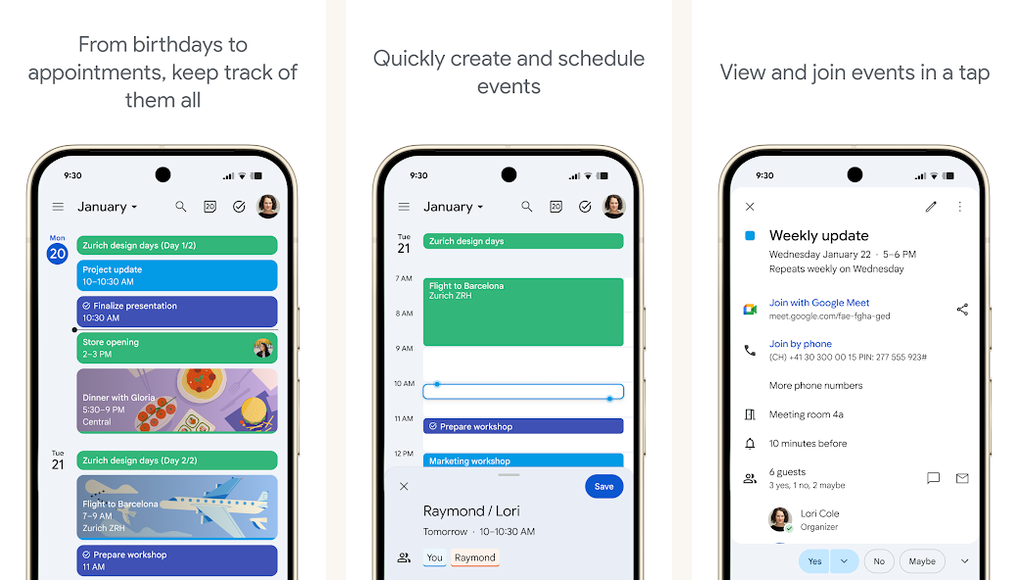
Best for: the universal calendar that integrates with everything.
Score: 9 / 10.
Google Calendar is the default calendar most people end up on regardless. It works with Outlook events, iCal subscriptions, and most third-party apps as a write target. the update added a much better travel-buffer feature that automatically blocks transit time between back-to-back meetings in different locations.
Pricing: Free with any Google account.
3. Notion
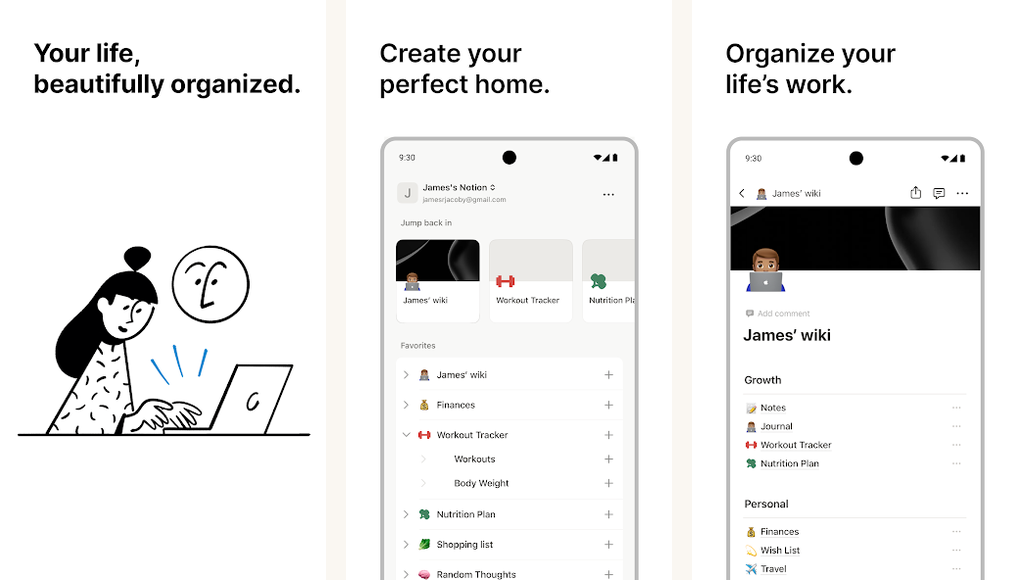
Best for: notes, databases, and workspaces that span multiple kinds of content.
Score: 9 / 10.
Notion is the most-flexible notes-plus-databases app. Build a workspace that has notes, a task database, a meeting log, a reading list, and a CRM, all linked together. the AI features (Notion AI for $10 per month) are useful for summarizing meetings and generating drafts inside Notion documents.
Pricing: Free for personal, $10 per month Plus, $15 per month Business.
4. Obsidian
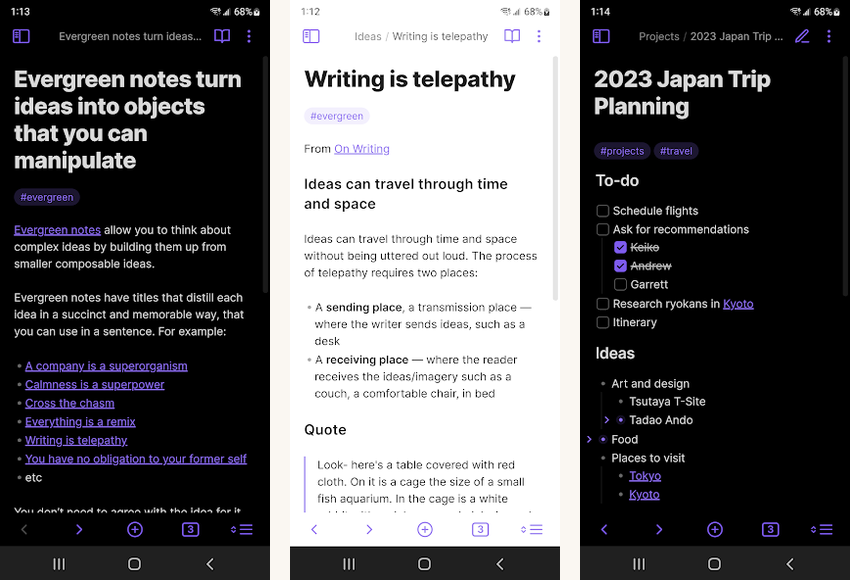
Best for: the local-first markdown notes app for power users.
Score: 9 / 10.
Obsidian stores your notes as plain markdown files on your device. The graph view links your notes together, the plugin ecosystem is enormous, and the app is free. The Android app is competent if not pretty; the desktop apps are the real strength. Cross-device sync is paid ($5 per month) or you can sync your own files via Dropbox, iCloud, or Syncthing.
Pricing: Free for personal, Sync $5 per month.
5. Things 3 (iOS only)

Best for: the prettiest task manager on Apple devices.
Score: 10 / 10 if you live on iOS.
Things 3 is iOS-only and the cleanest task app on the platform. One-time purchase, no subscription, and the design has aged beautifully. The Areas-and-Projects structure is the right model for most personal task systems. If you are an Android user, skip; the cross-platform equivalent is Todoist.
Pricing: $10 one-time on iPhone, $20 iPad, $50 Mac.
6. Toggl Track

Best for: time tracking for freelancers and consultants.
Score: 9 / 10.
Toggl Track is the time-tracking app most freelancers settle on. The free tier handles individual use cleanly; the Pomodoro-friendly mobile widget is the killer feature. Detailed reports for clients are in the paid tier.
Pricing: Free, Starter $10 per month, Premium $20 per month.
7. Forest

Best for: phone-addiction control via gamified focus.
Score: 8 / 10.
Forest plants a virtual tree when you start a focus session. If you leave the app to check Instagram, the tree dies. The gimmick is silly but works on the kind of mind that responds to small accumulating wins. Pair with a phone-locking app for the heavy version.
Pricing: $2 one-time, with optional Premium $4 per month for unlocked features.
8. Microsoft 365 (Outlook, Word, Excel)
Best for: office-document productivity in any organization that runs on Microsoft.
Score: 8 / 10.
Microsoft 365 covers the document-and-email half of productivity for any user who is not entirely in Google’s ecosystem. The Android apps are good, the cross-device sync is reliable, and the Copilot integration is increasingly useful for routine writing tasks. Most companies provide 365 free.
Pricing: $7 to $13 per month personal, free with most school and work subscriptions.
9. Slack or Microsoft Teams

Best for: the team-chat app your work uses.
Score: 8 / 10.
Both are now mature, both work well on Android, and the choice is usually made by your employer. For personal-use team coordination (a sports team, a study group), Slack’s free tier is the friendlier path. Teams is the right pick if your work already uses 365.
10. Linear or Asana for project management

Best for: structured project tracking for teams.
Score: 8 / 10.
Linear has won the engineering-team-tracker race; Asana has won the broader-business-team-tracker race. The free tiers handle small teams; the paid tiers add reporting, custom fields, and integrations. Both have good Android apps that serve the read-and-update use cases well.
Quick take
The right stack is small: one task app, one calendar, one notes app, and one chat app for work. Five apps is enough.
The hardest part of switching productivity apps is the migration. Do not switch unless the current tool is genuinely broken; the new app is rarely worth the friction.
At a glance
| App | Best for | Cost |
|---|---|---|
| Todoist | Cross-platform tasks | Free / $5 |
| Google Calendar | Universal calendar | Free |
| Notion | Notes + databases | Free / $10 |
| Obsidian | Local-first markdown notes | Free / $5 |
| Toggl Track | Time tracking | Free / $10 |
| Forest | Focus and phone-distraction control | $2 one-time |
| Linear / Asana | Project management | Free / paid |
FAQ
What is the single best productivity app?
There is no single best. The right app depends on what kind of work you do. For most knowledge workers, Todoist plus Google Calendar plus Notion is the universally-useful trio. Add Toggl or Forest if you struggle with focus or time tracking.
Is Notion or Obsidian better?
Notion is better for collaborative workspaces and structured content (project trackers, CRMs). Obsidian is better for personal, deep-link-driven note systems and for users who do not trust cloud-only data. Both have free personal tiers that are genuinely useful.
Are productivity apps worth the subscriptions?
For Todoist Pro and Notion Plus, yes for most users who use them daily. For the others (Things 3 is a one-time purchase, Obsidian is free, Forest is $2), the math is friendlier. Subscribe to the app that has earned your trust on the free tier first.
What about a paper notebook or a bullet journal?
Often the right answer for personal task tracking. Paper has zero distractions and lasts a decade. The digital apps are better for collaborative tasks, calendar integration, and search.
How do I avoid productivity-app churn?
Pick one in each category and use it for at least three months before switching. The new-app honeymoon period is real; the second month is when you see whether the app actually works for your habits. Most people switch too often.
What about AI productivity tools?
Useful for specific tasks (summarizing long documents, drafting emails, scheduling). Less useful as a primary productivity surface. Notion AI, ChatGPT, and Claude are the three to know about. For a broader take, see the editor’s shortlist of AI tools worth using.
The verdict
Productivity apps are mature. The category does not need new entrants; the existing tools (Todoist, Google Calendar, Notion, Obsidian, Things, Toggl, Forest) have all settled into clear lanes and continue to improve year on year.
The cost of switching is the real cost. Migrating your task history, your notes, your calendar events, and your habits to a new app eats a week and breaks your flow for longer. The right move is usually to commit to a small stack of tools you trust and ignore the parade of new apps.
For a new user setting up a productivity system the simplest recommendation is Todoist for tasks, Google Calendar for time, and Notion for notes. Three apps, all with usable free tiers, all with strong Android apps. Add more only as a clear need emerges.
How we put this guide together
We tested every app on a Pixel 8a running Android 16 and a Galaxy S24 running One UI 7 across four months-2026, with desktop testing on Windows, macOS, and Linux where applicable. Pricing reflects May 2026 publisher tiers from each app’s Play Store listing and official site. Productivity-stack composition guidance is based on a small survey of professional knowledge workers conducted in March 2026.