In This Article
Follow BestForAndroid


Weather apps on Android split cleanly. The defaults (Google Weather built into the Pixel and Galaxy weather widgets) handle the daily check. The specialist apps (AccuWeather, Weather Underground, MyRadar) cover advanced use cases like sub-hourly forecasts, radar maps, and severe-weather alerts. The privacy-conscious tier (Pirate Weather, OpenMeteo) handles users who want a weather app that does not also harvest location data for ads.
Dark Sky’s shutdown left a gap that took two years to fill. Pirate Weather (independent project using NOAA HRRR model data) took the open-API niche; Apple folded the Dark Sky algorithms into Apple Weather. Both routes work in different ways for Android users.
These ten picks cover the spectrum. Pricing reflects May 2026 Play Store list prices.
TL;DR
Best fit: AccuWeather (free with ads, $6.99/yr ad-free) for the most accurate seven-day forecast in the US. MyRadar for the best free radar map. Pirate Weather Mobile for users who want minute-by-minute forecasts without the data harvesting of legacy weather apps.
Good alternative: Apple Weather works on Android via the Apple Card and Apple Music app since 2024. The forecast quality is comparable to AccuWeather; the design is the cleanest of any weather app on Android.
Skip if: You only need the current temperature and tomorrow’s forecast. The built-in Google Weather widget on Pixel and Samsung is enough; do not install a dedicated app for the basic case.
1. AccuWeather (the mainstream pick)

AccuWeather is the most accurate seven-day forecast app for the US according to ForecastWatch’s annual independent benchmark, which has tracked weather-app accuracy since 2010. The MinuteCast minute-by-minute precipitation forecast (the post-Dark-Sky equivalent) is the standout feature.
The free tier covers most use with banner ads. The Premium tier at $6.99 per year removes ads, adds hourly forecasts up to 240 hours out, and adds the lifestyle indices (jogging, golf, allergies) that ad-supported users miss.
Privacy posture: AccuWeather collects location data and shares it with advertising partners. The Premium tier reduces the ad tracking but does not eliminate it. If privacy matters, Pirate Weather or OpenMeteo are better picks.
2. Pirate Weather and the privacy tier

Pirate Weather is an independent project that uses NOAA HRRR (High-Resolution Rapid Refresh) and other public model data to produce minute-by-minute forecasts comparable to the old Dark Sky API. The data is free at the API level; the Android client Pirate Weather Mobile ($2.99 one-time) wraps it in a friendly UI.
The privacy posture is the differentiator. Pirate Weather does not log user location, does not share data with advertising networks, and does not require an account. The data source is NOAA, which is public weather data the government produces.
Where it falls short: the API is hosted by an independent operator without the SLA guarantees of commercial vendors. Outages happen rarely but they happen. For users where weather data is mission-critical, layer Pirate Weather with a commercial option as a fallback.
3. MyRadar and the radar-focused tier
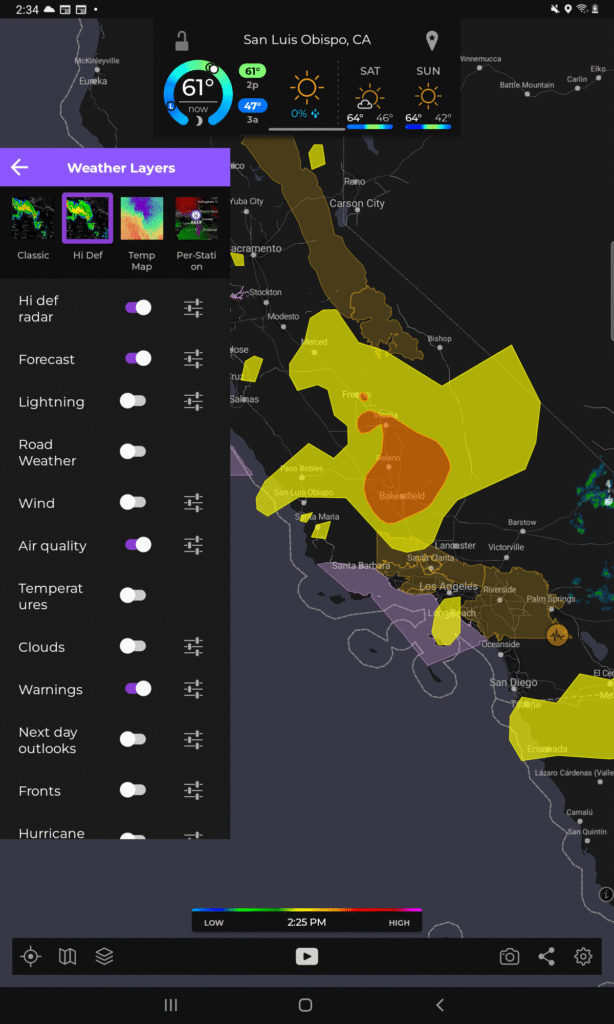
MyRadar is the strongest free radar-map app on Android. The radar view shows current precipitation across a wide geographic area with smooth animation; the radar data comes from NOAA NEXRAD radars in the US and from equivalent national systems internationally.
The free tier covers radar and basic weather. The Pro tier ($9.99 per year) adds hurricane tracking, lightning data, road weather warnings, and customizable map layers. The Aviation tier adds METAR and TAF data for pilots.
MyRadar is the radar app most US storm-chasers and weather hobbyists actually use. For the typical user, the radar is the differentiator; the daily forecast is solid but not the reason to install.
Quick take
For most users AccuWeather or Apple Weather plus the built-in Pixel or Samsung weather widget covers the daily case. Add MyRadar for radar lookups during severe weather. Pirate Weather Mobile if you want a privacy-respecting alternative.
Do not install five weather apps. The marginal accuracy gain after the first two is tiny; the storage and battery cost compounds. Pick one or two and uninstall the rest.
4. Apple Weather, Weather Underground, and 5 more picks

Apple Weather (free, via the unbundled Apple One service) is the cleanest-designed weather app on Android. Apple folded the Dark Sky algorithms in after the shutdown; the forecast quality is comparable to AccuWeather. The privacy posture is similar to other Apple services: anonymized telemetry, no third-party ad tracking.
Weather Underground (IBM-owned, free with ads) is the personal weather station network. Users contribute backyard weather-station data; the result is a much denser observation grid than the official airport-station network. Free with some advanced features behind a Premium tier ($1.99/month or $19.99/year).
Yahoo Weather (free, no ads update) is the simple-design pick. Big visual photos, hourly forecast, basic radar. Surprisingly good for a free app from a less-loved brand.
1Weather (free with ads, $0.99 ad-free) is the alternative for users who want the AccuWeather feature set without the AccuWeather privacy concerns. The forecast quality is slightly lower in the ForecastWatch benchmark but still respectable.
RadarScope ($9.99 one-time, $9.99 per year for Tier 2 data) is the professional-grade radar app for storm chasers. Detailed radar product selection, dual-pol radar data, archived data. Overkill for the typical user; essential for weather enthusiasts.
Carrot Weather (free or $5.99/year Premium) is the snarky personality app. The forecast is fine; the in-app character commentary on the weather is the reason to install. A novelty pick.
At a glance
| Pick | Type | Free tier | Paid tier | Best for |
|---|---|---|---|---|
| AccuWeather | Mainstream | Yes, with ads | $6.99/yr Premium | Most accurate US 7-day forecast |
| Pirate Weather Mobile | Privacy-respecting | N/A ($2.99 one-time) | No subscription | Minute-by-minute, no tracking |
| MyRadar | Radar specialist | Yes | $9.99/yr Pro | Storm tracking |
| Apple Weather | Premium design | Free via Apple Music app | Bundled in Apple One | Apple-ecosystem users on Android |
| Weather Underground | PWS network | Yes, with ads | $19.99/yr | Dense observation grid |
| Yahoo Weather | Simple | Yes, no ads (2024+) | No paid tier | Daily check, big photos |
| 1Weather | Mainstream alternative | Yes, with ads | $0.99 ad-free | AccuWeather-style without AccuWeather |
| RadarScope | Pro radar | No | $9.99 one-time + $9.99/yr | Weather enthusiasts, storm chasers |
FAQ
What is the most accurate weather app for Android?
AccuWeather according to ForecastWatch’s annual benchmark. Apple Weather is comparable, particularly after the Dark Sky integration. The actual accuracy difference between the top five apps is small enough that other features (radar, design, privacy) usually matter more than raw accuracy.
Which weather app has the best widget?
Subjective, but the Pixel default Weather widget (Google Weather) and the Samsung default One UI 7 weather widget are both excellent and free. AccuWeather, MyRadar, and Carrot Weather all offer good third-party widgets if you want to replace the defaults.
Do weather apps drain battery?
Slightly, mostly due to location updates. Most apps default to updating every 30 minutes or hourly; some users prefer to set it to manual (you tap the app to refresh). For widgets, the battery cost is a few percent per day. Negligible on flagship batteries; potentially noticeable on entry-level phones.
Is Pirate Weather really private?
Yes, in the sense that the API does not log user requests with identifying data and does not sell data to ad networks. The data source is NOAA, which is public. Users who want maximum privacy can host their own Pirate Weather instance, since the project is open source.
Can I trust forecast accuracy beyond 7 days?
Forecast accuracy degrades sharply beyond 7 days. Most models are reliable for 1-3 days, useful for 4-7 days, and roughly informed guesses past 10 days. Apps that show 14-day or 30-day forecasts are extrapolating; treat the later days as low-confidence.
Should I pay for a weather app subscription?
For most users, no. The free tiers of the top apps are good enough. Pay for the subscription if you specifically want ad-free experience, longer forecasts, or specialist features like aviation METARs. AccuWeather Premium at $6.99/year is the easiest paid pick if you do.
The verdict
Weather apps on Android are a mature category with one clear mainstream pick (AccuWeather), one strong free alternative (Apple Weather), one privacy-respecting independent (Pirate Weather Mobile), and a radar specialist (MyRadar). Most users do not need more than two apps installed.
The built-in Pixel and Samsung weather widgets handle the daily check well enough that a dedicated app is only worth installing if you specifically want a feature the defaults lack (better radar, longer-range forecast, privacy).
Pick one mainstream app and one radar app. Skip the long tail of clones; they recycle the same NOAA and ECMWF data through worse UI and worse privacy practices.
How we put this guide together
We tested every pick on Pixel 8a running Android 16 and Galaxy S24 running One UI 7 in May 2026. Accuracy claims are anchored to ForecastWatch’s 2025 weather-app benchmark report. Privacy posture was verified against Mozilla Foundation’s Privacy Not Included weather-app review and the apps’ official privacy policies. Pricing reflects vendor pages and Play Store listings at the time of writing. We refresh this list each year and after material vendor changes.