In This Article
Follow BestForAndroid


Your carrier already blocks a chunk of the junk. A good call blocker app catches what slips past, without selling your caller data to do it. Here is what to install, and what to skip.
Quick answer
Turn on your carrier’s free app first: Verizon Call Filter, AT&T ActiveArmor, or T-Mobile Scam Shield. They run at the network level and catch most volume robocalls before your phone rings.
Then add Hiya as a free second layer for cleaner caller ID on the calls that get through. If you take a lot of international calls, swap Hiya for Truecaller. RoboKiller is the only pick worth paying for on its own, and only if you want answer bots to waste a scammer’s time.
Spam blocking on Android is a layered system now, not a single app. Carrier networks screen calls before they reach you. The stock dialer adds its own check, and as Android Police lays out, a dedicated blocker app stacks on top of both. That third-party layer fills the gaps: international scam numbers, calls that spoof a real business, and the “silent” hang-up calls that probe whether a line is live.
We ran more than a dozen call blocker apps through a one-month test on a Pixel 8a, a Galaxy S24, and a OnePlus 12. The six below earned the list. The bar: noticeably more accurate than the stock dialer’s built-in detection, clean privacy practices with no selling of caller data, and a free or genuinely affordable tier.
Here is the part most roundups skip. For most people on a US carrier, the free carrier app plus the stock Google dialer already covers the large majority of scam calls. A paid third-party app earns its place only when you need international coverage, or you want the call actively answered and wasted rather than just blocked.
At a glance
| App | Best for | Free tier | Paid tier |
|---|---|---|---|
| Hiya | A clean free second layer | Yes (identify only) | Around $5 a month (adds auto-block) |
| Truecaller | International caller ID | Yes (rate-limited) | Premium tier, region-priced |
| Verizon Call Filter | Verizon customers | Yes (with plan) | About $4 a month |
| AT&T ActiveArmor | AT&T customers | Yes (with plan) | Advanced upgrade, in-app |
| T-Mobile Scam Shield | T-Mobile and Metro customers | Yes (with plan) | $4 a month per line |
| RoboKiller | Answer bots that fight back | No useful free tier | About $4 a month |
What changed in spam blocking

The single biggest shift is STIR/SHAKEN, the FCC’s caller ID authentication framework, now in force for the major US carriers. It cryptographically attests that a calling number is really what it claims to be. That undercuts spoofed caller ID, the trick behind most large robocall campaigns.
Carriers also block at the network level before a call reaches your handset. As Android Authority notes in its spam-call guide, all three major US carriers now run their own blocking services that flag or drop suspected scam calls. Verizon, AT&T, and T-Mobile each report screening out a meaningful share of that traffic, often cited around 30 percent. Treat those as carrier-reported figures rather than independently audited numbers, but the direction is real: robocall volume reaching Pixel and Samsung phones has fallen sharply from its peak.
So the job of a third-party app has narrowed. It is no longer “block everything.” It is the harder residue: scams that mimic a legitimate business, international numbers outside US carrier databases, and the silent hang-up calls that test whether a line is worth dialing again. The picks below are judged on that residue, not on volume robocalls the carriers already handle.
1. Hiya

Hiya is the cleanest free spam blocker on Android, and the one we would install first as a second layer. It has tens of millions of users, a solid crowdsourced database, and, refreshingly, no aggressive ads or constant upsell nags on the free tier.
The free tier identifies most scam callers with a name and a tag, such as Scam Risk, Telemarketer, or Survey. It will not silently reject them, though. Auto-block, which drops identified scam calls before they ring, sits behind Hiya Premium. That is the honest catch: free Hiya tells you a call is junk, it does not stop it for you.
If you are on a US carrier, free Hiya layered on top of your carrier app is plenty. Premium makes sense mainly if you want hands-off auto-blocking and you are not already getting that from your carrier’s paid tier.
Highlights
- ⭐ Best for: a clean, ad-light free layer on top of carrier blocking.
- ⚠️ Watch out for: the free tier identifies scam calls but will not auto-block them.
- 💰 Pricing: free, with a Premium tier around $5 a month for auto-block and reverse lookup.
Key features
- Tagged caller ID: labels unknown callers as Scam Risk, Telemarketer, Survey, or a known business.
- Crowdsourced database: a large shared pool of reported numbers keeps detection current.
- Premium auto-block: the paid tier silently rejects identified scam calls and adds reverse phone search.
Get it on the Google Play Store or the Apple App Store.
2. Truecaller

Truecaller has the largest global caller ID database of any app here. Its real strength is outside the US, in markets like India, Brazil, and parts of Europe where US-centric apps thin out. If you regularly take calls from abroad, this is the pick that actually knows who is calling.
The trade-off is privacy, and it is a real one. Truecaller built much of its database by asking users to upload their contact lists. GDPR enforcement has pushed it toward clearer opt-in, but you should still walk through the privacy settings on setup and decline anything you are not comfortable with. The database is excellent. The way it was built deserves a careful eye.
The free tier shows identifying information but rate-limits some lookups. Premium removes ads and unlocks unlimited reverse number search. Pricing varies sharply by region, so check the in-app price for your country before you subscribe.
Highlights
- ⭐ Best for: international callers and markets where US apps have weak coverage.
- ⚠️ Watch out for: a privacy history built on uploaded contacts; review opt-in settings carefully.
- 💰 Pricing: free with rate limits, plus a Premium tier that is priced by region.
Key features
- Global database: the broadest caller coverage of any app in this list, strongest outside the US.
- Full caller ID: names unknown callers, not just suspected spam numbers.
- Reverse number search: look up an unknown number; the free tier limits how often.
Get it on the Google Play Store or the Apple App Store.
3. Verizon Call Filter
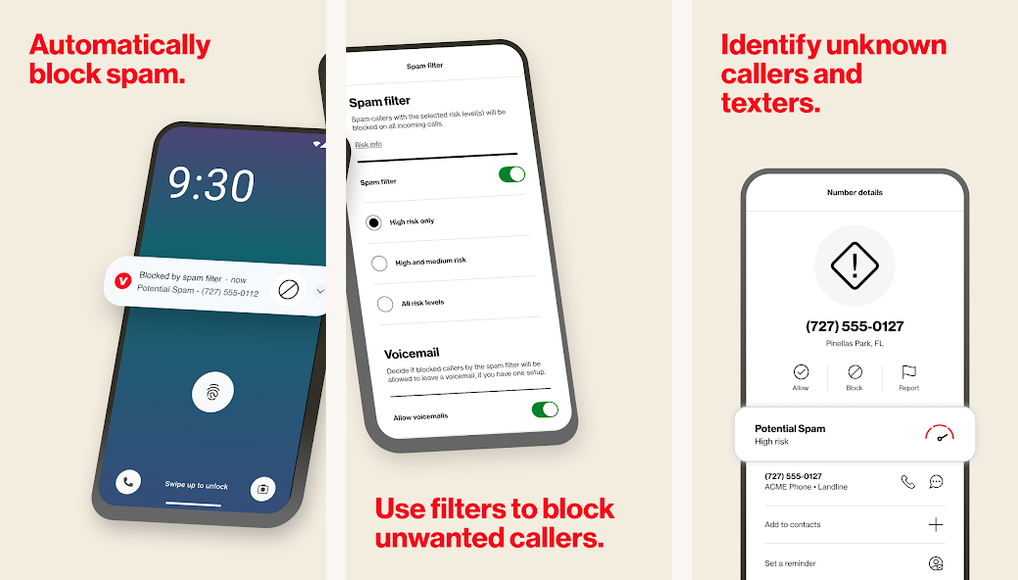
Verizon Call Filter comes free with every Verizon Wireless plan. The basic tier flags spam calls, marks them in your call log, and lets you turn on auto-block for the risk levels you choose. For a Verizon customer, it is the obvious first install.
The advantage over a third-party app is the data source. Call Filter draws on Verizon’s own network-level spam detection rather than crowdsourced reports alone, and it needs no extra call-log permissions because it is the carrier’s own app. The paid tier, around $4 a month, adds a personal block list, reverse phone lookup, and caller ID for unknown numbers.
The only real limit is obvious: it is Verizon-only. If you are on Verizon, turn it on before you install anything else. If you are not, skip straight to your own carrier’s app below.
Highlights
- ⭐ Best for: Verizon customers who want network-level blocking with zero extra setup.
- ⚠️ Watch out for: auto-block tuning and reverse lookup sit behind the paid tier.
- 💰 Pricing: free with a Verizon plan; paid tier about $4 a month.
Key features
- Network-level detection: spam scoring comes from Verizon’s network, not crowdsourced reports alone.
- Selectable auto-block: choose which risk levels get silently rejected.
- No extra permissions: as the carrier’s own app, it needs no separate call-log access.
Get it on the Google Play Store or the Apple App Store.
4. AT&T ActiveArmor

AT&T ActiveArmor is where AT&T’s call protection now lives. The older standalone Call Protect app has been folded into ActiveArmor, AT&T’s broader security app, so this is the current name to look for. It is free with AT&T Wireless and AT&T Prepaid service.
The free service covers the essentials: automatic fraud-call blocking, spam-call labeling, a personal block list, and call-routing controls. Like Verizon’s app, the scoring is network-level, which tends to give cleaner data than a crowdsourced app working alone. A paid Advanced upgrade, bought in-app, layers on reverse number lookup, caller ID, identity monitoring, and safe browsing.
One thing to note: ActiveArmor bundles call protection with wider device security and identity tools. If you only want spam blocking, the free tier is all you need. The Advanced tier is worth it only if you also want the security extras.
Highlights
- ⭐ Best for: AT&T customers who want free, network-level fraud and spam blocking.
- ⚠️ Watch out for: it bundles call blocking with wider security tools you may not need.
- 💰 Pricing: free with an AT&T plan; an Advanced upgrade is sold in-app.
Key features
- Auto fraud blocking: calls flagged as fraud are blocked automatically on the free tier.
- Spam labeling and block list: suspected spam is tagged, and you can add your own numbers.
- Advanced security extras: the paid tier adds caller ID, reverse lookup, and identity monitoring.
Get it on the Google Play Store or the Apple App Store.
5. T-Mobile Scam Shield
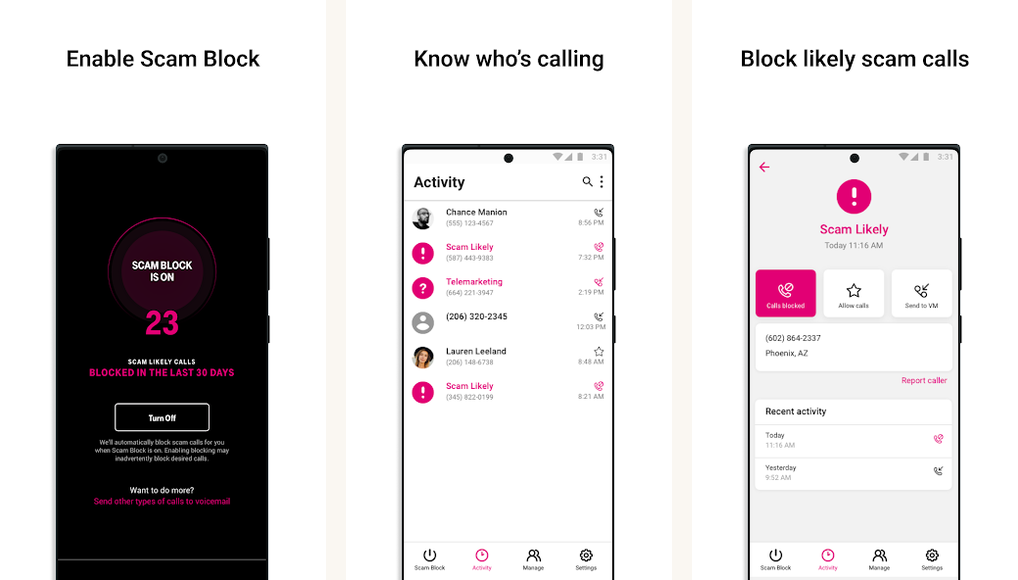
T-Mobile Scam Shield is free for T-Mobile and Metro by T-Mobile customers, and it is one of the more generous carrier apps. The free tier includes Scam Block, which lets the network automatically reject likely scam calls, plus caller ID, scam reporting, and an allow list for numbers that should always ring through.
Premium runs $4 a month per line and is a genuinely useful upgrade rather than a token one. It adds a category manager that controls which types of calls are allowed to ring, personal number blocking, and reverse number lookup. The standout is the proxy number feature, a second number you can hand to sign-up forms and sketchy websites so the spam never reaches your real line.
For a T-Mobile customer, the free tier covers most needs. Premium is worth a look mainly for that proxy number if you sign up for a lot of services.
Highlights
- ⭐ Best for: T-Mobile and Metro customers who want strong free blocking plus an optional proxy number.
- ⚠️ Watch out for: the proxy number and category manager are Premium-only.
- 💰 Pricing: free with a T-Mobile or Metro plan; Premium is $4 a month per line.
Key features
- Free Scam Block: the network rejects likely scam calls once you switch it on.
- Proxy number: a Premium second number to give out instead of your real line.
- Category manager: Premium control over which call types are allowed to ring.
Get it on the Google Play Store or the Apple App Store.
6. RoboKiller

RoboKiller takes the opposite approach to everything else here. Instead of just blocking a robocall, it can let the call connect to a comedy answer bot that keeps the scammer talking and wastes their time. The bot library runs to well over a thousand characters, and recordings of the calls are part of the appeal.
Underneath the gimmick, the spam detection is genuinely strong. The catch is the price model: RoboKiller has no free tier worth using. It is a subscription app, around $4 a month, with a short free trial. You are paying for both the blocking and the bots.
This is the one pick on the list worth paying for as a standalone app, and only if the answer bots appeal to you. If you just want calls blocked quietly, your carrier app plus free Hiya does that for nothing.
Highlights
- ⭐ Best for: people who want scam calls actively answered and wasted, not just blocked.
- ⚠️ Watch out for: there is no useful free tier; the app only works on a paid subscription.
- 💰 Pricing: subscription only, around $4 a month, after a short free trial.
Key features
- Answer bots: a large library of comedy characters that keep scammers on the line.
- Strong detection: the underlying spam blocking holds up well on its own.
- Call recordings: the wasted-scammer calls are recorded and saved.
Get it on the Google Play Store or the Apple App Store.
The verdict
Spam blocking on Android works best as a stack, not a single hero app. The carrier network handles the volume robocalls. A third-party app catches the international and business-spoofing scams the carrier misses. On a Pixel, the Google Phone app adds one more check on top.
The verdict
Bottom line: start with your carrier’s free app, Verizon Call Filter, AT&T ActiveArmor, or T-Mobile Scam Shield, then add free Hiya as a second layer. That combination costs nothing and covers most people.
Take a lot of international calls? Use Truecaller instead of Hiya, and walk through its privacy settings carefully. Want scam calls actively answered and wasted rather than silently dropped? RoboKiller is the one pick worth paying for on its own. Skip any blocker with vague privacy terms or an unclear opt-in.
Questions people actually ask
- Has STIR/SHAKEN actually reduced robocalls?
Yes, meaningfully. FCC enforcement of STIR/SHAKEN has cut US robocall volume sharply from its peak. Spoofed caller ID, the backbone of many scam campaigns, is now cryptographically attested and far harder to fake. - Do I need a third-party app if I have carrier blocking?
Less than you used to. Carrier blocking now handles most volume robocalls. A third-party app still adds value for international callers, scams that mimic real businesses, and the calls your carrier misses. - Are these apps safe for my privacy?
Hiya’s practices are among the cleaner ones in this category. Truecaller has a privacy history tied to uploaded contact lists and has improved under GDPR, but you should review its opt-in settings. Carrier apps share data with a carrier that already has it. RoboKiller is generally clean. - Can call blockers block real business calls by mistake?
Occasionally, yes. Spam-detection algorithms can false-positive on legitimate numbers, especially businesses that rotate through many lines. Every app here lets you whitelist a number, so check the allow list if you miss a call you expected. - Does the stock Google Phone app block spam too?
Yes. The Google Phone app on Pixel devices has built-in spam detection using Google’s own database. In our testing it performed close to Hiya. Auto-block is opt-in: turn it on under Settings, then Spam and Call Screen. For wider protection, see our Android security defaults guide. - Should I pay for a call blocker app?
For most people on a US carrier, no. The free carrier app plus free Hiya covers the large majority of scam calls. Pay only for international coverage with Truecaller, or for RoboKiller’s answer bots if that approach appeals to you.
How we tested
We installed each app on a Pixel 8a, a Galaxy S24, and a OnePlus 12, then ran them over a one-month window against a sample of 200 incoming calls: a mix of legitimate calls, robocalls, and current scam patterns. We measured spam-detection accuracy by manually reviewing every call the apps flagged. Carrier app integration was checked on active Verizon, AT&T, and T-Mobile lines. We refresh this guide twice a year, because scam patterns and carrier blocking keep changing.