In This Article
Follow BestForAndroid


A calendar app should make your week clearer in one glance, not give you one more thing to manage. These ten do the first job well.
Missed a meeting because the reminder never fired. Double booked yourself because two calendars were not talking to each other. Stared at a cluttered month grid trying to work out when you are actually free. If any of that sounds familiar, the problem is rarely your memory. It is your tool.
The right calendar app turns scheduling from a chore you avoid into a habit that quietly runs your day. We installed and lived in every app below across Pixel and Galaxy hardware, and picked the ten that go past showing dates on a grid. They manage tasks, protect focus time, sync across devices, and lay out a busy week so it feels readable instead of overwhelming.
Quick answer
For most people, Google Calendar is the right starting point: it is free, it syncs everywhere, and it pulls events out of Gmail on its own. Pick something else when you have a specific need. Cozi for a busy household, TickTick or Any.do when tasks and your schedule must live together, Structured for visual time blocking, and Proton Calendar when privacy comes first.
There is no single best calendar app, only the best one for how your brain plans. Some people need a rigid time blocked grid. Others want a fluid daily list. Some want the app to schedule everything for them. The table below maps each pick to the planning style it fits, so you can skip straight to yours.
| If you want this | Use this pick | Cost |
|---|---|---|
| A free default that just works | Google Calendar | Free |
| Encrypted, private events | Proton Calendar | Free, paid tier |
| Tasks and schedule in one view | Any.do, TickTick | Free, paid tier |
| A shared family calendar | Cozi, TimeTree | Free, paid tier |
| Visual time blocking | Structured Daily Planner | Free, paid tier |
| Deep customization and widgets | DigiCal, Business Calendar 2 | Free, one time unlock |
| Work email and calendar together | Microsoft Outlook | Free |
Before you choose
Most of these apps have a free tier that covers everyday planning. Paid plans unlock extras like multi device sync, advanced recurring tasks, or an ad free view. App pricing changes often, so treat the figures here as a guide and confirm the current price in the store before you subscribe.
Why the right calendar matters

Installing a calendar app does not make you organized. Using one that fits the way you think does. The wrong app adds friction: too many taps to add an event, a cluttered view you stop checking, notifications you learn to ignore. After a week, it goes unopened.
Here is where most roundups get it wrong. They rank calendar apps as if one design wins for everyone. It does not. A solo freelancer juggling client deadlines needs something very different from a parent coordinating three kids and a carpool. Match the app to the job, and the difference is a calendar you check versus one you actually run your day from.
1. Google Calendar
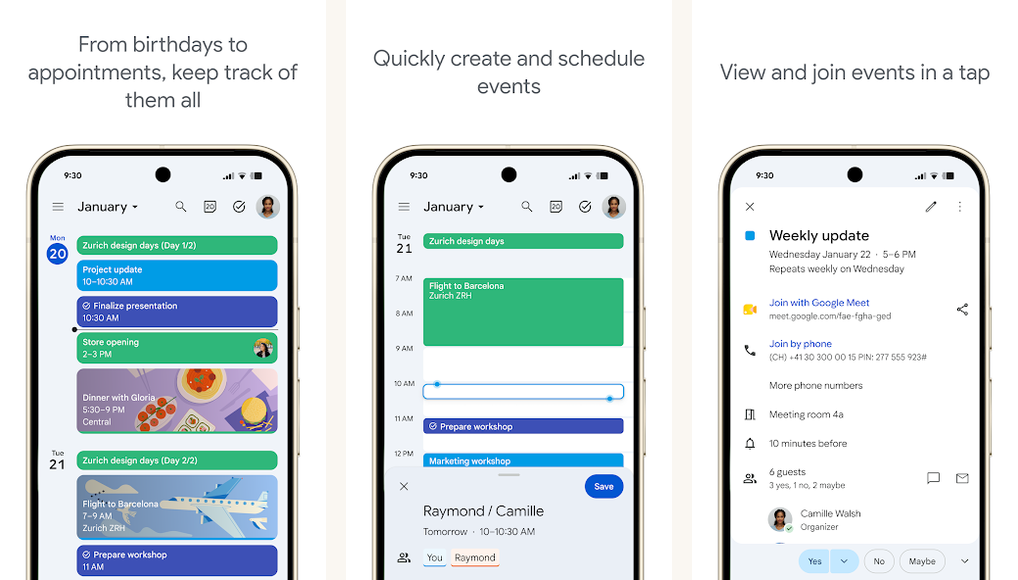
Google Calendar is the default for a reason. It is free, it is already signed in on most Android phones, and it handles the basics without fuss. You get day, week, and month views, smart suggestions for event titles and locations, and reminders that actually arrive.
Its real edge is quiet automation. It pulls flight, hotel, and reservation details out of Gmail and drops them onto your calendar without you lifting a finger. Built in Tasks let you keep to-dos and events in one place. If you live in Gmail and Google Workspace, nothing else slots in this cleanly. The trade off is depth: power users who want heavy customization or strong offline control will find it plain.
Highlights
- ⭐ Best for: most people, and anyone already inside the Google ecosystem.
- ⚠️ Watch out for: limited customization and a fairly basic offline experience compared with dedicated power user apps.
- 💰 Pricing: free for personal use.
Key features
- Gmail event extraction: flights, hotels, and bookings appear on your calendar automatically.
- Smart event creation: suggestions for titles, locations, and people speed up adding anything.
- Built in Tasks: to-dos and events sit side by side in one app.
- Shared calendars: reliable sharing for teams, partners, and family.
2. Proton Calendar

Proton Calendar comes from the team behind Proton Mail, and it brings the same privacy first stance to your schedule. Event titles, descriptions, and locations are end-to-end encrypted, so Proton itself cannot read what is on your calendar. For anyone who treats their schedule as sensitive, that is the whole point.
The app itself is clean and quick, with familiar day, week, and month views and straightforward event creation. It works best if you already use Proton Mail, since the two share one account and one login. If you have never used Proton, the upside is real but smaller, and the ecosystem is narrower than Google’s.
Highlights
- ⭐ Best for: privacy minded planners, and existing Proton Mail users who want one encrypted account for mail and calendar.
- ⚠️ Watch out for: a smaller feature set than Google Calendar and fewer third party integrations.
- 💰 Pricing: free with a Proton account; paid Proton plans add storage and extras.
Key features
- End-to-end encryption: event details are encrypted, not just stored behind a password.
- One Proton account: mail and calendar share a single private login.
- Clean, fast interface: standard views with no clutter and no ads.
- Open source apps: the code is public, so the privacy claims can be checked.
3. Any.do Calendar

Any.do sits in the sweet spot between a calendar and a to-do list. The calendar view is clean and uncluttered, with daily, weekly, and monthly layouts, and adding events takes a tap or two. The real strength is that your tasks and your appointments live in the same screen, so nothing falls through the gap between them.
A standout is the Plan My Day feature, which walks you through your tasks each morning and forces a quick triage. Location based reminders are handy too, nudging you to buy milk when you reach the shop. As a pure business scheduler it is lighter than Google Calendar, but as a daily task and calendar combo it is hard to beat.
Highlights
- ⭐ Best for: people who want one app for tasks and events, with a daily planning ritual built in.
- ⚠️ Watch out for: heavy collaboration and multi device sync are reserved for the paid plan, and the calendar side is lighter than a dedicated scheduler.
- 💰 Pricing: free for the basics; Premium runs a few dollars a month on the annual plan. Confirm the current price in the store.
Key features
- Tasks and calendar in one view: drag a task onto the calendar to turn it into a scheduled block.
- Plan My Day: a morning prompt that makes you review and order your tasks.
- Location based reminders: get nudged when you arrive somewhere, not just at a set time.
- Recurring tasks: set repeating to-dos for routines and regular chores.
4. TimeTree

TimeTree is built around one idea: a calendar you share. It is designed for couples, families, and small groups who need everyone looking at the same schedule. Each shared calendar shows upcoming events, deadlines, and appointments in real time, so no one is working from stale information.
What sets it apart is the chat tucked inside each calendar. Instead of jumping to a messaging app to ask about an event, you discuss it right there next to the date. You can attach notes and task lists to events too. The interface leans social, which is great for coordination but a little busy if you only want a quiet personal planner.
Highlights
- ⭐ Best for: couples, families, and small groups coordinating several schedules in one place.
- ⚠️ Watch out for: the feed and chat focus can feel cluttered if you want a strictly personal calendar, and the free tier carries ads.
- 💰 Pricing: free with ads; a small monthly or yearly fee removes ads and adds file attachments.
Key features
- Shared calendars: create a calendar and everyone in the group sees updates instantly.
- Built in calendar chat: discuss an event right beside it, with no separate messaging app.
- Event notes and tasks: attach details and checklists so context lives with the event.
- Multiple calendars: keep separate shared calendars for family, work, and friends.
5. Structured Daily Planner
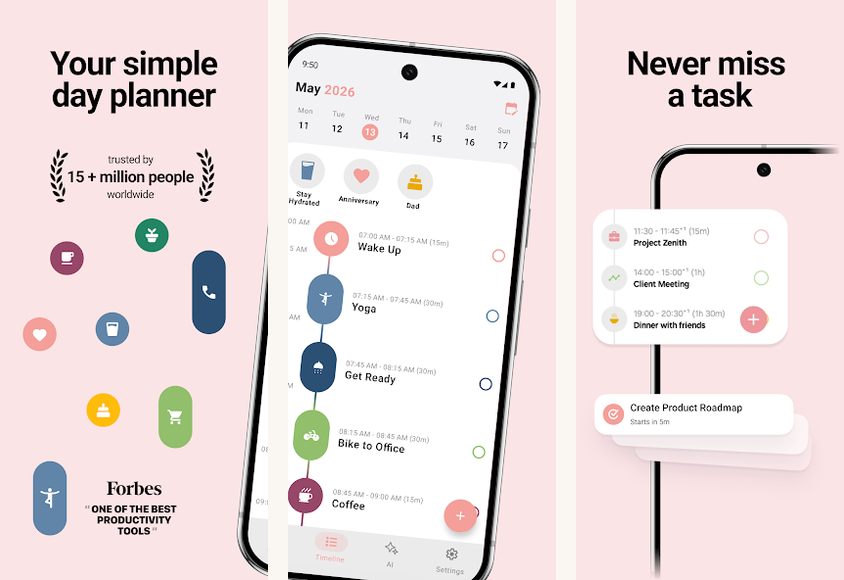
Structured takes a different shape from a normal grid calendar. It lays your whole day out as a single vertical timeline, from morning to night, so you can see the shape of it at a glance. Calendar events, tasks, and habits all sit on that one line.
If you think in time blocks, this is the layout that finally clicks. Creating a task takes seconds, deadlines are easy to set, and you can drag things around as the day shifts. It syncs with your existing calendars so it sits on top of what you already use. It works best as a day planner, though, so people with long range, unpredictable schedules may find it a touch rigid.
Highlights
- ⭐ Best for: people who plan in time blocks and want a clear linear path through the day.
- ⚠️ Watch out for: it is a day planner more than a long range calendar, so it can feel rigid for unpredictable weeks.
- 💰 Pricing: free basic version; a subscription or a one time lifetime purchase unlocks the rest. Confirm current pricing in the store.
Key features
- Visual day timeline: your whole day as one scrollable line you can read instantly.
- Calendar sync: pulls in events from your existing calendars so nothing is missed.
- Habit tracking: set daily or weekly habit goals and tick them off on the timeline.
- Fast task entry: add and rearrange tasks in seconds as the day changes.
6. TickTick

TickTick is a task manager and calendar rolled into one, and it is built for people who want a lot of control. Smart date parsing lets you type a due date in plain language, and four priority levels let you sort the urgent from the optional at a glance. For power users, it is the closest thing to a single productivity command center on Android.
It also folds in a Pomodoro focus timer, a habit tracker with streaks, and a Kanban board view for tasks that move through stages. Sharing lists makes it solid for teamwork. The catch is that several of the better calendar views, including the month grid and drag and drop, sit behind the paid plan, so the free version is more task app than full calendar.
Highlights
- ⭐ Best for: power users who want tasks, calendar, a focus timer, and habits in one well built app.
- ⚠️ Watch out for: the richest calendar views are locked to the paid plan.
- 💰 Pricing: free basic version; an annual subscription unlocks the full calendar and advanced reminders. Confirm current pricing in the store.
Key features
- Four priority levels: tag tasks Urgent, Important, Normal, or Low with clear visual cues.
- Built in Pomodoro timer: run focus sessions without leaving the app.
- Habit tracker: streaks and statistics keep routines on track.
- Kanban board view: move tasks through stages like To Do, In Progress, and Done.
7. Cozi Family Organizer

Cozi is not trying to be a sleek personal planner. It is built for the practical chaos of a household: soccer practice, dentist appointments, the grocery run, and who is cooking on Thursday. One shared calendar with color coding per person keeps everyone’s activities visible in a single place.
Around the calendar, Cozi adds shared shopping lists, to-do lists, chore charts, and a recipe box. The whole family signs into the same account, so a list updated on one phone shows up on every phone. The design feels dated next to modern apps, and the free version leans on banner ads, but for raw family logistics it still earns its place.
Highlights
- ⭐ Best for: families who need one shared place for schedules, shopping, and chores.
- ⚠️ Watch out for: a dated interface and prominent ads on the free tier.
- 💰 Pricing: free with ads; Cozi Gold removes ads and adds trackers and reminders for a yearly fee.
Key features
- Color coded shared calendar: each family member gets a color so the week is easy to scan.
- Shared shopping lists: one real time list everyone can add to and check off.
- To-do lists and chore charts: assign tasks so household work is shared fairly.
- Recipe box and meal planning: keep recipes and the week’s meals in the same app.
8. DigiCal Calendar Agenda

DigiCal is for people who want their calendar to look exactly the way they like it. It offers seven distinct calendar views and a far wider color palette than the stock options, so home screen widgets and life categories can be tuned in detail. Where Google Calendar gives you a handful of event colors, DigiCal gives you dozens.
It syncs with Google Calendar, Outlook, and Microsoft Exchange, so it can sit on top of accounts you already use. Copy and paste events, a built in location search that fills in addresses, and a pop up that shows event details without leaving the screen all speed up everyday use. The free version shows ads, which can grate in a productivity app.
Highlights
- ⭐ Best for: visual planners who want highly customized widgets and at a glance information on the Android home screen.
- ⚠️ Watch out for: ads on the free version, and no iPhone app if you switch platforms.
- 💰 Pricing: free with ads; a one time DigiCal+ unlock removes them.
Key features
- Seven calendar views: agenda, day, week, month, and more, with a built in weather forecast.
- Large color palette: far more colors than stock calendars for fine grained categories.
- Customizable widgets: tune home screen widgets to show exactly what you want.
- Built in location search: search a place and DigiCal fills in the address for you.
9. Business Calendar 2

Business Calendar 2 is one of the most configurable calendars on Android. It is fast, it covers month, week, day, and agenda views, and it ties in weather, tasks, and a deep set of home screen widgets. If you like to micro manage how your schedule is laid out, this is the app that lets you.
Natural language input means you can type “Lunch with Sarah at noon on Friday” and let the app sort it out. A slider lets you stretch the week view from one day to fourteen with a single swipe, which is genuinely useful for planning ahead. The flip side of all that control is complexity: the sheer number of settings can overwhelm anyone who just wants somewhere quick to jot appointments.
Highlights
- ⭐ Best for: people who want to fine tune their layout and lean heavily on home screen widgets.
- ⚠️ Watch out for: the volume of settings is a lot if you only want a simple calendar.
- 💰 Pricing: free basic version; a one time Pro purchase unlocks the full feature set.
Key features
- Adjustable week view: slide the week view from one to fourteen days with a swipe.
- Natural language input: type events in plain English and let the app parse them.
- Deep widget set: a wide range of configurable home screen widgets.
- Quick appointment scheduler: streamlined dialogs with smart suggestions from past entries.
10. Microsoft Outlook

Microsoft Outlook is best known as an email app, but its calendar is a full feature in its own right, not an afterthought. For anyone whose work runs on Outlook or Microsoft 365, it keeps email and calendar in one place, which removes a lot of app switching.
The calendar handles meeting invites cleanly, suggests times, and shows your schedule next to the message that created an event. It connects to work and personal accounts side by side, including Google accounts, so you can see everything together. If you do not live in the Microsoft world, a lot of the app is email you may not need, and the calendar alone is heavier than a standalone pick.
Highlights
- ⭐ Best for: people who use Outlook or Microsoft 365 for work and want email and calendar together.
- ⚠️ Watch out for: it is an email app first, so it is heavier than a dedicated calendar if you only want scheduling.
- 💰 Pricing: free; a Microsoft 365 subscription adds more for the wider app suite.
Key features
- Email and calendar together: see the message and the meeting it created side by side.
- Strong meeting tools: clean invites, RSVPs, and scheduling suggestions.
- Multiple account support: work, personal, and Google accounts in one view.
- Microsoft 365 integration: ties into Teams and the wider Microsoft work suite.
How to get the most out of any calendar app
The app is only half the job. The other half is the habits you build around it. A few small choices make any of the picks above far more useful, whichever one you land on.
- Put it on your home screen. A calendar you have to hunt for is a calendar you forget. A widget that shows today and tomorrow keeps your schedule in view.
- Use color coding with intent. Assign colors to work, personal, and family so a glance at the week tells you where your time is going.
- Set reminders that match the event. A bill needs one nudge the day before. A flight needs several. Tune the timing instead of using one default for everything.
- Add the details, not just a title. Put the address, the meeting link, and any notes on the event itself, so you are not scrambling when it starts.
- Make recurring events recurring. Stop re-entering the weekly standup or the monthly bill. Set it once and let the app remember.
- Book time to review. A short weekly look at the week ahead catches conflicts early. Harvard Business Review makes the case for scheduling time for reflective thinking as a habit worth protecting.
Most of these apps offer a free trial of their paid tier. Use it. The only real way to know whether an app fits your brain is to live in it for a week. For more ways to build a system around your schedule, our roundup of the best productivity apps for Android covers the tools that pair well with a good calendar.
Common mistakes that make a calendar app useless
| Mistake | Why it bites | Better move |
|---|---|---|
| Running two calendars that do not sync | You double book because each app only shows half your life | Connect every account into one app, or pick one calendar and commit |
| Leaving the default reminder on everything | Every nudge feels the same, so you stop noticing the important ones | Set reminder timing per event type |
| Adding only event titles | You arrive without the address, link, or notes you need | Fill in location and details when you create the event |
| Chasing features you will not use | A complex app you fight with gets abandoned in a week | Match the app to how you actually plan, not the longest feature list |
Key takeaways
- Google Calendar is the safe default: free, synced, and low effort for most people.
- Pick by planning style. Tasks and schedule together point to Any.do or TickTick; visual time blocking points to Structured.
- For a household, Cozi and TimeTree are built for shared coordination, not solo planning.
- Proton Calendar is the choice when you want event details encrypted and private.
- The best app is the one you will still be using next month, so try the free tier before you pay.
The verdict
Ten good apps, but they are not interchangeable. The right pick depends on the job you need it to do.
The verdict
Best for most people: Google Calendar. Free, synced everywhere, and it does the quiet work of pulling events out of Gmail on its own.
Best for tasks and schedule together: TickTick for power users, Any.do for a lighter daily ritual.
Best for families: Cozi for full household logistics, TimeTree for a shared calendar with chat built in.
Best for privacy: Proton Calendar, with event details end-to-end encrypted.
Skip the hunt for perfect. Any of these beats a calendar you do not check. Install one, give it a week, and switch only if it genuinely does not fit.
Questions people actually ask
- What is the best free calendar app for Android?
Google Calendar is the strongest free option for most people. It costs nothing for personal use, syncs across every device, and includes Tasks and Gmail event extraction. Proton Calendar is the best free pick if privacy is your priority. - Is Google Calendar good enough for most people?
Yes. For everyday scheduling, reminders, and shared calendars, Google Calendar covers what most people need. Look elsewhere when you have a specific demand, such as deep customization, a shared family hub, or encrypted events. - Which calendar app is best for families?
Cozi is built for household logistics, with a color coded shared calendar plus shopping lists, chores, and meal planning. TimeTree is a strong alternative if you mainly want a shared calendar with chat attached to each event. - Can a calendar app sync across Android and iPhone?
Many can. Google Calendar, Proton Calendar, Any.do, TimeTree, Structured, TickTick, Cozi, and Microsoft Outlook all have apps on both Android and iOS, so a household on mixed phones can share one calendar. - What is the best calendar app for task management?
TickTick and Any.do both merge tasks and a calendar in one app. TickTick suits power users who want priorities, a focus timer, and habit tracking. Any.do is lighter and leans on a daily planning prompt. - Do I need to pay for a calendar app?
No. Every app here has a free tier that handles everyday planning. Paid plans unlock extras like multi device sync, advanced recurring tasks, or an ad free view. Try the free version first and only pay if a feature genuinely earns it.
How we tested
We installed each app on Pixel and Galaxy hardware and used it for a planning week, adding real events, tasks, and reminders rather than skimming a feature list. We checked sync across devices, notification reliability, and how each app handled a genuinely busy schedule. Pricing changes often, so confirm the current figures in the store before you subscribe.