
In This Article
Follow BestForAndroid


The default calculator on your phone runs out of room fast. Trigonometry, step-by-step solutions, graphing: the right free app handles all of it, with no install fee and no wall of ads.
Quick answer
For a standard scientific calculator, install RealCalc. It is free, ad-free, and mimics a physical TI or Casio. For solving a problem from a photo, install Photomath, which is now owned by Google and free for the core solver. Those two cover most school and daily math. Add Desmos if your class uses graphing, and Wolfram Alpha for the genuinely hard problems.
Best picks for most people

Most people need one of two things: a calculator with real scientific functions, or a tool that reads a problem and shows the working. RealCalc and Photomath together cover both, and both are free.
RealCalc is the no-drama choice for trigonometry, logarithms, and conversions. Photomath turns your camera into a step-by-step tutor. If you only install two apps from this list, install those. Everything below is for a more specific need: handwriting input, graphing, engineering functions, or harder applied math.
At a glance
| App | Type | Free tier | Paid tier | Best for |
|---|---|---|---|---|
| RealCalc | Scientific calculator | Free, no ads | Small one-time Plus | Daily math, school |
| Photomath | Photo solver | Free core solver | Plus subscription | Step-by-step solutions |
| HiPER | Scientific calculator | Free | One-time Pro | Fractions, history |
| MyScript Calculator | Handwriting input | Free | None | Stylus and tablet users |
| Maple Calculator | Photo solver, grapher | Free, daily step limit | Subscription | Step-by-step plus graphs |
| Symbolab | Step-by-step solver | Free results | Subscription for steps | Algebra and calculus |
| Wolfram Alpha | Universal solver | Free app, or paid classic | Pro subscription | Hard, applied problems |
| TechCalc | Scientific calculator | Free with ads | One-time ad-free | Engineering functions |
| Gauth | AI study helper | Free with limits | Premium subscription | Word problems |
| Mathway | Step-by-step solver | Free results | Subscription for steps | Broad math coverage |
Before you install
Two things decide most of this list. First, do you want to type math or photograph it? Calculator apps want input; solver apps want a picture. Second, does the free tier do what you need? Many solver apps show the answer for free but hide the step-by-step working behind a subscription. Check that before you rely on one for homework.
How scientific calculator apps split into tiers

The Play Store lists hundreds of calculators. They sort cleanly into three groups, and knowing the group tells you what to expect.
Calculator replacements mimic a physical scientific calculator: a key grid, a display, instant answers. RealCalc, HiPER, and TechCalc live here. Photo solvers read a problem from a picture and show the steps, which is the tier that helps you learn, not just answer. Photomath, Maple Calculator, Symbolab, and Mathway sit here. AI study helpers stretch to word problems and applied math, with Gauth as the example and Wolfram Alpha as the heavyweight that spans every group.
A scientific calculator in the traditional sense is the first tier. The other two are study tools that happen to do arithmetic. Most students end up with one from the first tier and one from the second.
1. RealCalc Scientific Calculator

RealCalc is the trusted scientific calculator replacement for Android. The interface mimics a physical TI-30Xa or Casio fx-115: function keys at the top, number pad at the bottom, a two-line display showing both the expression and the result. If you want a calculator that behaves exactly like the one from class, this is it.
The free version covers every standard scientific function: trigonometry, logarithms, factorials, permutations and combinations, statistics, fraction math, and binary, hex, and octal conversion. RealCalc Plus, a small one-time purchase, adds engineering notation, more unit conversions, and themes.
RealCalc has been on the Play Store for well over a decade, which shows in how stable it is. It runs no ads, has no in-app purchases in the free version beyond the optional Plus upgrade, and asks for minimal permissions. For a reader who just wants a dependable scientific calculator with no friction, it is the safest pick on this list.
Highlights
- ⭐ Best for: anyone who wants a no-ads scientific calculator that works like the physical one.
- ⚠️ Watch out for: no graphing and no photo solving, this is a pure calculator.
- 💰 Pricing: free, with an optional one-time Plus upgrade.
Get it on the Google Play Store. RealCalc is an Android-exclusive app, so there is no App Store version.
2. Photomath

Photomath is the photo solver to install first. Point your camera at a math problem and the app reads the equation and produces both the answer and a step-by-step solution. The steps are what turn it into a study tool instead of an answer key.
The recognition is reliable on handwritten problems, printed textbook questions, and worksheets. Algebra, calculus, trigonometry, statistics, and matrices are all in scope. Google completed its acquisition of Photomath, and the core photo-solver is free with no ads.
One correction worth making, since older guides get this wrong: Photomath still has a paid tier. Photomath Plus, a monthly or yearly subscription, adds textbook solutions and animated tutorials. You do not need Plus for everyday solving, but it is not gone. The free tier alone covers most homework.
Highlights
- ⭐ Best for: photographing a problem and seeing the worked steps, free.
- ⚠️ Watch out for: textbook solutions and animated tutorials sit behind the paid Plus tier.
- 💰 Pricing: free core solver, optional Plus subscription.
Get it on the Google Play Store or the Apple App Store.
3. HiPER Scientific Calculator

HiPER is the natural alternative to RealCalc, with a slightly different feel. It has strong fraction support, an expression history you can scroll and reuse, and a layout that expands on larger screens. If RealCalc feels too plain, HiPER is the friendlier scientific calculator.
The free version handles the full scientific function set. A one-time Pro upgrade unlocks extras, including a graphing mode and a wider precision range. For most school use the free tier is enough; the Pro upgrade is worth it if you want graphing without a separate app.
Highlights
- ⭐ Best for: readers who want strong fraction handling and a usable history.
- ⚠️ Watch out for: graphing is a Pro-only feature, not in the free tier.
- 💰 Pricing: free, with a one-time Pro upgrade.
Get it on the Google Play Store or the Apple App Store.
4. MyScript Calculator
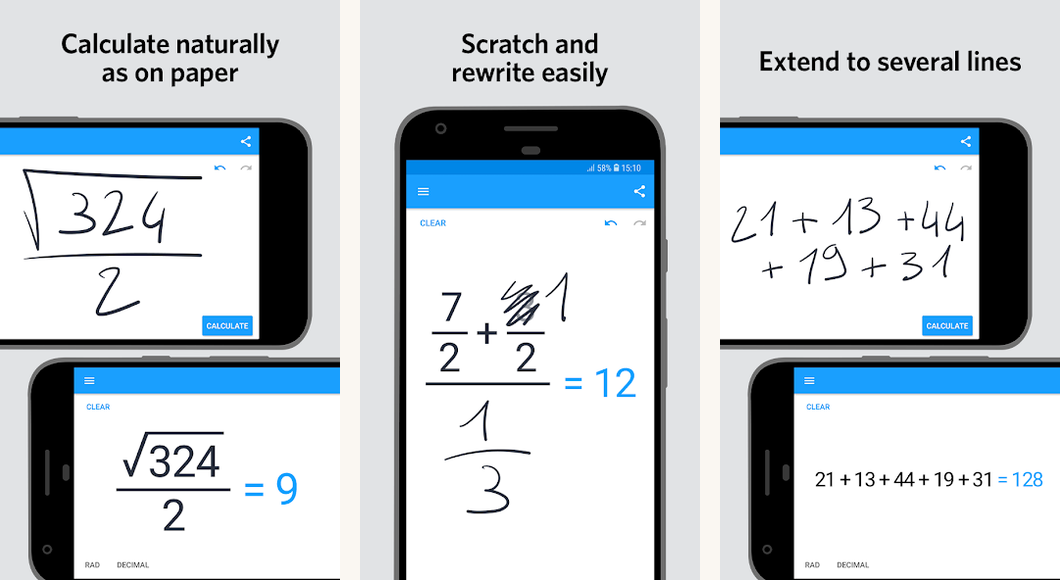
MyScript Calculator drops the key grid entirely. You write the equation with your finger or a stylus, and the app recognises the handwriting and solves it live as you go. It is the calculator that feels closest to working on paper.
The handwriting recognition is the whole point, and it is genuinely good. It is strongest on a tablet with a stylus, where you have room to write naturally. On a phone with a finger it still works, but cramped input lowers the recognition accuracy. It is free with no paid tier.
Highlights
- ⭐ Best for: stylus and tablet users who would rather write than tap.
- ⚠️ Watch out for: finger input on a small phone screen lowers recognition accuracy.
- 💰 Pricing: free, no paid tier.
Get it on the Google Play Store or the Apple App Store.
5. Maple Calculator

Maple Calculator is the free math solver from Maplesoft, the company behind the Maple computer-algebra system. It takes typed or photographed problems, returns step-by-step solutions, and draws 2D and 3D graphs of your expressions. It is a solver and a grapher in one app, backed by a serious math engine.
It handles derivatives, integrals, limits, matrix operations, and systems of equations. The free version gives you a set number of step-by-step solutions per day that refill over time; heavier use needs a subscription. For a student who wants both worked steps and graphs without juggling two apps, it is a strong pick.
It replaces Microsoft Math Solver, a popular free solver that Microsoft has since retired. Maple Calculator fills the same role, and it is actively maintained.
Highlights
- ⭐ Best for: students who want step-by-step solutions and graphs from one solver.
- ⚠️ Watch out for: the free tier caps how many step-by-step solutions you get per day.
- 💰 Pricing: free with a daily step limit, optional subscription for more.
Get it on the Google Play Store or the Apple App Store.
6. Symbolab

Symbolab is a step-by-step solver aimed squarely at algebra and calculus. Type an equation, an integral, or a derivative, and it returns the answer with the working laid out. It is built for the moment you have an answer but not the method.
It covers algebra, calculus, trigonometry, statistics, and matrices. The catch is the pricing model: the free tier shows results, but the full step-by-step working sits behind a Symbolab subscription. If you only need answers, free is fine. If you need the steps to learn, budget for the subscription or use a free-step alternative.
Highlights
- ⭐ Best for: algebra and calculus students who want detailed worked steps.
- ⚠️ Watch out for: step-by-step solutions are gated behind a paid subscription.
- 💰 Pricing: free results, subscription for the full steps.
Get it on the Google Play Store or the Apple App Store.
7. Wolfram Alpha
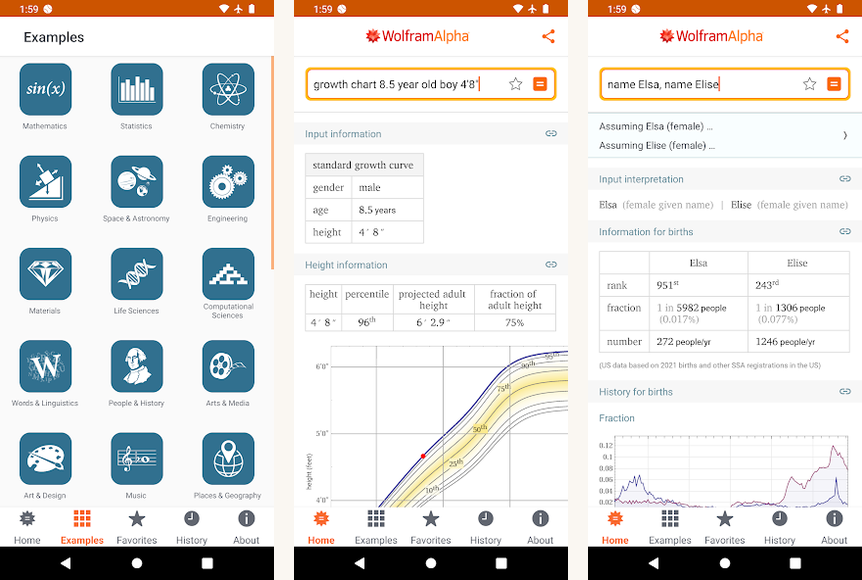
Wolfram Alpha is the universal solver. It answers math, science, and applied questions, from closed-form integrals to series expansions to unit-aware physics problems. When a regular calculator app gives up, Wolfram Alpha is usually the one that does not.
There are two Android apps. WolframAlpha Classic is a small one-time purchase with no subscription. The newer WolframAlpha app is free to install, with a Pro subscription for step-by-step solutions and extra features. The interface is dense and a little dated, but the depth is unmatched. For an engineering or upper-level science student, the one-time classic app is genuinely useful value.
Highlights
- ⭐ Best for: hard, applied problems that beat ordinary calculator apps.
- ⚠️ Watch out for: the interface is dense, and step-by-step needs the Pro tier or the paid classic app.
- 💰 Pricing: free app with a Pro subscription, or a one-time paid classic app.
Get it on the Google Play Store or the Apple App Store.
8. TechCalc Scientific Calculator
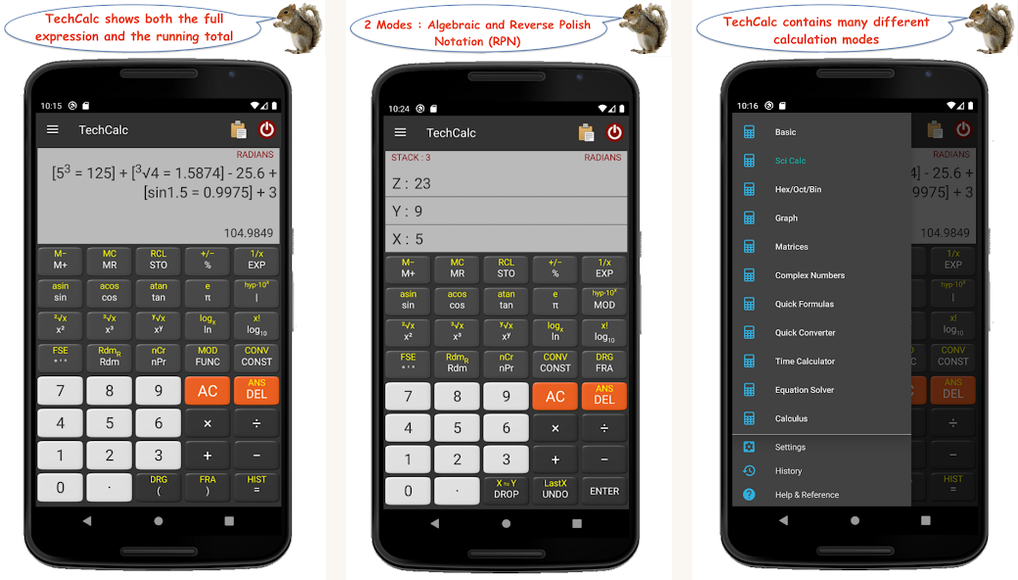
TechCalc is the calculator for people whose math goes past the standard set. It packs unit conversions, financial functions, a periodic table, equation solvers, and a long list of modes most calculator apps skip. It is the most feature-dense pick here, built for engineers more than for casual use.
That breadth is the trade-off. The interface has a lot of buttons and modes, so it is busier than RealCalc. The free version is supported by ads; a one-time purchase removes them. If you regularly need conversions and functions that RealCalc and HiPER do not include, the depth is worth the steeper learning curve.
Highlights
- ⭐ Best for: engineering students who need conversions and advanced functions in one app.
- ⚠️ Watch out for: the dense interface and ads in the free version.
- 💰 Pricing: free with ads, one-time purchase to go ad-free.
Get it on the Google Play Store. TechCalc is an Android-exclusive app, so there is no App Store version.
9. Gauth

Gauth, formerly Gauth Math, is an AI study helper rather than a calculator. It takes a photo of a problem, including word problems, and returns an explained solution. It reaches into subjects beyond math too. It is the pick for problems that need reading, not just calculating.
The free tier handles a useful number of questions, then a Premium subscription unlocks unlimited questions and more detailed explanations. As with any AI solver, treat the output as a starting point and check the reasoning. It is useful for understanding a problem, less reliable as a final answer you copy without review.
Highlights
- ⭐ Best for: word problems and questions that need an explanation, not just a number.
- ⚠️ Watch out for: AI answers can be wrong, so check the reasoning before you trust it.
- 💰 Pricing: free with limits, Premium subscription for unlimited use.
Get it on the Google Play Store or the Apple App Store.
10. Mathway

Mathway, published by Chegg, is a broad step-by-step solver. It takes a photo or a typed equation and covers a wide span of math, from basic algebra through statistics and calculus. It is the generalist of the solver tier, strong on coverage rather than any one specialty.
The pricing works like Symbolab: the free tier shows the answer, and the step-by-step working sits behind a Mathway subscription. If you have several solvers installed, Mathway earns its place when another app does not recognise your problem. As a single solver, the locked steps make it a weaker value than the free-step options.
Highlights
- ⭐ Best for: broad math coverage and a useful second opinion when another solver stalls.
- ⚠️ Watch out for: step-by-step solutions are locked behind a paid subscription.
- 💰 Pricing: free results, subscription for the full steps.
Get it on the Google Play Store or the Apple App Store.
What about graphing calculators?

A scientific calculator and a graphing calculator are not the same tool. If your class plots functions, you need a graphing app, and two free ones stand out.
Desmos is the strongest free graphing option. The Android app mirrors the widely used Desmos web tool, so if your school already uses Desmos in class, the app is the consistent companion. GeoGebra Graphing is the other strong choice, bundling graphing, algebra, geometry, and statistics in one app, with a free tier that covers most school work.
One honest caveat: if your curriculum specifies a physical TI graphing calculator for exams, an Android app is not always an accepted substitute. School and exam policies vary. Check yours before you assume an app will be allowed in the test room.
Common mistakes to avoid
| Mistake | Why it matters | Better move |
|---|---|---|
| Installing an ad-heavy free calculator | Full-screen ads between operations make the app unusable for real work | Stick to clean apps: RealCalc, or the ad-free upgrade on TechCalc |
| Assuming a free solver shows the steps | Several solvers show the answer free but lock the working behind a subscription | Check the free tier first, or pick a free-step app like Photomath |
| Using a photo solver in an exam | Schools often ban photo solvers; using one can count as cheating | Use solvers to study and check work, not during a test |
| Treating an AI answer as final | AI solvers can produce confident but wrong answers | Read the steps and verify the reasoning before you trust it |
| Expecting a scientific app to graph | Scientific calculators and graphing calculators are different tools | Install a graphing app such as Desmos when you need plots |
The verdict
Scientific calculator apps on Android are a mature category with genuinely strong free picks. You do not need to spend money to cover most school and daily math.
The verdict
Bottom line: install RealCalc for the standard scientific calculator and Photomath for photo-based problem solving. Those two, both free, handle most of what a student or a daily user needs.
Add Desmos if your class uses graphing. For engineering and upper-level science, TechCalc covers the advanced functions and Wolfram Alpha handles the genuinely hard problems, with the one-time classic app costing little. If you only want worked steps without a subscription, Maple Calculator is the free-step pick. Whatever you choose, avoid the ad-flooded free calculators; the friction is not worth it.
Tools from independent Android calculator roundups overlap heavily with this list, which is a good sign: the strong apps in this category are well known and stable. Start with the two free picks and add only what your specific coursework needs.
Questions people actually ask
- What is the best free scientific calculator app for Android?
RealCalc, for anyone who wants the standard scientific-calculator interface with no ads. For solving a problem from a photo with step-by-step working, Photomath. Most people are well covered by those two. - Is Photomath free?
The core photo-solver is free, with no ads, since Google acquired the app. Photomath Plus is a paid subscription that adds textbook solutions and animated tutorials. You do not need Plus for everyday solving. - Is using a photo math solver cheating?
It depends on how you use it. Photographing a problem to check your answer or understand the method is widely accepted as studying. Copying answers without learning is not, and many schools restrict these apps during exams. - Do calculator apps work offline?
Most scientific calculators do. RealCalc, HiPER, and TechCalc all work with no network. Photo solvers such as Photomath and Maple Calculator usually need a connection to process the image and generate the solution. - Can I use a calculator app on a school device or in an exam?
Offline calculators such as RealCalc are usually fine on a school device. Photo solvers are often restricted because they make answer-checking easy. Always check your school’s policy before installing one near exam time. - Which calculator app is best for engineering students?
TechCalc handles the unit conversions and advanced functions, and Wolfram Alpha handles the harder closed-form and applied problems. Add Desmos if your curriculum requires graphing. For broader study help, see our guide to learning Android development.
How we put this guide together
How we tested
We installed and used every app on this list on a Pixel 8a running Android 16 and a Galaxy S24 running One UI. For the photo-solver apps, we ran a set of around fifty printed and handwritten problems to gauge recognition accuracy. Pricing reflects vendor pages and Play Store listings at the time of writing, and is described as a range because app prices drift. We checked each app’s permissions and store listing, and we revisit this list when a major calculator app changes its pricing, features, or store availability. For more daily-driver picks, see our roundup of the best Android productivity apps.