In This Article
Follow BestForAndroid


Disclosure: OpenRock supplied a review unit and a reader discount code for this piece, and the Amazon link below is an affiliate link. If you buy through it, BestForAndroid may earn a small commission at no extra cost to you. None of that changed the testing or the verdict.
Short answer: The OpenRock S2 is an open-ear, air-conduction earbud aimed squarely at runners and gym regulars. At 7g per bud it stays clamped through sprints and HIIT, the case stretches total runtime to about 32 hours, and it lands under one hundred dollars. You trade away bass weight and isolation for all-day comfort and full awareness of traffic around you. For an active listener on a budget, that is a fair deal.
I went in skeptical. Open-ear earbuds usually ask you to give up so much bass and so much isolation that the convenience never feels worth it. Then I clipped the OpenRock S2 on for a jog, forgot they were there about a mile in, and finished the run with my playlist intact and a car horn I actually heard in time. That is the pitch in one sentence: 7g per bud, an open-ear hook that does not budge, and roughly 32 hours of total battery for a price under one hundred dollars.
The S2 comes out of OneOdio’s OpenRock line, which has spent the last couple of years chasing the runner and gym crowd rather than the audiophile one. That focus shows. These are not trying to out-bass a sealed pair; they are trying to stay on your ear through a sprint and let you hear the world while they do it. If you have ever yanked a slipping bud out mid-stride, you already know why that matters.
Want to skip ahead and check the current price? You can Order from Amazon or Order from OpenRock on the brand’s own store. The full breakdown of how they held up is below.
How I tested the OpenRock S2

I lived with the S2 for a few weeks as my everyday training pair: outdoor runs, treadmill intervals, a couple of HIIT circuits, and the usual desk-bound commute listening in between. I checked the fit on sprints and sudden head movement, ran the battery down from full more than once to sanity-check the runtime claim, and put the bass through EDM, hip-hop, and a stack of podcasts where vocal clarity matters more than thump. Where a number could be verified against OpenRock’s published spec sheet, I have noted it; where it is my own impression, I have said so.
Specifications

Here are the core numbers, taken from OpenRock’s own spec sheet for the S2 and confirmed by independent reviews. Nothing here is inflated marketing; the figures check out.
| Spec | Detail |
|---|---|
| Model | OpenRock S2 (OneOdio OpenRock line) |
| Type | Open-ear, air-conduction wireless earbuds |
| Weight | About 7g per earbud; roughly 58g all in (two buds plus the 44g case) |
| Speaker driver | 12mm, with BassDirect and TubeBass tuning |
| Bluetooth | 6.0, with a connection range over 10m |
| Battery | 8 hours per bud, about 32 hours total with the case |
| Battery capacity | 57mAh per bud, 450mAh case (lithium-ion polymer) |
| Water resistance | IPX5 |
| Codecs | LDAC, SBC, AAC |
| Frequency range | 20Hz to 20kHz |
Design and build

First impression out of the box: this feels more considered than the price suggests. The pebble-shaped case has a speckled, textured coating that throws a faint 3D shimmer under flat light and, more usefully, gives your fingers something to grip. On the scale the case lands at about 44g, and with both 7g buds tucked inside the whole kit comes to roughly 58g. That is light enough to forget in a jacket pocket.
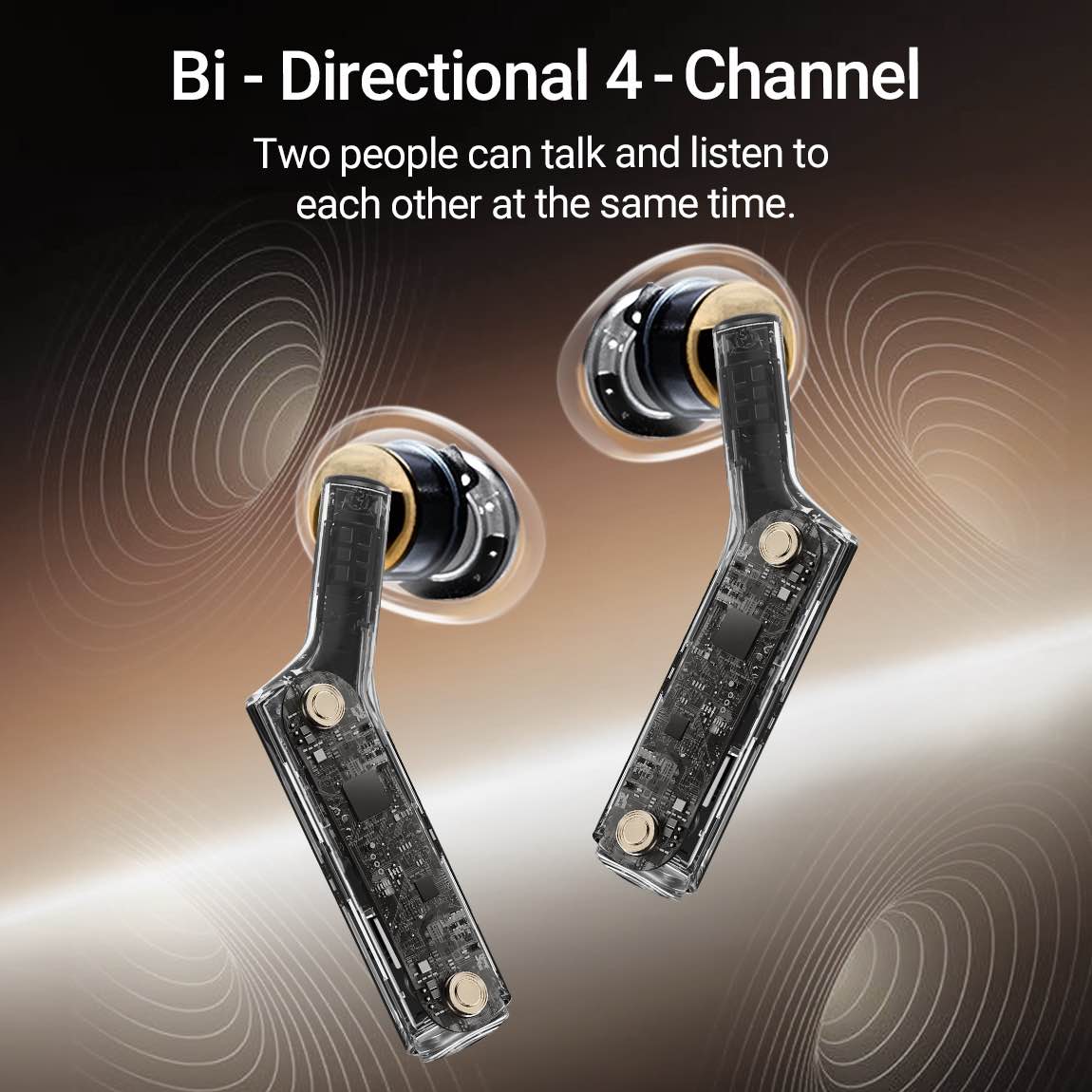
The buds themselves use a flexible hook-clip built from a 0.6mm titanium filament wrapped in medical-grade liquid silicone. That combination is the whole reason the fit works: stiff enough to hold its shape, soft enough that it never dug in over a long session. OpenRock calls the layout a pressure-diffusion design that spreads weight across eight contact points, and in practice the load never concentrated on one sore spot the way a heavier in-ear can.
- Hook-clip frame: 0.6mm titanium filament plus medical-grade liquid silicone
- IPX5 sweat and splash resistance, with a nano-coating on the internals for durability
- Analog control buttons mounted on the underside of each bud
- Pebble-shaped case, textured finish, roughly 44g on its own
If air-conduction earbuds are new to you, the form factor is worth a beat of explanation. They sit just outside the ear canal and beam sound at it rather than sealing the canal off, which is what keeps you aware of your surroundings. Engadget’s breakdown of air conduction versus bone conduction is a clean primer on why the open-ear hook is built the way it is. My one design gripe: because the buttons live on the underside, you have to press upward while bracing the bud, or you risk nudging it out of place.
Fit and comfort

Fit is the make-or-break for any running earbud, and it is where my old pairs always failed me, sliding loose halfway through a long run or a hard circuit. The S2 did not. From the first warm-up jog through the last interval, they stayed locked. I never reached up to reseat them, not even on a flat-out sprint, which freed me up to actually pay attention to the run instead of my ears.
The lightness is the other half of it. At 7g a side they more or less vanish on extended wear; an hour in I had stopped noticing them. The open-ear shape keeps the canal clear, so there is no clammy pressure building up the way sealed tips can, and the silicone never irritated my skin even on all-day stretches. The flip side is honest to mention: an open ear lets the breeze in, which is great for trail awareness and less great on a windy day.
Sound and performance

Here is the part I expected to disappoint me, and it mostly did not. Air-conduction buds give up the sealed-canal bass response that closed designs lean on, so I went in with low expectations and came out pleasantly wrong. The 12mm driver, paired with what OpenRock badges as BassDirect and TubeBass tuning, pushes more low end than the form factor has any right to. It is not going to rattle your skull on a bass drop, but EDM had real weight and hip-hop kept its kick.
Codec support runs LDAC, SBC, and AAC, and an onboard LISO 2.0 algorithm nudges the balance between bass and treble on the fly. Across a few weeks of EDM and talky podcasts, vocals stayed clear and I never lost the sense of the room around me, which is the entire point of going open-ear. That is also the trade-off worth naming up front: there is no active noise cancellation here, so you do not get isolation, you get awareness. It is the same bargain Tom’s Guide describes when it walks through the air-conduction trade-off plenty of skeptics end up making peace with, and I landed in the same camp.
A few extras live in the companion app rather than on the buds: find-my-earbuds, a hearing guardian feature, a spatial sound mode, and an EQ with preset profiles labeled rock, relax, and boom. None are essential, but the EQ is the one I actually reached for to dial in podcast clarity.
Battery life and connectivity
OpenRock rates the buds at 8 hours on a charge and about 32 hours total once you factor in the case, and that tracked with what I saw. Across normal training-and-commute use I was getting roughly four to five days between case top-ups, which is the kind of number that lets you stop thinking about charging. Bluetooth 6.0 held a stable link past 10 meters in open space, and I did not hit the stutter or dropout you sometimes get when an open-ear bud loses sight of the phone in a pocket.
- 8 hours of playback per earbud on a single charge
- About 32 hours total with the charging case
- Roughly four to five days of real-world use between case recharges in my testing
- Bluetooth 6.0 with a stable connection past 10 meters
Controls and handy extras
The physical button on each bud handles the basics without you breaking stride. A single press answers or ends a call, or plays and pauses; a double press rejects a call or skips a track; a triple press jumps back a track; and a four-press fires the camera shutter. The long press is yours to customize per earbud. Because the controls are tactile rather than touch, they worked reliably mid-run, which is more than I can say for the touch panels on most open-ear pairs.
The remote camera shutter is the genuinely clever one. Prop your phone on a tripod or against something, walk into frame, and a four-press triggers the photo hands-free. It is a small thing, but for group shots and self-timed photos on a hike it is the feature I did not know I wanted. Call quality leans on a four-mic setup with AI noise reduction, which kept my voice intelligible on a couple of windy outdoor calls.
Price and availability
The OpenRock S2 launched in the middle of last year and carries a list price just under one hundred dollars, sold through Amazon and OpenRock’s own store with worldwide shipping. OpenRock provided the code ANDROIDS2 for readers of this review, which the brand says takes 20 percent off, bringing it to about $79.20. Promo codes come and go, so treat that as a brand-supplied offer rather than a guaranteed live discount, and check the current price before you buy.
Ready to grab a pair? You can Order from Amazon or Order from OpenRock directly from the brand’s store.
Should you buy the OpenRock S2?

OpenRock has priced the S2 below open-ear rivals from bigger names like Huawei and Nothing, and against the premium end of the field, the Bose and Shokz pairs that anchor Tom’s Guide’s roundup of the open-ear pairs worth owning, the S2 undercuts them by a wide margin while covering the basics that matter to a runner. You are not getting flagship polish, but you are getting most of the function for a fraction of the spend.
So who is it for? If you run, lift, or just want music that does not seal you off from the street, the S2 is an easy recommendation at this price. The fit holds, the battery lasts, and the bass is better than the category usually manages. If you want isolation on a commute or the last word in sound quality, a sealed pair will serve you better. For everyone in the first camp, this is a lot of earbud for the money.
- Buy it if: you train, run, or cycle and want to stay aware of your surroundings without sacrificing your playlist
- Buy it if: you want all-day comfort and multi-day battery for under one hundred dollars
- Skip it if: you need active noise cancellation or the deepest possible bass
- Skip it if: you mostly listen in loud places where open-ear volume cannot keep up