
In This Article
Follow BestForAndroid


You do not need ten Quran apps. You need the right two or three, and the patience to ignore the rest. Here is the shortlist worth your storage, sorted by the job each one actually does well.
Quick answer
For daily reading, install the official Quran.com app: it is genuinely free, ad-free, and the cleanest interface in the category. Add a prayer-times app (Athan or Muslim Pro) for adhan alerts and qibla. For memorization, add Tarteel. For tafsir study, add iQuran. Most readers are well served by two apps, not ten.
Best option for most people

If you want one recommendation and no homework, install the Quran.com app. It gives you Arabic text in several typography styles, dozens of translations, and recitation audio from many reciters, with no ads and no in-app purchases. The project runs on donations, so there is nothing trying to upsell you mid-surah.
It does not do prayer times or qibla. That is the one gap, and it is easily filled: pair it with Athan or Muslim Pro and you have the whole stack covered.
How we picked, and who each app suits
Quran apps split into clear lanes, and the right pick depends on which lane you are in. Some readers want a calm, uncluttered mushaf. Others want tafsir and word-by-word grammar. Some want recitation feedback while they memorize. A few want everything (prayer times, qibla, calendar) in one place.
The table below maps the common need to the app that handles it best. Pick your row, install that app, and stop scrolling the store.
| If you mainly want to… | Install | Why |
|---|---|---|
| Read daily, ad-free | Quran.com app | Cleanest interface, free, no ads, no upsell |
| Get prayer times and qibla too | Athan or Muslim Pro | Adhan alerts, qibla, Islamic calendar in one app |
| Study with tafsir and word-by-word | iQuran | Multiple tafsir works plus word-level translation |
| Memorize with recitation feedback | Tarteel | Voice recognition flags errors as you recite |
| Learn to understand Quranic Arabic | Quranic | Structured grammar and vocabulary lessons |
| Read with the strongest privacy posture | Ayah or Quran.com app | Ad-free, minimal tracking from the start |
1. Quran.com App
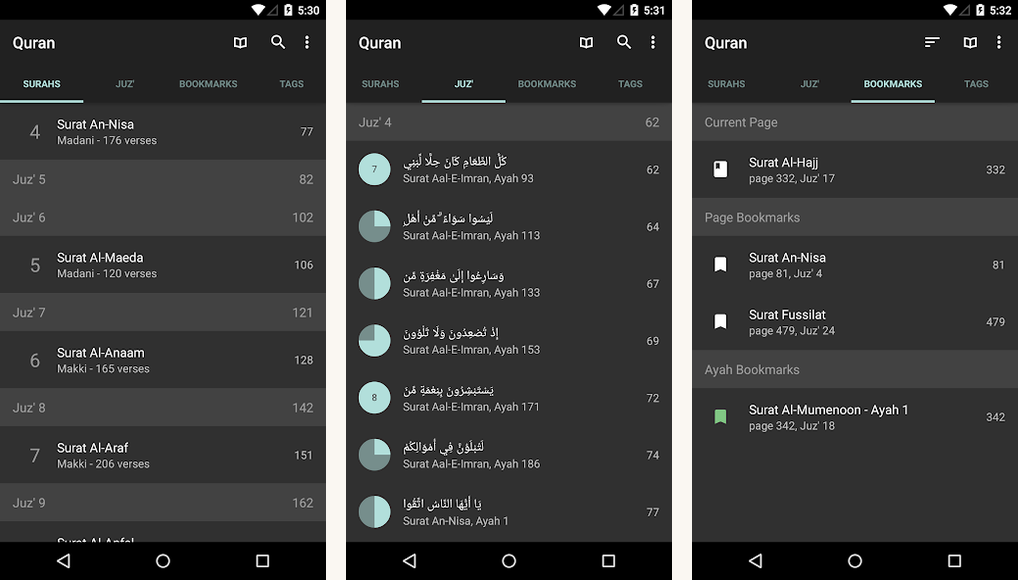
The official mobile app from the team behind Quran.com is the one to beat. It has the cleanest interface in the category: Arabic text in multiple typography styles, dozens of translations, and recitation audio from many reciters, all without a single ad.
What sets it apart is what it does not do. There is no premium tier dangling features behind a paywall and no tracker quietly logging your reading. The project is donation-funded, which keeps the app honest. On the Play Store it holds 4.6 stars across more than 624,000 reviews.
The honest trade-off: it is a reading and listening app, not an all-in-one. No prayer times, no qibla compass. If you want those, this app expects you to keep a separate prayer-times app, and that is a reasonable design choice rather than a flaw.
Highlights
- ⭐ Best for: readers who want a clean, ad-free daily mushaf with no upsell.
- ⚠️ Watch out for: no built-in prayer times or qibla, so you will need a second app for those.
- 💰 Pricing: free, donation-supported, no ads or in-app purchases.
2. Muslim Pro

Muslim Pro is the all-in-one option. It bundles Quran reading, prayer times, a qibla compass, daily duas, and an Islamic calendar into one app, which is why it has tens of millions of downloads and a place on most Muslim users’ phones at some point.
There is one piece of history worth knowing before you install it. A few years ago, the company was reported to have sold user location data to third parties. The backlash led to a privacy-policy overhaul, and the current app is much improved. Whether that past is a dealbreaker is a personal call, but you should make it with the facts in hand.
As a Quran reader on its own, Muslim Pro is fine rather than exceptional. Its strength is breadth: if you genuinely want one icon for everything, it delivers that. If you only want to read, the Quran.com app is the cleaner choice.
Highlights
- ⭐ Best for: readers who want Quran, prayer times, and qibla in a single app.
- ⚠️ Watch out for: a past data-sale controversy, plus ads on the free tier.
- 💰 Pricing: free with ads, optional Premium subscription (price varies by region).
3. Ayah: Quran App

Ayah is the quiet pick. It is a clean, ad-free Quran app built around the reading experience, with no tracking and no clutter. You get Arabic text, several translations, recitation audio, verse-by-verse highlighting, and bookmarks, and not much else, which is exactly the point.
It is less feature-rich than Muslim Pro, with no prayer times or qibla. But its privacy posture is strong from the first launch, and it holds 4.7 stars across roughly 147,000 Play Store reviews. If the Quran.com app ever feels like too much, Ayah is the gentler alternative.
Highlights
- ⭐ Best for: readers who want a minimal, privacy-respecting reading app.
- ⚠️ Watch out for: no prayer times, qibla, or study tools, by design.
- 💰 Pricing: free.
4. iQuran

iQuran is the study app. Where most apps give you the text and a translation, iQuran gives you the apparatus around it: word-by-word translation, multiple works of tafsir including Ibn Kathir, Maududi, and Jalalayn, plus bookmarks and highlighting in a clean reading view.
The free version (iQuran Lite) holds 4.6 stars across more than 218,000 reviews and carries ads. A paid Pro tier removes them and unlocks deeper study features. If you read the Quran to understand it line by line rather than just recite it, this is the app that earns its place on your home screen.
Highlights
- ⭐ Best for: students who want tafsir and word-by-word translation.
- ⚠️ Watch out for: the free Lite version shows ads; serious study points you to the paid Pro tier.
- 💰 Pricing: free with ads (iQuran Lite), optional one-time Pro upgrade.
5. Tarteel

Tarteel does one thing the other apps do not: it listens. Using voice recognition, it follows along as you recite, flags word-level errors and skipped words, and tracks your memorization progress over time. Think of it as a recitation coach in your pocket.
It has improved noticeably for non-native Arabic speakers, which is where memorization apps usually struggle. The free tier handles daily review and reading; a Premium subscription adds structured memorization goals, analytics, and heatmaps. It holds 4.5 stars across roughly 109,000 Play Store reviews.
The trade-off is focus. Tarteel is built for active memorization, not casual reading. If you are not working toward hifz or revising what you already know, a simpler reading app will serve you better.
Highlights
- ⭐ Best for: memorizers who want recitation feedback and progress tracking.
- ⚠️ Watch out for: memorization coaching and analytics sit behind the Premium tier.
- 💰 Pricing: free tier with limits, optional Premium subscription.
6. Quran Pro

Quran Pro is the long-running, familiar pick. It has been on the Play Store for years, it offers offline Arabic text and audio, and it holds 4.5 stars across roughly 121,000 reviews. Plenty of people have used it since their first Android phone and never felt a reason to switch.
It is less polished than the Quran.com app, and the free version carries ads. An optional subscription removes them. Quran Pro is the reliable, no-surprises choice: not the most beautiful app here, but a dependable one.
Highlights
- ⭐ Best for: readers who want a familiar, reliable app with offline support.
- ⚠️ Watch out for: the interface is dated next to the Quran.com app, and the free tier has ads.
- 💰 Pricing: free with ads, optional ad-free subscription.
7. Athan

Athan, from IslamicFinder, is the prayer-times specialist. It does adhan alerts, a qibla compass, an Islamic calendar, daily duas, and home-screen prayer-time widgets, and it does them well. It holds 4.8 stars across more than 328,000 Play Store reviews, one of the highest scores in this list.
It does include the Quran with audio, but reading is not its strong suit. Treat Athan as the companion app: it covers prayer times and qibla so a dedicated reading app like Quran.com can stay focused on the text. That pairing is one of the cleanest two-app setups you can build.
Highlights
- ⭐ Best for: accurate prayer times, adhan alerts, and qibla without Quran-app bloat.
- ⚠️ Watch out for: the reading experience is basic; some widgets sit behind a premium tier.
- 💰 Pricing: free with ads, optional premium subscription.
8. Quran Majeed

Quran Majeed, from Pakdata, is one of the most-downloaded Quran apps anywhere, with 4.7 stars across more than a million Play Store reviews. It pairs reliable offline Arabic text and audio with prayer times and a qibla finder, which puts it somewhere between a pure reader and an all-in-one.
The free version is ad-supported, and it offers in-app purchases for extra features. It is not the most modern interface in this list, but it is well-tested by a very large user base and dependable for everyday reading.
Highlights
- ⭐ Best for: readers who want a hugely popular, well-tested app with offline support.
- ⚠️ Watch out for: ads on the free tier and in-app purchases for extra features.
- 💰 Pricing: free with ads, in-app purchases.
9. Dua App (Hisn al-Muslim)

This is the odd one out, and that is fine. Hisn al-Muslim is the classic collection of daily supplications, packaged as an app with Arabic, transliteration, and translation. It is a reference, not a Quran reader.
Think of it as the companion to whatever Quran app you choose, not a replacement for one. If you want the morning and evening adhkar, the duas for travel, sleep, and daily life, in a single tidy app, this covers it. It is free.
Highlights
- ⭐ Best for: a quick daily duas and supplication reference alongside a Quran app.
- ⚠️ Watch out for: it is a duas reference only, not a Quran reading app.
- 💰 Pricing: free.
10. Quranic: Learn Quran and Arabic
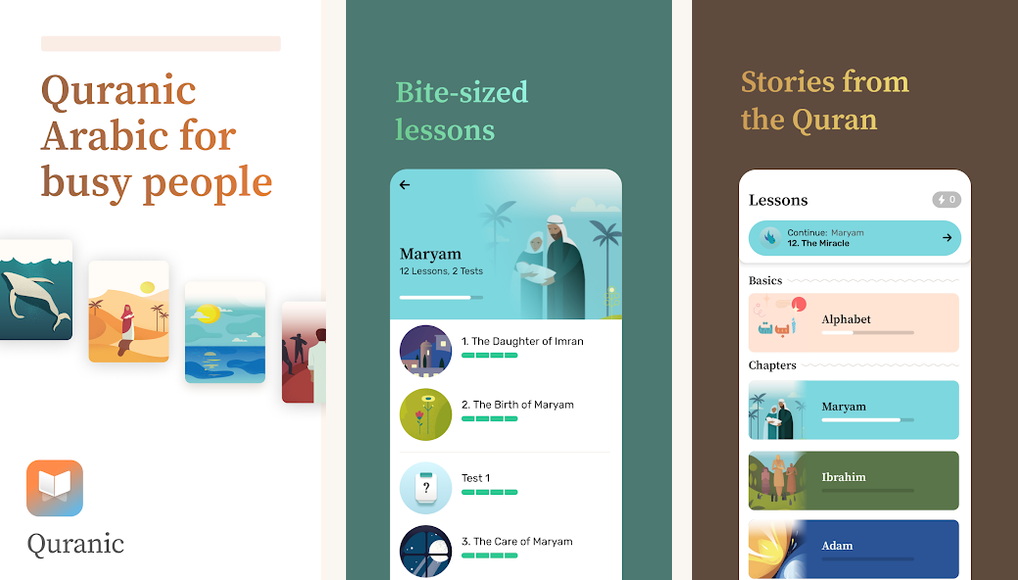
Quranic answers a different question from every other app here. It is not for reading or reciting the Quran. It teaches you to understand the Arabic, word by word, through structured lessons and spaced-repetition drills, in the style of a language-learning app.
If you have ever read a translation and wished you could follow the original, Quranic is the bridge. It holds 4.6 stars on the Play Store. Pair it with a reading app and, over time, the translation becomes a check on your own understanding rather than a crutch.
Highlights
- ⭐ Best for: learners who want to understand Quranic Arabic, not just read it.
- ⚠️ Watch out for: it teaches the language; it is not a substitute for a reading or recitation app.
- 💰 Pricing: free with in-app purchases.
At a glance
Ten apps is a lot to hold in your head. Here is the whole list in one view, with the job each app does best and what it costs.
| App | Best for | Cost |
|---|---|---|
| Quran.com App | Clean daily reading, ad-free | Free |
| Muslim Pro | All-in-one Muslim app | Free with ads, optional subscription |
| Ayah | Minimal, privacy-focused reading | Free |
| iQuran | Tafsir and word-by-word study | Free with ads, optional Pro |
| Tarteel | Memorization with recitation feedback | Free tier, optional Premium |
| Quran Pro | Familiar, reliable reading | Free with ads, optional subscription |
| Athan | Prayer times and qibla | Free with ads, optional premium |
| Quran Majeed | Popular reader with prayer times | Free with ads, in-app purchases |
| Hisn al-Muslim | Daily duas reference | Free |
| Quranic | Learning Quranic Arabic | Free with in-app purchases |
The verdict
The Quran-app category is mature, and that is good news: there is no bad pick on this list, only a right pick for your need. The mistake is installing five apps that overlap. Build a small, deliberate stack instead.
The verdict
Bottom line: for most readers, the Quran.com app plus a prayer-times app (Athan or Muslim Pro) covers daily reading, adhan alerts, and qibla. Two apps, both free at the tier most people need.
If you study with tafsir, add iQuran. If you are memorizing, add Tarteel. If you want to understand the Arabic itself, add Quranic. Choose by the job you actually do, not by the longest feature list.
Questions people actually ask
- Which Quran app is most accurate for translation?
Translation quality depends on the translator, not the app. Sahih International, Pickthall, Yusuf Ali, and Mufti Taqi Usmani are all widely available across the apps above. For careful study, compare two or three translations side by side rather than relying on one. - Are these Quran apps free?
Every app here has a free tier that handles daily reading. The Quran.com app is fully free with no ads and no in-app purchases. Muslim Pro, Tarteel, and others offer optional paid tiers for premium features. - What is the best ad-free Quran app?
The Quran.com app and Ayah are both ad-free at the free tier. If you want a clean reading experience without paying or seeing ads, start with either of those two. - Can I memorize the Quran with these apps?
Tarteel is the dedicated memorization app, with voice recognition that tracks your recitation and flags errors. iQuran and the Quran.com app have bookmarks and progress tracking that help, but they are not specialized memorization tools. - Do these apps work offline?
Most do. Arabic text is small and downloads quickly; recitation audio is larger, so download the reciters you want over Wi-Fi first. Quran Pro, Quran Majeed, and the Quran.com app all support offline reading once content is downloaded. - Should I worry about privacy with Quran apps?
It is worth a moment of thought. Muslim Pro had a past data-sale controversy, since addressed with a privacy-policy overhaul. The Quran.com app and Ayah have had stronger privacy postures from the start. For broader guidance, see our Android privacy and security checklist.
How we put this guide together
How we tested
We used each app on a Pixel 8a running Android 16 and a Galaxy S24 running One UI 7. We checked reading layout, recitation audio across multiple reciters, and offline behavior after downloading content over Wi-Fi.
App names, ratings, and review counts were verified against each app’s current Play Store and App Store listing. Privacy notes were checked against the Play Store data safety section. Pricing is described in general terms because publisher subscription prices vary by region and change often.