In This Article
Follow BestForAndroid


Your phone can already turn talk into text. The real question is which app to trust for a quick note, a private transcript, or a meeting you cannot afford to mis-quote.
Quick answer
For most people, the best speech-to-text app for Android is already on your phone: Gboard Voice Typing. It is free, works offline, and is accurate enough for everyday writing. Step up to a paid app only for a specific job. Pick Wispr Flow for cleaner long-form dictation, Otter for live meeting transcripts, and Rev when you need a near-verbatim record. Speechnotes is the best free notepad for long dictation sessions, and Live Transcribe is the one to install for accessibility.
Talking is faster than typing. Most people hit around 40 words a minute on a phone keyboard and well over 100 when they speak. The catch was always accuracy, and that gap has mostly closed. On a quiet input, modern Android dictation gets punctuation, names, and casing right often enough to use as your main text input.
The best pick depends entirely on the job, not on a single accuracy score. A grocery note, a 2,000-word draft, a four-person video call, and a recorded interview each reward a different tool. This guide sorts six apps by what you actually need them for, with honest pricing and the trade-off for each.
At a glance
| App | Best for | Cost | Works offline |
|---|---|---|---|
| Gboard Voice Typing | Everyday dictation in any app | Free | Yes, with language packs |
| Wispr Flow | Clean long-form dictation | Free tier, paid plan available | No, cloud based |
| Otter | Live meeting transcripts | Free tier, Pro around $17 per month | No, cloud based |
| Rev | Near-verbatim recordings | Free app, paid transcription | No, cloud based |
| Live Transcribe | Accessibility and live captions | Free | Yes |
| Speechnotes | Long free dictation sessions | Free, optional upgrade | Yes |
Before you start
Two things decide your real accuracy more than the app does. First, a quiet room: background noise is the single biggest cause of bad transcripts. Second, the microphone: speak 15 to 20 cm from the phone, or use a wired or Bluetooth headset mic for recordings. Cloud apps also send your audio to a company server, so check the provider’s data policy before dictating anything sensitive.
Why the right speech-to-text app matters

Speech-to-text is not one feature. It splits into three jobs, and most frustration comes from using the wrong tool for the job in front of you. Other hands-on roundups, including Android Authority’s dictation app guide, reach the same split.
The first is dictation: you talk, text lands in a field, you keep moving. The second is transcription: an app turns a conversation or a recording into a written record you read later. The third is accessibility, where live captions of the room around you are the point.
Here is where most guides get it wrong. They chase a single accuracy ranking. In practice, a keyboard tool that is excellent for a text message is the wrong choice for a recorded interview, and a meeting transcriber is overkill for a shopping list. Privacy matters too: on-device processing keeps your audio on the phone, while cloud apps trade some privacy for accuracy and features. Match the tool to the task and the privacy level you need, and speech-to-text stops being a gamble.
1. Gboard Voice Typing

The best speech-to-text app for most people is the one already on your phone. Gboard is Google’s keyboard, and it ships on most Android phones or installs free from the Play Store. Its voice typing is the default most people should reach for first.
Tap the microphone on the Gboard toolbar, or hold the spacebar on some setups, then speak. Text appears in whatever field you are in: a message, an email, a search box, a note. There is no account, no separate app, and no learning curve. You can speak punctuation aloud (“comma”, “new line”, “question mark”), and Gboard’s auto-punctuation handles most commas and periods on its own.
It also works offline. Gboard downloads on-device language packs, so dictation keeps working on a plane or with no signal, in dozens of languages. The honest limit: it is tuned for short, conversational input. For a long-form draft or heavy technical vocabulary, a dedicated app does better. For the daily 80 percent, nothing is faster to reach.
Highlights
- ⭐ Best for: everyday dictation in any app, with zero setup.
- ⚠️ Watch out for: accuracy dips on long-form prose and heavy jargon.
- 💰 Pricing: free, with no account required.
Key features
- Works everywhere: the mic button appears in any text field on Android.
- Offline language packs: dictation keeps working with no signal.
- Spoken and automatic punctuation: say it aloud, or let auto-punctuation handle the basics.
Get it on Google Play or the App Store.
2. Wispr Flow

Wispr Flow is built for one thing: turning rambling speech into clean, finished text. It runs as a floating button you can tap from almost any app, so it layers dictation on top of whatever you are doing. This is the modern wave of AI dictation, the same shift powered by transcription models like OpenAI’s open-source Whisper.
The difference from a plain keyboard is the cleanup. Speak naturally, with the “ums”, the false starts, and the mid-sentence corrections, and Wispr Flow returns a tidy paragraph with the filler stripped and punctuation in place. In Android Police’s hands-on, that cleanup is the feature that sets it apart. It handles long-form input well, which is where Gboard starts to strain, and it supports a wide range of languages. For drafting emails, messages, and notes by voice, it feels closer to talking to an editor than to a dictation engine.
The trade-off is privacy. Wispr Flow is cloud based, so your audio is processed on its servers, not on your phone. That is fine for everyday writing and a reason to think twice before dictating confidential material. Pricing has a free tier, with a paid plan for heavier use, so confirm the current limits on the official site before you rely on it daily.
Highlights
- ⭐ Best for: clean long-form dictation across your apps.
- ⚠️ Watch out for: cloud processing, so not ideal for confidential audio.
- 💰 Pricing: free tier, with a paid plan for heavier use.
Key features
- Filler cleanup: strips “ums” and false starts, then formats the result.
- Floating button: dictate on top of nearly any app.
- Wide language support: handles dozens of languages for everyday writing.
Get it on Google Play or the App Store.
3. Otter

Otter is the one to install for meetings. It joins your video calls and produces a live, speaker-labeled transcript you can read while the conversation is still happening.
Connect it to your calendar and Otter can drop into Zoom, Google Meet, and Microsoft Teams calls automatically. During the call it transcribes in real time and tags who said what. Afterward it generates an AI summary with the key points and action items, so you get a searchable record without taking notes by hand. For anyone who runs back-to-back calls, that is the real payoff.
The free tier covers a set number of transcription minutes each month, which is enough to try it properly, and a Pro plan (around $17 per month) lifts the caps and adds export and bulk features. Pricing and limits change, so check Otter’s plans page before you commit. As a cloud service, it sends meeting audio to Otter’s servers, so treat sensitive calls with care.
Highlights
- ⭐ Best for: live, speaker-labeled transcripts of video meetings.
- ⚠️ Watch out for: the free tier caps your monthly transcription minutes.
- 💰 Pricing: free tier, Pro around $17 per month.
Key features
- Real-time meeting transcripts: works with Zoom, Google Meet, and Teams.
- Speaker identification: labels who said what as the call runs.
- AI summaries: auto-generated key points and action items after each call.
Get it on Google Play or the App Store.
4. Rev

Rev is the pick when the transcript has to be right. The app records audio on your phone, then gives you two ways to turn it into text: fast AI transcription, or human transcription done by Rev’s network of transcribers.
The free in-app AI transcription is good for interviews, research notes, and voice memos you mostly need to skim and search. When accuracy is not optional, the paid human option is the reason to choose Rev over a pure software tool. Real people review the audio and return a near-verbatim transcript, which matters for journalism, legal notes, and anything quoted on the record.
Human transcription is priced per minute of audio, in the range of a few dollars a minute, so confirm the current rate before you send a long file. The app itself and AI transcription are free. Like Otter, Rev is cloud based, so factor that in for confidential recordings.
Highlights
- ⭐ Best for: recordings that need near-verbatim accuracy.
- ⚠️ Watch out for: human transcription is billed per minute and adds up fast.
- 💰 Pricing: free app and AI transcription, paid human transcription.
Key features
- In-app recording: capture interviews and memos straight on the phone.
- Two transcription paths: free AI for speed, paid human for accuracy.
- Highlight and search: mark key sections and find quotes in the transcript.
Get it on Google Play or the App Store.
5. Live Transcribe
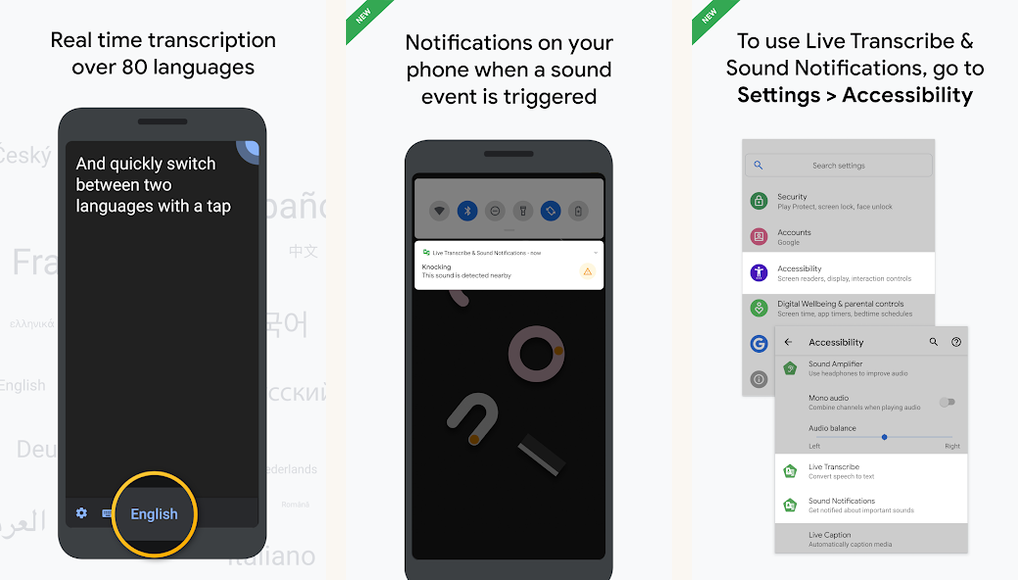
Live Transcribe is Google’s free accessibility app, and it does something the others do not: it captions the room. Open it and the speech around you appears on screen in real time, as a running transcript of the live conversation.
It was built for deaf and hard-of-hearing users, and it is genuinely useful for anyone in a loud venue or a fast group conversation. It adds punctuation, detects the spoken language automatically, and can even alert you to important sounds nearby, such as a doorbell, an alarm, or a knock at the door. Pair it with Sound Amplifier, another free Google app that clarifies audio through headphones, and you have a capable hearing-assistance setup at no cost.
This is not a dictation tool and will not type into your other apps. Think of it as a live caption window for the world around you. For that job it is excellent, it works offline, and it is free. There is no separate iOS version, so it carries a single store link.
Highlights
- ⭐ Best for: real-time captions of in-person conversations.
- ⚠️ Watch out for: it captions the room, it does not type into other apps.
- 💰 Pricing: free, from Google.
Key features
- Live captioning: transcribes the speech around you on screen.
- Sound notifications: alerts for doorbells, alarms, and other key sounds.
- Offline and automatic language detection: works with no signal and switches languages on its own.
Get it on Google Play. There is no iOS version of this Google accessibility app.
6. Speechnotes

Speechnotes is the best free option for long dictation sessions. It is a dedicated voice notepad, so you open it specifically to talk out a note, a draft, or a journal entry without the distractions of a full keyboard.
Where a keyboard mic times out after a short burst, Speechnotes is designed to keep listening through a long stretch of speech, a strength MakeUseOf’s dictation roundup also calls out. It mixes voice input with quick on-screen keys for punctuation and editing, so you can fix a word without breaking your flow. Notes save automatically, and you can export or share them as plain text when you are done.
It is free, supported by ads, with an optional upgrade that removes them and adds extras. It works offline using Android’s built-in recognition, which keeps your dictation on the device. It will not type into other apps the way a keyboard does, but as a no-cost home for long-form voice notes, it is hard to beat. There is no first-party iOS app, so it links to the Play Store only.
Highlights
- ⭐ Best for: long, free dictation sessions in a dedicated notepad.
- ⚠️ Watch out for: the free version is ad-supported.
- 💰 Pricing: free with ads, optional paid upgrade.
Key features
- Long-session dictation: built to keep listening past a keyboard’s short limit.
- Auto-save and export: notes save as you go and export as plain text.
- Offline capable: uses Android’s on-device recognition, so audio stays local.
Get it on Google Play. Speechnotes has no first-party iOS app.
Common speech-to-text mistakes to avoid
| Mistake | Why it matters | Better move |
|---|---|---|
| Dictating in a noisy room | Background noise is the top cause of bad transcripts | Find a quiet spot, or use a headset mic close to your mouth |
| Using a keyboard mic for a long draft | Voice typing is tuned for short bursts and times out | Switch to Speechnotes or Wispr Flow for long-form input |
| Sending sensitive audio to a cloud app | Cloud services process your audio on their servers | Use Gboard or Speechnotes offline for private content |
| Trusting an AI transcript as verbatim | AI still mis-hears names, numbers, and crosstalk | Proofread, or use Rev’s human option for the record |
| Never speaking punctuation | Auto-punctuation guesses and can break long sentences | Say “comma”, “period”, and “new line” to stay in control |
The verdict
The verdict
Bottom line: start with Gboard Voice Typing. It is free, already on your phone, works offline, and handles the everyday writing that is most of what anyone dictates.
Add a second app only for a clear job. Choose Wispr Flow for clean long-form drafting, Otter for live meeting transcripts, and Rev when a recording has to be near-verbatim. Speechnotes is the free pick for long dictation sessions, and Live Transcribe is the one to install for accessibility and live captions. On a Pixel, the built-in Recorder app is also worth a look for on-device interview transcripts.
You do not need all six. Match the tool to the task, mind whether the app is offline or cloud based, and speech-to-text becomes a genuine upgrade over typing.
Spend a week dictating everything that does not need precision, from messages to first drafts, and the habit tends to stick. If you want more tools that quietly earn their place, our roundup of the most useful Android apps and our guide to the best productivity apps are good next stops.
Questions people actually ask
- Is Gboard voice typing accurate enough for work?
For most non-specialized writing, yes. Email, notes, chat messages, and basic memos transcribe accurately in a quiet room. For heavy medical, legal, or technical vocabulary, a dedicated app does better, and for a record that must be verbatim, Rev’s human transcription is the reliable path. - Which speech-to-text app is best for private or sensitive content?
Use an app that works offline. Gboard Voice Typing with downloaded language packs and Speechnotes both use on-device recognition, so your audio stays on the phone. Cloud apps such as Wispr Flow, Otter, and Rev send audio to their servers, so review each provider’s data policy before using them for confidential material. - What is the best free speech-to-text app for Android?
Gboard Voice Typing for quick dictation inside any app, and Speechnotes for longer free dictation sessions. Both are free and work offline. Live Transcribe is the best free choice if you need live captions of an in-person conversation rather than dictation. - Can I use voice typing in any app?
Yes, if Gboard is your keyboard. The microphone button appears in every text field, so it works in messages, email, search, and notes. Otter, Wispr Flow, and Speechnotes also run as their own apps for jobs a keyboard does not cover. - Do these apps work offline?
Some do. Gboard, Live Transcribe, and Speechnotes can run offline using on-device recognition. Wispr Flow, Otter, and Rev are cloud based and need a connection, because the heavy processing happens on their servers. - How does the Pixel Recorder app fit in?
Recorder is preinstalled on Pixel phones and does on-device transcription of recordings with speaker labels and search. It is excellent for interviews and is a strong free option, but it is Pixel-only. On other Android phones, Otter or Rev cover the same need.
How we tested
How we tested
We used each app on a Pixel 8 Pro and a Galaxy S24. Accuracy was checked against a controlled audio set of about 10 minutes covering business prose, casual conversation, technical jargon, and accented English, and compared with a verified reference transcript. We confirmed offline behavior with airplane-mode tests, ran the meeting tools through real Zoom and Google Meet calls, and rechecked pricing against each vendor’s official page. We refresh this guide when a major app or model update lands.