
In This Article
Follow BestForAndroid


Slow Wi-Fi is rarely the phone’s fault. The right analyzer app will not boost your signal, but it will show you the exact wall, channel, or dead corner that is the real problem.
Quick answer
No Android app increases Wi-Fi signal strength. “Signal optimizer” and “booster” apps measure, visualize, and diagnose, nothing more. For most homes, three free apps cover the job: WiFiAnalyzer for channel conflicts, NetSpot for a dead-zone heatmap, and Speedtest by Ookla for raw bandwidth. The real fix is always hardware: router placement, a channel change, or a mesh node.
Here is the uncomfortable part. The word “optimization” in app store listings is marketing. Wi-Fi signal is decided by your router’s transmit power, your home’s walls, and the distance between the two. An app cannot change physics. What a good analyzer app does is hand you information: which channels your neighbors have crowded, which room runs weak, whether your phone sat on 2.4 GHz when 5 GHz was free.
That information is what makes the fix obvious. We tested ten Android apps that do this honestly, from a one-tap speed check to a survey-grade heatmap tool. If your Wi-Fi keeps dropping in one part of the house, one of these will tell you why.
Best pick for most people

WiFiAnalyzer by VREM is the one app to install first. It is open source, genuinely free, and it answers the single most common Wi-Fi question: which channel should my router use. If you suspect dead zones rather than channel conflict, pair it with NetSpot and its floor-plan heatmap. Most people never need a third app.
At a glance
| App | Type | Pricing | Best for |
|---|---|---|---|
| WiFiAnalyzer (VREM) | Channel scanner | Free, open source | Quick channel-conflict diagnosis |
| NetSpot | Survey and heatmap | Free tier, paid Home upgrade | Mapping dead zones room by room |
| Speedtest by Ookla | Bandwidth test | Free, optional Premium | Measuring ISP throughput |
| WiFiman by Ubiquiti | All-in-one tools | Free | UniFi gear owners |
| Fing | Device inventory | Free tier, paid Premium | Spotting unknown devices on Wi-Fi |
| analiti | Survey-grade tester | Free tier, paid upgrade | Detailed per-band RF metrics |
| Network Analyzer | LAN and Wi-Fi toolbox | Free tier, paid Pro | Discovery plus ping and port scan |
| PingTools | Diagnostic toolbox | Free with ads, ad-free unlock | Telling Wi-Fi faults from ISP faults |
| Network Cell Info Lite | Cellular signal | Free | Diagnosing mobile dead spots |
| WiFi Analyzer (pzolee) | Signal meter | Free | Live router-throughput readout |
Before you start
Android needs Location permission switched on for any app to scan nearby Wi-Fi networks. That is an OS rule, not the app spying on you. Grant it while scanning, and your channel and signal lists will simply appear empty if you forget.
What a Wi-Fi analyzer app can and cannot do

This is where most “best Wi-Fi booster” lists get it wrong. An app on your phone cannot add power to your router or punch a signal through a concrete wall. The radio hardware and the building decide your signal. Software only reads it.
What an analyzer app can do is real and useful. It tells you the channel every nearby network is using, so you can move your router off a crowded one. It logs signal strength as you walk, so a weak corner stops being a guess. It separates “the Wi-Fi is weak here” from “my whole internet plan is slow,” which are two different problems with two different fixes. Treat these apps as a diagnosis, then fix the hardware.
1. WiFiAnalyzer (open source)

WiFiAnalyzer by VREM Software Development, the one explicitly labeled open source, is the most polished free Wi-Fi scanner on Android. It charts every nearby network by channel, graphs signal strength over time, and flags the least crowded channel for your router. The layout is dense, but a minute with it and the channel graph becomes the clearest picture of your airspace you can get without paid hardware.
It is open source under GPL v3 and ships on F-Droid as well as the Play Store. The F-Droid build carries no ads at all; the Play Store build shows a small banner. The features are identical either way. The limit is scope: it reads your phone’s current spot, not a survey of the whole house.
Highlights
- ⭐ Best for: finding and fixing a crowded Wi-Fi channel fast.
- ⚠️ Watch out for: a dense interface, and no whole-home survey mode.
- 💰 Pricing: free and open source, ad-free on F-Droid.
Get it on Google Play. There is no first-party iOS version; it is an Android-only project.
2. NetSpot

NetSpot is the strongest survey-grade analyzer on Android. The free tier handles discovery and signal logging. The paid Home upgrade unlocks the heatmap survey: you load a floor plan, tap your position as you walk each room, and the app paints a color map of where the signal is strong and where it dies.
That heatmap is the fastest way to settle a dead-zone argument. Walk the perimeter and the interior, tap at each point, and NetSpot names the weakest corner and suggests where a mesh node or extender should go. The trade-off is effort: it is more setup than a one-tap scanner, so for a quick check, WiFiAnalyzer is faster.
Highlights
- ⭐ Best for: mapping signal strength room by room with a visual heatmap.
- ⚠️ Watch out for: the heatmap survey takes real walking-around time to set up.
- 💰 Pricing: free tier covers basics; the heatmap needs a paid Home upgrade (confirm the current price in store).
Get it on Google Play or the App Store.
3. Speedtest by Ookla

Speedtest by Ookla is the universal bandwidth check. It measures throughput between your phone and the nearest Ookla server, which is a different number from your Wi-Fi signal strength. Signal strength affects the link between phone and router; throughput is what you can actually do once connected. You want both, and they fail for different reasons.
The free version covers the test and a recent history, which is enough for nearly everyone. A low-cost Premium tier removes ads and adds VPN throughput testing. One catch worth knowing: Speedtest does not label which network it tested. Turn Wi-Fi off to measure cellular, leave it on to measure the Wi-Fi-to-router-to-internet path, and note which you ran.
Highlights
- ⭐ Best for: checking whether your ISP delivers the speed you pay for.
- ⚠️ Watch out for: it will not tell you which connection you just tested, so track that yourself.
- 💰 Pricing: free; an optional low-cost Premium tier removes ads.
Get it on Google Play or the App Store.
4. WiFiman by Ubiquiti

WiFiman is Ubiquiti’s free network-tools app, and it punches above its price. It bundles a speed test, network discovery, a signal scanner, and a clean readout of nearby access points. Nothing is locked behind a paywall, which is rare in this category.
It is at its best in a UniFi household. If you run Ubiquiti access points, WiFiman ties straight into them and the discovery view becomes genuinely powerful. On non-UniFi gear it is still a solid free scanner, just without the deeper integration. Either way, free is free.
Highlights
- ⭐ Best for: owners of Ubiquiti UniFi gear who want one matching tools app.
- ⚠️ Watch out for: the standout features assume you are on UniFi hardware.
- 💰 Pricing: completely free, no ads, no paid tier.
Get it on Google Play or the App Store.
5. Fing
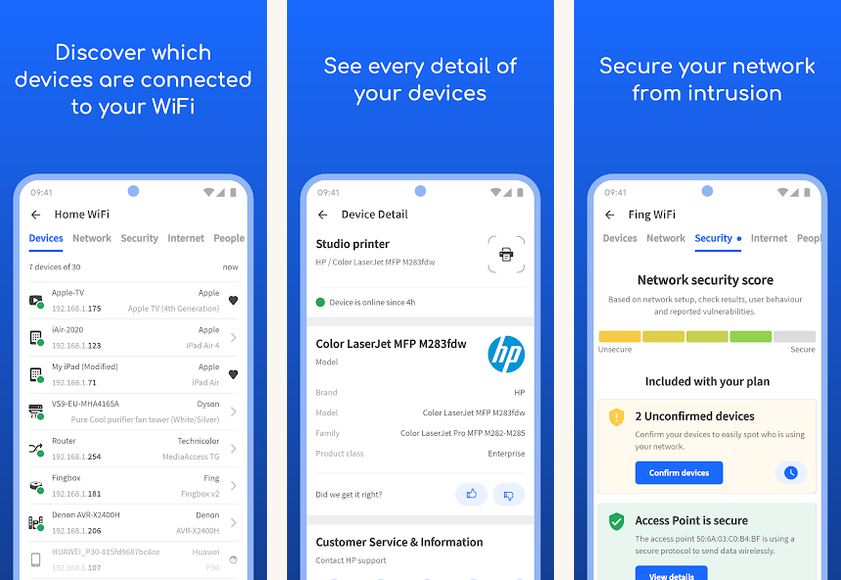
Fing answers a different question: who is on my Wi-Fi. It scans every connected device, identifies each by manufacturer and type, and flags anything you do not recognize. When your network feels slow for no reason, Fing is how you find the tablet, smart bulb, or neighbor’s device quietly using it.
The free tier covers scanning and device identification, which is the part most people need. A paid Premium tier adds device-presence tracking and alerts. Fing is less about radio signal and more about network hygiene, and on that job it is the clearest tool on Android.
Highlights
- ⭐ Best for: seeing every device on your network and catching intruders.
- ⚠️ Watch out for: it inventories devices, it does not map Wi-Fi signal strength.
- 💰 Pricing: free for scanning; a paid Premium tier adds presence tracking.
Get it on Google Play or the App Store.
6. analiti
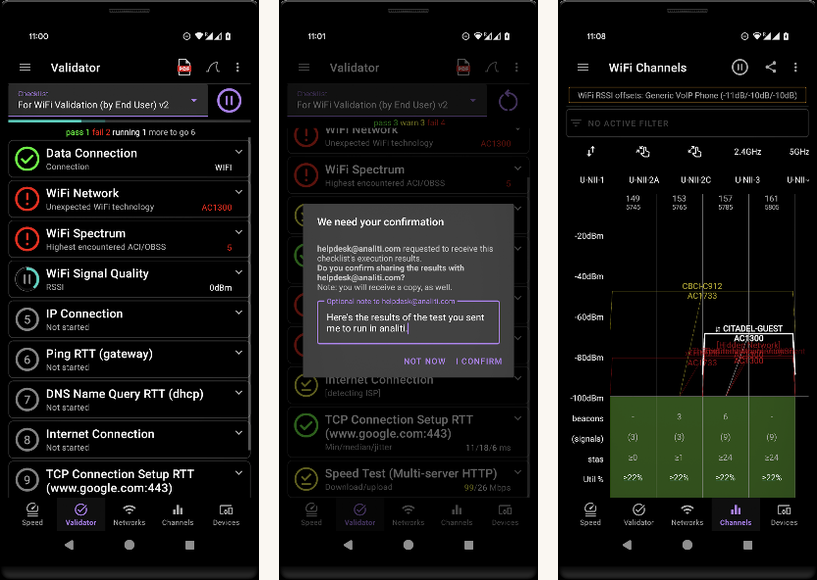
analiti – Speed and WiFi is the closest a free Android app gets to professional survey software. It reports detailed per-band RF metrics, runs validated speed tests, and breaks down signal quality, noise, and channel use with more depth than the simpler scanners on this list.
It is the pick for the reader who wants the numbers behind the graph. That depth is also its catch: the readouts assume you know what RSSI, SNR, and PHY rate mean. If you just want “switch to channel 11,” WiFiAnalyzer is simpler. If you want to understand why, analiti rewards the time.
Highlights
- ⭐ Best for: power users who want detailed RF and per-band metrics.
- ⚠️ Watch out for: the depth assumes you are comfortable reading RF terminology.
- 💰 Pricing: free tier covers a lot; a paid upgrade unlocks the rest.
Get it on Google Play. There is no first-party iOS app.
7. Network Analyzer
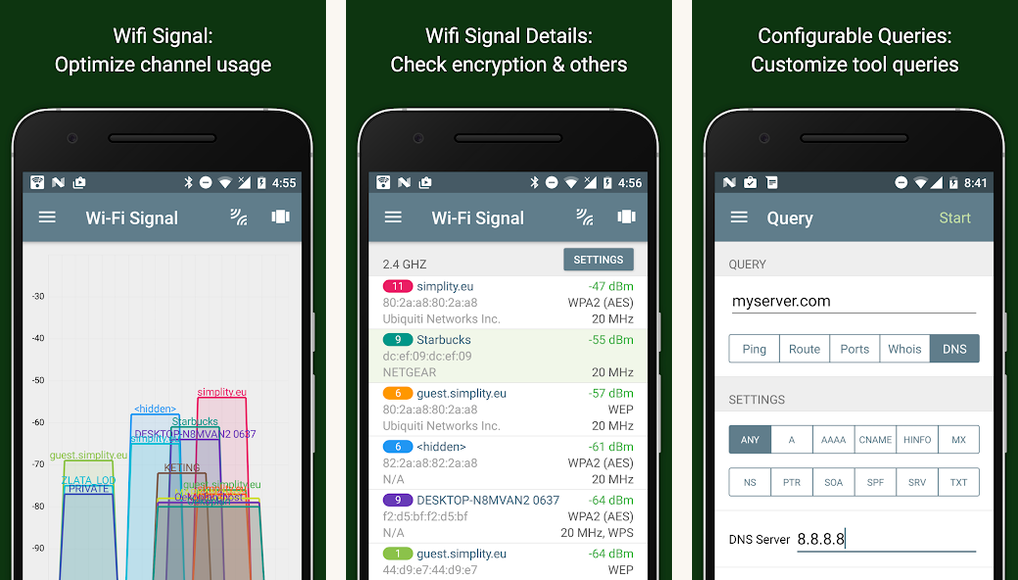
Network Analyzer by Techet is the well-rounded LAN and Wi-Fi toolbox. It discovers every device on the network, shows your Wi-Fi connection details, and bundles ping, traceroute, port scan, DNS lookup, and WHOIS. It is the app to reach for when “the Wi-Fi is broken” needs to become a specific, named fault.
The free tier covers the core scanning and connection info; a paid Pro upgrade removes ads and unlocks the deeper tools. It overlaps with PingTools below, so you rarely need both. Pick Network Analyzer if you also want device discovery in the same place.
Highlights
- ⭐ Best for: device discovery plus diagnostics in one tidy app.
- ⚠️ Watch out for: it overlaps heavily with other toolbox apps, so pick one.
- 💰 Pricing: free tier with ads; a paid Pro upgrade unlocks the full set.
Get it on Google Play or the App Store.
8. PingTools
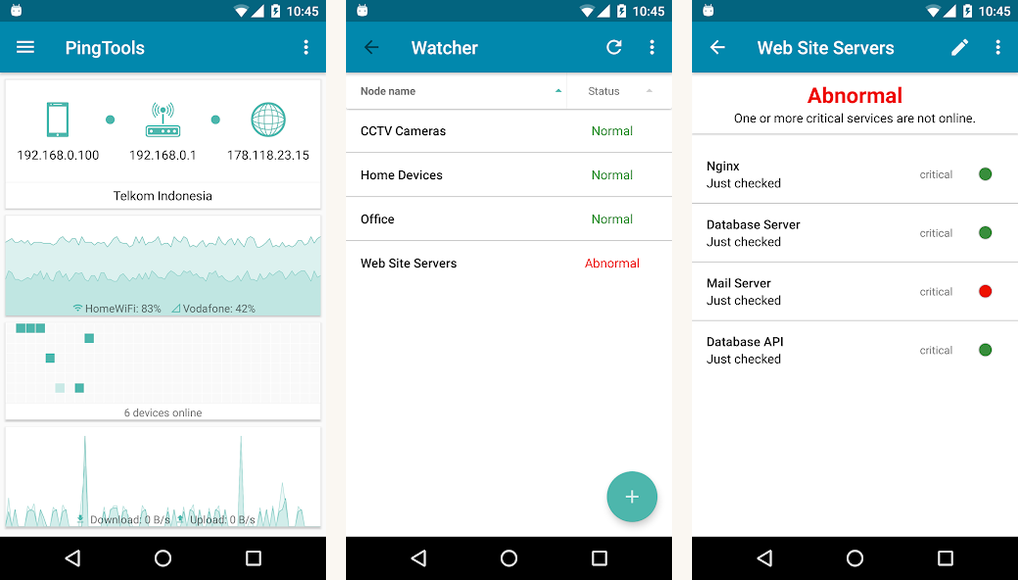
PingTools is the app that answers one stubborn question: is it my Wi-Fi or my ISP. It packs ping, traceroute, port scanner, DNS lookup, WHOIS, and a router config view into a single utility. When a page will not load, a quick traceroute shows whether the hop fails inside your house or out on the internet.
It is free with ads, with a small one-time unlock to remove them. PingTools does not map signal strength; it is a connectivity diagnostic, not a scanner. Pair it with a channel app like WiFiAnalyzer and you have the Wi-Fi side and the internet side both covered.
Highlights
- ⭐ Best for: proving whether a fault sits in your Wi-Fi or with your ISP.
- ⚠️ Watch out for: it diagnoses connectivity, it does not measure signal strength.
- 💰 Pricing: free with ads; a small one-time unlock removes them.
Get it on Google Play. There is no first-party iOS app.
9. Network Cell Info Lite
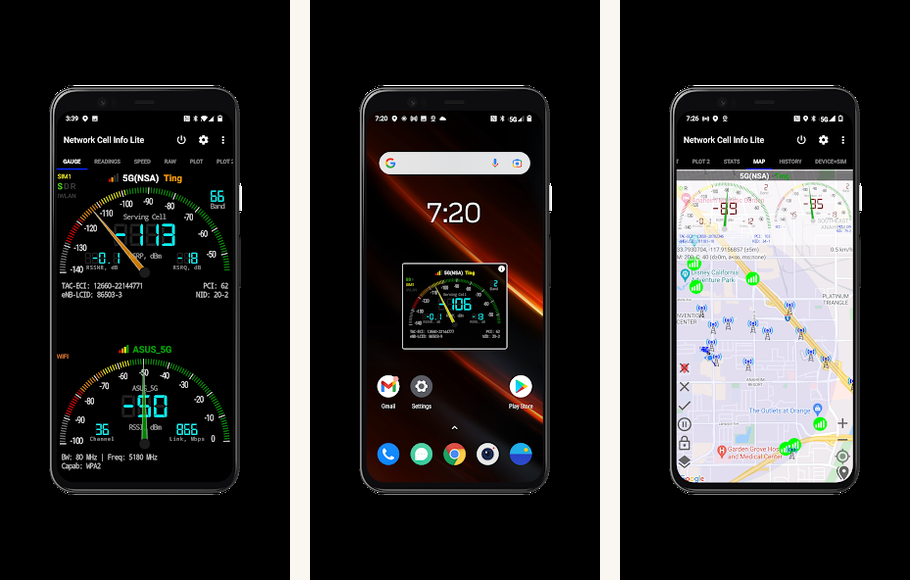
Network Cell Info Lite covers the side the Wi-Fi apps cannot: cellular. It reports which tower you are connected to, the band, the signal strength, and the carrier ID. When the dead spot is mobile data rather than Wi-Fi, this is the app that shows you what is happening.
It is genuinely useful for confirming whether you are on 5G or LTE, and for finding where coverage drops on a commute. It belongs on this list because diagnosing a connection means knowing which connection failed. It is free, and it is Android-only by necessity: iOS does not expose this telephony data to third-party apps.
Highlights
- ⭐ Best for: diagnosing cellular dead spots and confirming 5G versus LTE.
- ⚠️ Watch out for: it reads cellular data, not Wi-Fi signal.
- 💰 Pricing: free.
Get it on Google Play. iOS blocks the cellular data this app reads, so there is no iPhone version.
10. WiFi Analyzer (pzolee)

WiFi Analyzer by pzolee is a focused signal meter with one feature the others lack: a live router-throughput meter. It shows real-time signal strength, a channel view, and a multi-host ping, and the throughput readout helps you spot the exact point where moving the phone tanks the connection.
It is free and lightweight, which makes it a fine companion to a heavier survey tool. The name collides with several other Android apps, so install the one credited to pzolee. As a quick “how strong is the signal right here” meter, it does the job cleanly.
Highlights
- ⭐ Best for: a quick live signal and router-throughput readout.
- ⚠️ Watch out for: a crowded name; install the build credited to pzolee.
- 💰 Pricing: free.
Get it on Google Play. There is no first-party iOS app.
Common mistakes to avoid
| Mistake | Why it matters | Better move |
|---|---|---|
| Installing a “signal booster” app | No app adds signal power; these are scanners with a marketing name and often weak privacy | Use a real analyzer, then fix the router or add a mesh node |
| Leaving the router on 2.4 GHz channel auto | Auto often parks you on a crowded channel in a dense area | Scan with WiFiAnalyzer and set channel 1, 6, or 11 manually |
| Blaming the phone for slow Wi-Fi | The bottleneck is almost always the router, the walls, or the ISP | Run Speedtest on cellular and Wi-Fi to isolate the cause |
| Hiding your network name for security | A hidden SSID adds connection friction, not real protection | Use a strong password with WPA3, or at least WPA2-AES |
| Buying a Wi-Fi extender before measuring | An extender in the wrong spot just rebroadcasts a weak signal | Map dead zones with NetSpot first, then place the node |
The verdict
The verdict
Bottom line: install WiFiAnalyzer first. It is free, open source, and it fixes the most common Wi-Fi problem, a crowded channel, in five minutes.
If your trouble is dead zones rather than channel conflict, add NetSpot and walk its heatmap. Want to know if your internet plan itself is slow? Speedtest by Ookla settles it. Those three free apps cover almost every home. Reach past them only for a specific need: Fing to audit devices, Network Cell Info Lite for cellular dead spots, analiti for deep RF metrics.
What none of them do is boost anything. Skip the “optimizer” apps in the store. The signal lives in your router and your walls, and these apps simply make the real fix obvious.
Questions people actually ask
- Can a Wi-Fi signal app actually improve my signal?
No. Apps measure and diagnose; they do not amplify. To improve signal, move the router, change the broadcast channel, switch bands (5 GHz or 6 GHz), or add mesh nodes. - What is the best free Wi-Fi analyzer for Android?
WiFiAnalyzer by VREM for channel scanning, NetSpot’s free tier for a basic site survey, and Speedtest by Ookla for bandwidth. Those three cover most home diagnosis at no cost. - Which Wi-Fi channel should I use?
On 2.4 GHz, only three channels do not overlap, 1, 6, and 11, as the list of WLAN channels shows, so pick whichever is least crowded near you. On 5 GHz, auto-channel usually works because there is more room. The 6 GHz band is nearly empty since few devices use it yet. - Why does my Wi-Fi work in some rooms and not others?
Distance and obstacles. Signal weakens with range and is absorbed by walls, especially concrete, brick, and metal. NetSpot’s heatmap shows where it drops. Fix it by repositioning the router or adding a mesh node to the weak room. - Should I hide my Wi-Fi network name?
Probably not. Every network broadcasts its name by default, and hiding it adds connection friction rather than real security. Protection comes from a strong password and WPA3 encryption, or at least WPA2-AES. - Is Wi-Fi 7 worth it yet?
Marginally. The headline features of Wi-Fi 7, such as wider channels and multi-link operation, need both your router and your phone to support the standard, plus a clean 6 GHz band. Most people see no real difference today; the upgrade pays back as more devices support it.
How we tested
How we tested
We ran every named app on a Pixel 8a (Android 16) and a Galaxy S24 (One UI 7). Diagnostic accuracy was cross-checked against a hardware spectrum analyzer and against the router admin pages of three brands, TP-Link, ASUS, and Netgear Orbi. Pricing reflects vendor pages and Play Store listings, both of which drift, so confirm current prices before you subscribe. We refresh this list when a major analyzer app changes its feature set or store status.